


Estimated Study Time: 20 minutes
SCADA Control and Supervision
It is impossible to keep control and supervision on all industrial activities manually. Some automated tool is required which can control, supervise, collect data, analyses data and generate reports. A unique solution is introduced to meet all this demand is SCADA system. SCADA stands for supervisory control and data acquisition.
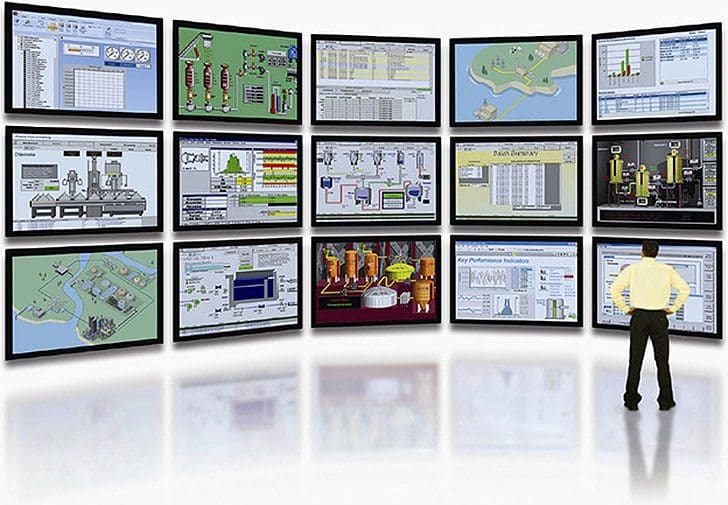
It is an industrial control system where a computer system monitoring and controlling a process. Another term is there, Distributed Control System (DCS). Usually there is a confusion between the concept of these two.
A SCADA system usually refers to a system that coordinates, but does not control processes in real time, but DCS do that. SCADA systems often have Distributed Control System (DCS) components.
Understanding the Elements of SCADA Software
The modern SCADA system comprises user operation workstations, SCADA server computers, communication networks, programmable field controllers, and field devices and signals. All components are effectively integrated into a comprehensive operating system, facilitating both automated functions and user-directed actions.
Regardless of whether the SCADA architecture has been established or is in the detailed design phase, the software requirements for each process area must be taken into account. Field devices supply signal data for processing by a Programmable Process Controller; significant equipment, such pumps, motors, and valves, requires monitoring and control.
The objective of dividing the entire system into smaller, more manageable subsystems is to designate functional areas, each of which can be engineered to execute area-specific tasks. All signals or data necessary for the region, along with the program logic needed to execute the relevant operations, must be explicitly defined and documented.
Important to Read – The essentials of automation applied to distribution systems via PLCs, SCADA, IEDs, and RTUs
The essentials of automation applied to distribution systems via PLCs, SCADA, IEDs, and RTUs
Typical SCADA System Architecture
Figure 1 depicts the architecture of a conventional SCADA system, highlighting the interconnected components or parts over a communication network. Subsequent to the illustration are comprehensive elucidations of each key component.
In summary, the SCADA system comprises five principal components, detailed as follows:
- Field Devices and Signals
- Programmable Process Controller
- SCADA Operations User Workstation
- SCADA Server Computer
- Communication Network
The PPC is the core of every SCADA system, executing monitoring and control functions over field devices. The programming of software for these components can become highly complicated, involving several tasks, programs, and routines.
Figure 1 – Typical SCADA system architecture

The SCADA Operations User Workstation offers the user interface through process graphic representations, trends, and related data. Most SCADA systems feature several workstations that enable human interaction for monitoring processes and controlling equipment.
The SCADA Server Computer is utilized to manage the process and historical databases for user workstations, in addition to facilitating the communication interface between the server computer and the Programmable Process Controllers.
The Communication Network comprises the hardware and software that interlinks all system components. Contemporary networks typically comprise Ethernet utilizing Transmission Control Protocol/Internet Protocol (TCP/IP) and proprietary communication architectures.
Field Devices and Signals
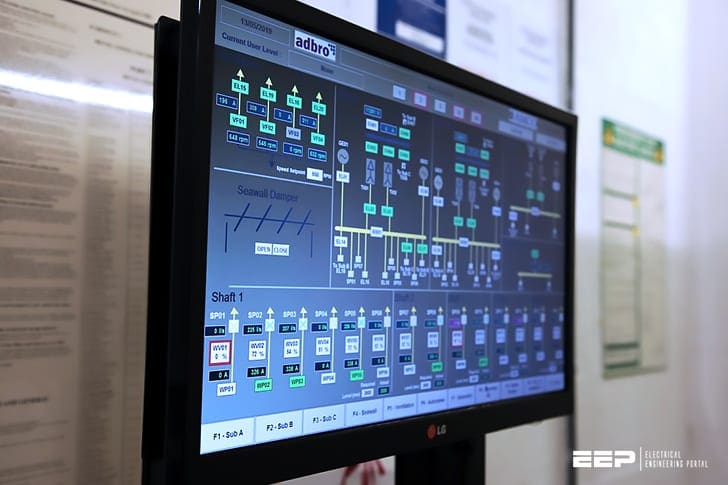
The icons in the picture titled ‘Device’ indicate separate signals, which can be either discrete or analog, serving as inputs to or outputs from the PPC. In the design of software for a SCADA system, it is essential to evaluate the numerous field signals and devices concerning the information to be monitored and the equipment to be controlled.
Field devices may include signal transmitters, such as level or pressure transmitters, as well as discrete signals, such as the open or closed status of a valve or the operational status of a motor. Certain devices may indeed output several signals, such as a water quality unit that measures both chlorine residual and water pH. In the architecture of SCADA software, it is essential to identify all field signals for each process area.
The field devices are connected to the numerous PPCs, which then process the signals.
Analog signals can also be both input and output types; such signals can have a range of values between two preset limits, most often zero and some maximum value. Analog input signals may include levels, flowrates, motor speeds, voltage and current from power monitors, water quality signals, and temperatures and pressures.
Analog output signals might include motor speed controls for Variable Frequency Drives (VFDs) for variable speed motors, valve positioning signals for modulating valves, and analog display devices.
The Programmable Logic Controller (PLC) serves as the core component for monitoring and controlling every process area in a SCADA system, utilizing field signals such as levels, flows, and pressures to regulate equipment operation.
SCADA software must account for all equipment and signals to be processed. For example, consider a Raw Water Pumping Station for a Water Treatment Plant (WTP); there will be two or more pumps, valves and field signals. For any device or piece of equipment, it is essential to ascertain the necessary signals, both from the equipment (inputs) and to the equipment (outputs). Thus, a piece of equipment may be depicted by an assemblage of signals linked to the process area PPC.
A pump may encompass numerous input and output signals. Moreover, field signals are generally necessary for the proper operation of the process area. For the WTP application, a raw water pump station may encompass intake well level, water turbidity, water pH, water temperature, and discharge flow rate and pressure. The application program running on the PPC will utilize these distinct field signals.
Upon completion, the field device and signal list for any process area must encompass all signals pertaining to both the physical equipment and the raw signals.
Figure 2 – Field devices and signals used for LV SCADA operations (photo credit: adbro.co.uk)
Programmable Process Controller
A SCADA system application is divided into process zones. Each zone defines specific operations to be performed. A pumping station may employ two or three pumps operating in a lead/lag/standby arrangement; the automation program in the controller is designed to manage the pumps based on operator-defined setpoints and duty assignments.
Each process zone defined within a SCADA system requires a distinct PPC. The PPC will be set up to monitor all signals within the process zone and to control the process equipment in accordance with the program’s specifications.
From the application’s perspective, the program views all modules as occupying a single, extended rack.
Every programmable controller requires programming in one or several formats. The field controller, referred to as the PLC, is typically programmed in a language called Ladder Logic, which emulates the electrical control circuitry that existed before to the PLC’s inception.
Presently, most PLCs endorse various programming languages to meet application requirements; for example, these languages comprise:
- Function Block Diagram,
- Structure Text (High-Level Programming),
- Sequential Function Chart, and
- Instruction or Statement List (Low-Level Assembly Programming).
The programmer may opt to utilize one or many of these languages in a particular PPC application software.
Further Study – PLC ladder and sequential programming for industrial automation
PLC ladder and sequential programming for industrial automation
SCADA Operations User Workstation
The user operations workstations, commonly known as the Human Machine Interface (HMI), necessitate the programming of process visual displays with animated links to various places in a process database. Configuration programming is necessary to create the process database, the historical database, and the communication interface to the field controllers or PLCs.
Additional background applications, referred to as scripts, are frequently utilized to execute ‘behind the scenes’ functions for the application.
Consequently, there are both interfaces that provide the information and underlying programming that retrieves the information for the intended display.
Moreover, background scripts or programs are frequently employed to do tasks related to the displays and to initiate commands to the PPCs and other devices.
Suggested Reading – Three most common SCADA applications in MV/LV distribution systems you SHOULD know
Three most common SCADA applications in MV/LV distribution systems you SHOULD know
Communication Network
The in-plant equipment, Programmable Process Controller (PPCs), and SCADA Operations User Workstation (SOWs) are generally linked through a Local Area Network (LAN), utilizing Ethernet or alternative high-speed communication systems. Certain SCADA systems may expand beyond the physical structure to remote locations; these locations necessitate a communication link to the host facility as well.
The previously depicted SCADA hierarchy features modems connecting to a remote location, enabling remotely situated controllers to function over the same high-speed communication network.
Three fundamental topologies have been identified here.
The Bus Topology depicted in Figure 3 comprises a hardware/software link among all nodes inside the system. This building mimics a principal thoroughfare to which all other roads converge. Traveling from one point to another necessitates accessing the primary roadway network and proceeding until an exit to the intended route is located.
Figure 3 – Bus topology
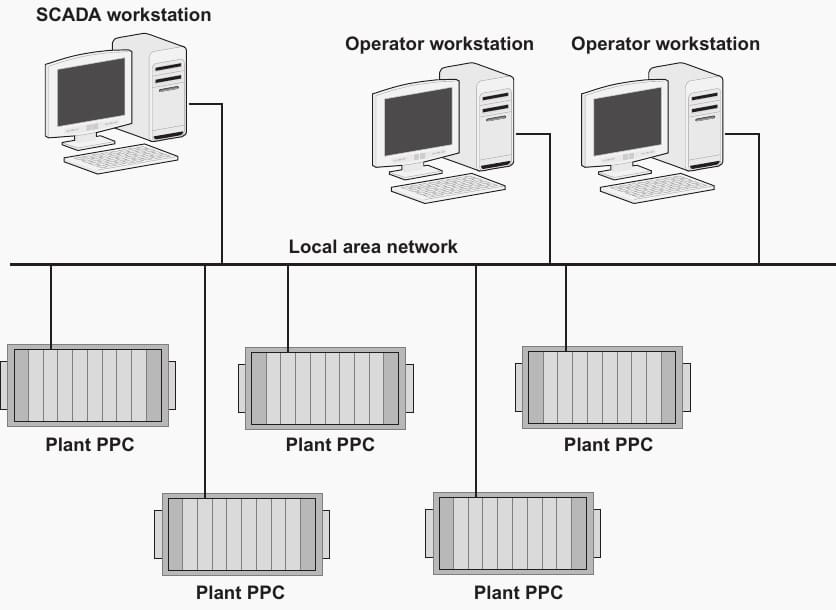
All traffic or communications inside the system are conducted through this one bus-type network. Increased traffic can lead to network congestion, resulting in a deceleration of data transit between nodes. Although Ethernet over a bus network is typically sufficiently fast, certain applications may encounter obstacles to efficient data transmission due to this bus design.
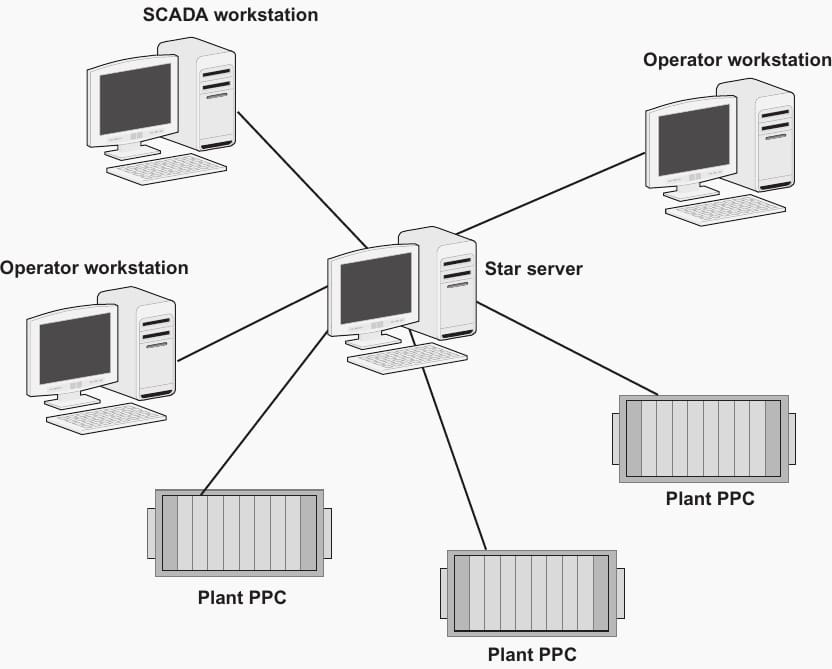
The Star Topology, seen in Figure 4, comprises numerous network paths spreading from a singular master or host node. The master node often comprises one or two master SOWs operating as the system’s supervisors. Data collection from the many PPC nodes is conducted via individual connections in a star configuration.
Update intervals to the host node are very fast; nonetheless, they necessitate numerous egress routes from the host master node.
Data transit between nodes in the Star network necessitates that information is transmitted initially from the source node, subsequently through the host node, and finally to the destination node.
Figure 4 – Star topology
A Token Ring Topology, as depicted in Figure 5, operates as a ring where all nodes are coupled by two network links. All nodes in the topology possess equal value, and data is transmitted through this ring from one node to the subsequent node. Contrarily oriented duplicate rings offer redundancy and security. Information from any node circulates through the ring, transmitted from node to node, until it arrives at the intended destination node.
This topology is predictive, as the speed remains constant and the data transfer occurs at a given rate. As the quantity of nodes in the network escalates, the aggregate data transfer rate diminishes due to the increased number of nodes through which data must traverse to reach the destination node from the source node. A potential enhancement is to implement a hybrid topology in the SCADA network.
The choice of communication technique is contingent upon the volume of data to be transmitted, the significance of the data, and the frequency of transmission required.
The communication component of the SCADA software include the creation and implementation of diverse software drivers to facilitate data exchange between the SOWs and PPCs. Specialized languages and configurations are once more necessary. In systems comprising various PLC brands, a distinct software driver is required for each brand or type of PLC.
Figure 5 – Token ring topology

Components of SCADA
1. Human Machine Interface (HMI)
It is an interface which presents process data to a human operator, and through this, the human operator monitors and controls the process.
2. Supervisory (computer) system
It gathers data on the process and sending commands (or control) to the process.
3. Remote Terminal Units (RTUs)
It connect to sensors in the process, converting sensor signals to digital data and sending digital data to the supervisory system.
4. Programmable Logic Controller (PLCs)
It is used as field devices because they are more economical, versatile, flexible, and configurable than special-purpose RTUs.
5. Communication infrastructure
It provides connectivity to the supervisory system to the Remote Terminal Units.
SCADA System Summary
The term SCADA usually refers to centralized systems which monitor and control entire sites, or complexes of systems spread out over large areas (anything between an industrial plant and a country).
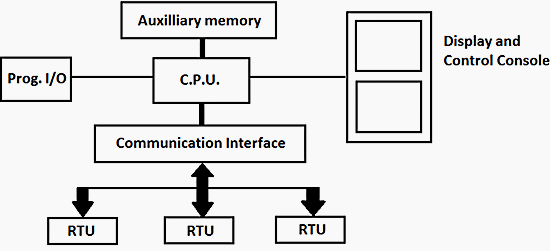
Host control functions are usually restricted to basic overriding or supervisory level intervention. For example, a PLC may control the flow of cooling water through part of an industrial process, but the SCADA system may allow operators to change the set points for the flow, and enable alarm conditions, such as loss of flow and high temperature, to be displayed and recorded.
The feedback control loop passes through the RTU or PLC, while the SCADA system monitors the overall performance of the loop.
Figure 6 – A simple SCADA system with single computer
SCADA/PLC Video Introduction/Example
Waste Water Treatment SCADA System Raising your Plant IQ
Introducing students to Industrial Programmable Controllers
Related electrical guides & articles




Bipul Raman
Bipul Raman (@BipulRaman) is a Technology Enthusiast, Programmer and Blogger. Read more at : https://www.bipul.inProfile: Bipul Raman

I really learnt very much from your blog. Thank you for share this information on PLC SCADA. Please keep share, I am waiting for your next blog. PLC SCADA has very good career, PLC programmer is the most attractive job in engineer field. PLC SCADA Training is must for doing the job in this field.
the subject need to be more advanced
I would like to give me a brief concept if its possible and can work that to design a hydropower plant using SCADA software.
I am in Port harcourt,Nigeria. I want to be a real time SCADA engineer, how do i get started
Hi I am a computer engineering student. My family members taken a municipal project for water purification worth of 35 crore. They asked me to join with them. I m good at test automation selenium likely that. I don’t know scada. But they pleased to . so can I join in that as scadac engineer???
Good blogging for beginners in engineering, the post also help everyone who wants to know about SCADA systems. It is one gateway to control all the activities in a plant or a company. You can get information on the equipment from a good and reputed manufacturer like Chemtrols. All you neded is to just log into the website and heck for details. You can even ask for a quote.
I working on Twido PLC TWDLMDA20DRT and would like to control it using movicon-scada. For some reason I am not able to establish communication between PLC and movicon using Schneider comm drivers. Please guide me how to establish the communication.
Dear sir,
I am D.naresh, my designation is electrical engineer. Now am doing AUTOCAD Designer in panel board manufacturing company. Sometimes the clients are asking PLC & SCADA Connections to panel. But i dont know how to connect. I want to know that if PLC & SCADA Coaching is important for Electrical engineers
can you suggest a good training center to join the course…..pls
Hi, everyone.
We deal with Scada compatible equipments used in electrical Systems.We need some help to integrate the equipments with SCADA system.
We welcome all Automation Professionals to join ISA (isa.org).
We have a strong and vibrant section in Bangalore and ISA Bangalore Section has just received awards at the recently conducted Automation Week.
Do contact us.
Regards
Rajshekhar Uchil
President
ISA Bangalore Section
Dear sir,
I mr walling working as a ppo in moulding department in which i had done my course,
ppt in cipet but i am not satisfying with my present work becuase i want to engage in maintainence and not as a ppo. Therefore is it helpfull by taking course on PLC repearing,SCADA to get opportunity in maintainance field,i will b very gratefull to you ,thinking you
we want some other information about PLC scada
We have bid for providing SCADA automation system for a rural water supply project. We need to understand SCADA and locate the best in the industry SCADA providers and installers. These can be Indian or international.
Introducing ourself as a complete scada/dcs system provider for automation in water supply system used in the department of jal nigam/sansthan. Electrical and Technologies Engineers(E&T Engineers) is a complete solution for that u want & desire. We will provide u a complete scada system for ur bid as per instruction. If u r interested plz contact 7037189489.
hi ! i’m prepararing for my ppt projet about SCADA and HMI .. can you help me please ??
Hi Engineer
What kind help you need.? Let me know. As i know the part ill help you on the subject layouts.
I want more information
please am just newly recruited in the SCADA dept.need more information.
Very useful domain….regarding plc,scada,dcs
Interested in knowing more for plc and scada filed of work and studies.
Thank you.
Sir me scada ralated information and vedio in electrical engineering career growth me increased .so please help me . more information send me sir
hi frnds,
lot’s of automation institute is there but less no of opportunities, whenever i am searching job in automation field at web portal i am facing only institute advertisement only,can u please tell me automation job portal name please suggest me.
thank ui
Hi do you have a scada for street lighting
BONSOIR .. je prépare mon mémoire de fin d’étude et j’aimerai bien avoir plus d’information (en français si c’est possible ) Merci
sent more details about scada & plc &sir tell me even about training centres nearest to belgaum
Please share more scada videos. also provide tutorial links to learn about scada and plc automation system. also please let us know how to do PLC programing.
Sir, Can u send me more scada video tutorial links? i want to learn about scada and plc automation system.
do you offer scada training videos for RSVIWE32.
please sent me article
I love this
O
I really enjoy the lecture and it is well understand. but i really want to no difference between RTUs and PLCs. Thanks while waiting for your respond as soon as possible.
More details required
Is SCADA different to BMS? Or it is just the same?
classic information abt PLC S SCADA rather than wikipedia
Heartly THANKS
Hi,
For some examples of what can be done with all the data that is generated by a wind farm typical SCADA system, check out http://www.scadaminer.com/applications/wind-turbine-scada-analysis/
Regards,
Tom
useful for beginners .
am an electrica/electronics technician and interested to study SCADA
i like this course
i like this, and am about to implement on eof its kind
I am very much passionate to do a job in scada as i completed my course in Industrial automation (plc scada hmi ), i did b.tech in electrical & electronics please send me the details regarding jobs on scada. please do the needfull.
Thanks & regards.
please give the detailed information and other processing processes involved in SCADA
@Vivek, This article is for Beginer level learners. For detailed study, you may refer to another article on this link: https://electrical-engineering-portal.com/scada-as-heart-of-distribution-management-system
thanks sir
Great article! However, you need to improve on your writing skills…
Thanks for your kind suggestion. I will try my best to improve it.
Good article for beginners.. Thanks Mr. Bipul