


Estimated Study Time: 7 minutes
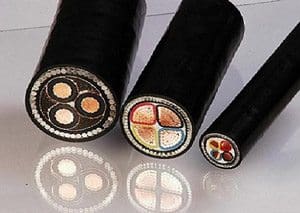
Electrical insulation materials are employed over the metallic conductors of underground cables at all voltage ratings. Polymeric materials are employed as the insulation, but the nature of the polymer may vary with the voltage class.
Since paper insulation was used first in the power industry, and was later replaced in low and medium voltage applications, any comparison of properties usually employs the paper-fluid system as the standard.
.
Transmission cables, which are defined as cables operating above 46 kV, have traditionally used paper / oil systems as the insulation. The paper is applied as a thin film wound over the cable core. Some years back, a variation of this paper insulation was developed, the material being a laminate of paper with polypropylene (PPP or PPLP).
Since the advent of synthetic polymer development, polyethylene (PE) has been used as an insulation material, and in most countries (France being the exception) the use of polyethylene was limited to the crosslinked version (XLPE).
Major Differences Between Paper and Polyolefinic Insulations
| Paper / Cellulose | Polyethylene |
| Natural | Synthetic |
| Carbon / hydrogen/oxygen | Carbon / hydrogen/oxygen |
| More polar / medium losses | Less polar, low losses |
| Chains linear | Chains branched |
| Fibrils | Non-fibrils |
| Partially crystalline / Relatively constant | Partially crystalline / Varies with grade employed |
| No thermal expansion on heating | Significant thermal expansion |
| Not crosslinked | Not crosslinked |
| Thermal degradation via cleavage at weak link | Degrades at weak links |
.
| Crosslinked Polyethylene | Ethylene Propylene Rubber |
| Synthetic | Synthetic |
| Carbon / hydrogen | Carbon / hydrogen |
| Less polar, low losses | Losses due to additives |
| Chains branched, crosslinked | Chains branched, crosslinked |
| Non-fibril | Non-fibril |
| Slightly less crystalinevs PE | Least crystaline of all |
| Same thermal expansion as PE | Slight thermal expansion |
| Crosslinked | Crosslinked |
| Degrades at weak links | Same as XLPE |
This table provides a comparison of the properties of paper, polyethylene, crosslinked polyethylene, and ethylene propylene rubber insulations. Only the paper is a natural polymer and is therefore processed differently. Paper is obtained fi-om a wood or cotton source.
The synthetic polymers are produced by polymerization of monomers derived from petroleum. All consist of carbon and hydrogen, but paper also contains oxygen. The latter is present as fuctional hydroxyl or ether groups. The contribute a measure of polarity that is absent in the synthetic polymers. (Polarity means increased dielectric losses.)
Of special note is the concept of thermal expansion during heating. While all of the synthetic polymers undergo thermal expansion during heating, this does not occur with cellulose-although the oil will do so. How these insulations respond on aging is a well studied subject since it is directly related to reliability of the cable after installation and energization. When cellulose degrades, it does so at a “weak link,” the region of the oxygen linkage between the rings. When this happens, the DP is reduced.
On the other hand, polyolefins degrade by a completely different mechanism–oxidative degradation at specific sites.
This was later carried over to extruded dielectric cables. Research and development in the past few years has shown that PE and XLPE may be harmed by the use of a dc test, but this does not occur with paper-oil systems.
EPR cables have not been studied to the same extent and no conclusions can be drawn at this time about the effect of dc testing on the insulation.
Advantages of polyethylene
- Low permittivity (low dielectric constant)
- Low tan delta (low dielectric loss)
- High initial dielectric strength
Advantages of crosslinked polyethylene (in addition to the ones above)
- Improved mechanical properties at elevated temperature
- No melting above 105 “C but thermal expansion occurs
- Reduced susceptibility to water treeing
Advantages of EPR
- Reduced thermal expansion relative to XLP
- Reduced sensitivity to water treeing
- Increased flexibility
Advantages of PILC
- Lack of sensitivity to dc testing
- Known history of reliability
Particular advantages of synthetic polymer insulations over PILC
- Reduced weight
- Accessories more easily applied
- Easier to repair faults
- No hydraulic pressure / pumping requirements
- Reduced risk of flame propagation
- Reduced initial cost
Some of these advantages are electrical and some are not. Care must be taken in seeking to compare EPR to XLPE to TR-XLPE. There are many different EPR formulations.
The nature of the non-polymeric additives, including fillers, plays a major role in influencing properties as well as the nature of the mixing process. What is clear is that any EPR formulation will have higher losses than a non-mineral filled PE or XLPE system. Some EPR systems may have very high losses. This may influence resistance to water treeing. However, EPR systems are generally ‘‘softer” due to their lack of crystallinity and therefore easier to handle in the field-especially at very low temperatures.
Disadvantages to PILC include the fact that lead is usually used as an outer sheath and the motivation not to use lead for new installations is very high. Paper is also highly susceptible to deterioration from moisture.
Related electrical guides & articles





Edvard Csanyi
Hi, I'm an electrical engineer, programmer and founder of EEP - Electrical Engineering Portal. I worked twelve years at Schneider Electric in the position of technical support for low- and medium-voltage projects and the design of busbar trunking systems.I'm highly specialized in the design of LV/MV switchgear and low-voltage, high-power busbar trunking (<6300A) in substations, commercial buildings and industry facilities. I'm also a professional in AutoCAD programming.
Profile: Edvard Csanyi
want simple comparison between Bakelite/Teflon/DMS/Ebonite as insulation material
Dear Sir,
Pl help me to get enriched knowledge on Extra high voltage XLPE cables.CCV insulation process and xlpe property testing
Dear Sir or Madam
I can get acquainted with a large transformer insulation test methods.
A.Marvi
Transmission cables, which are defined as cables operating above 46 kV, have traditionally used paper / oil systems as the insulation.
In the present time the PLC is already gone in history PVC/SWA/XLPE cable is in use .and accessories is following such as jointing with cross bonding ,fiber optic for thermal record and cable connectors all the system is in practical use … and so many advance on side of XLPE cables …
The above is follow with standard for AC testing and commissioning what is different than for PLC cables
Note: for the transfer of huge amount of power on long distance, already have systems DC current transmission and convertors DC/AC for the start and end of the T.Line above 400 kV… and etc.
Regards
Stojce