

Motor and generator
The Navy Electricity and Electronics Training Series (NEETS) was developed for use by personnel in many electrical and electronic-related Navy ratings. Written by, and with the advice of, senior technicians in these ratings, this series provides beginners with fundamental electrical and electronic concepts through self-study.
The presentation of this series is not oriented to any specific rating structure, but is divided into modules containing related information organized into traditional paths of instruction.
Module 1
Introduction to Matter, Energy, and Direct Current, introduces the course with a short history of electricity and electronics and proceeds into the characteristics of matter, energy, and direct current (DC).
It also describes some of the general safety precautions and first-aid procedures that should be common knowledge for a person working in the field of electricity. Related safety hints are located throughout the rest of the series, as well.
Module 2
Introduction to Alternating Current and Transformers, is an introduction to alternating current (ac) and transformers, including basic ac theory and fundamentals of electromagnetism, inductance, capacitance, impedance, and transformers.
Module 3
Introduction to Circuit Protection, Control, and Measurement, encompasses circuit breakers, fuses, and current limiters used in circuit protection, as well as the theory and use of meters as electrical measuring devices.
Module 4
Introduction to Electrical Conductors, Wiring Techniques, and Schematic Reading, presents conductor usage, insulation used as wire covering, splicing, termination of wiring, soldering, and reading electrical wiring diagrams.
Module 5
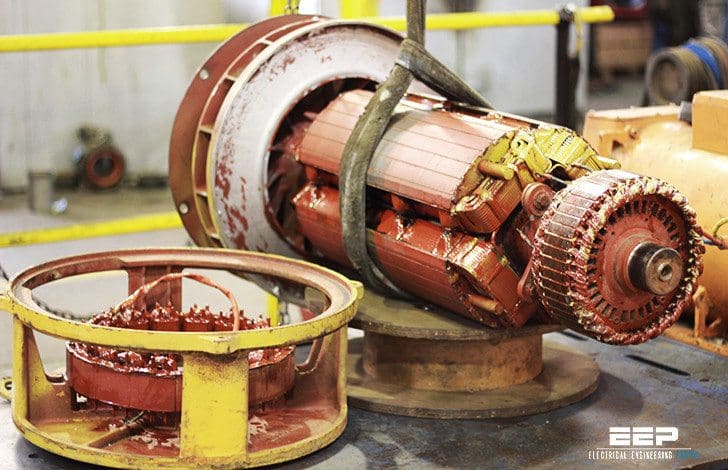
Introduction to Generators and Motors, is an introduction to generators and motors, and covers the uses of ac and dc generators and motors in the conversion of electrical and mechanical energies.
| Title: | Introduction to motor and generator – United States Navy |
| Format: | |
| Size: | 1.3 MB |
| Pages: | 120 |
| Download: | Right here | Video Courses | Membership | Download Updates |

Tout savoir sur les différents rebobinage
Please send me the details
I am interested in reading the other listed modules. I also concur, My electrical degree was more mathematically focused than gaining a more rounded view of the real-world.
Hi, I have recently completed my Electrical Engineering. But I have not been able to find out a suitable job for my profile.But on a serious note, I have started studying your study materials and found that I was less aware of all these facts and informative concepts in my Engineering tenure. Also one good impact of following your study packages is that it has increased my interest in most known as well as unknown areas of Electrical Engineering. Now, I am willing to learn about PLC & Scada courses(Automation) through months long training programes available near my city.
Thank you.
And Please keep doing this noble cause of providing others to avail the benefits of your hard work for sharing appropriate and required knowledge about Electrical Engineering
sir it’s a beneficial to a third year student of electrical engineering to join plc scada coaching.