

Fundamental features of distance relay
Distance functions have been in use for many years and have progressed from the original electromechanical types through analog types and now up to digital types of functions.
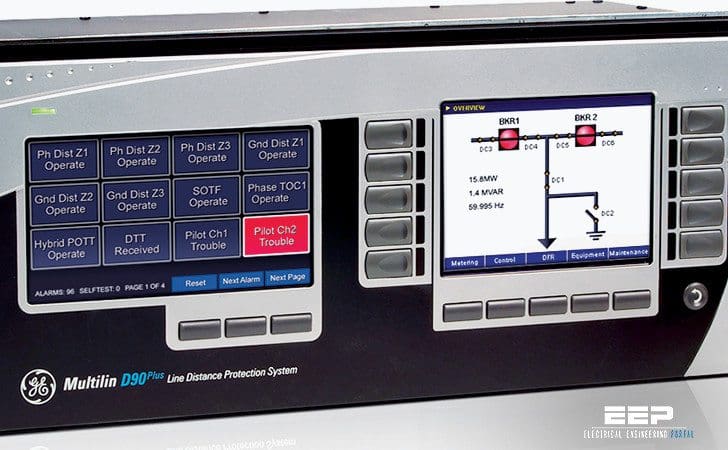
The purpose of this paper is to discuss fundamental features of the three types of functions and possible problems that may be encountered in their design and application.
Simple MHO Function
A simple mho distance function, with a reach of Z ohms, is shown in Figure 1. This diagram is exactly equal to an R-X diagram except that all of the impedance vectors have been operated on by the current I. The mho function uses the current and voltage measured at the relay to determine if the apparent impedance plots within the mho characteristic.
If the angle is less than or equal to 90°, then the fault impedance Zf plots within the characteristic, and the function will produce an output.
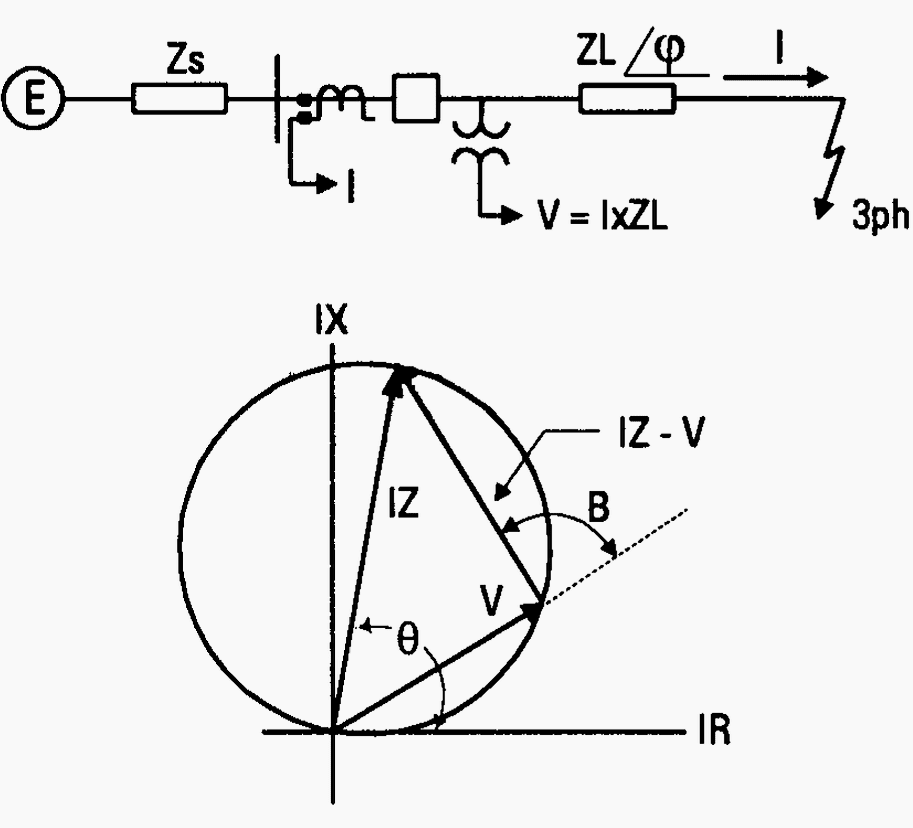
If the angle is greater than 90°, then Zf falls outside of the characteristic and no output will be produced. Assume that the angle of maximum reach (q) and the angle of ZL (f) are equal. On that basis, the conditions shown in Figure 2 will be obtained. The key point to note in this phasor analysis (a convenient way to view relay performance) is the magnitude of the IZ – V (Vop) phasor and its relationship to the V (Vpol) phasor.
Operation will occur whenever Vop and Vpol phasors are within 90° of each other and provided both Vop and Vpol are greater than the minimum values established by the sensitivity of the relay design.
| Title: | Distance Relay Fundamentals by GE |
| Format: | |
| Size: | 220 KB |
| Pages: | 20 |
| Download: | Right here | Video Courses | Membership | Download Updates |

Not able to download pdf
Good Evening,
Dear Friends,
This is Ramesh, working as a electrical engineer in Uganda.
We have commissioned 2 no of 220/132/33kV, 250MVA transformers on December 2016 but we are facing EHV Restricted earth fault(REF) by some times and we made solid earthing on neutral side. The incoming of the transformers is 132kV from existing switch yard and it is a step up transformer.
The main thing is, transformers are not connected to load up to now.
What is the cause of EHV REF(220kV side) every time.
For this existing 132kV switch yard there is 6 outgoing feeders.
Thanks and Regards,
Ch Ramesh Kumar
EEP is giving helpful technical articles and guides to electrical engineers and beginners. Thanks a lot lot…
regards
ih
CAN I LEARN RELAY CONFIGURATION HERE..CAN YOU PLEASE TELL ME HOW TO LEARN RELAY CONFIGURATION..I AM TRYING SINCE TWO YEARS..I DONT KNOW HOW TO CONFIGURES.BUT I CAN TESTING RELAY.
Could not download any of the guides.
Maybe it’s some glitch at the Box side, file is downloadable, I just checked.
Anyone having soft copy of “Numerical distance protection by gerhard ziegler” please share it. [email protected]. Thanks