

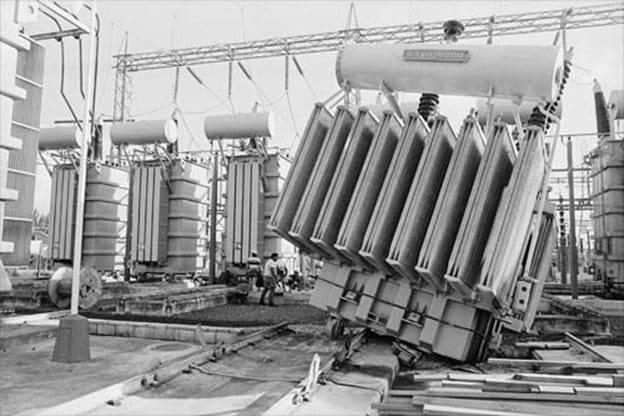
Causes – Location
The majority of earthquakes occur on the fault lines which demarcate the tectonic plates from the earth’s crust. Tension accumulates when the plates slowly shift away from each other. The sudden release of distorting energy which has thus accumulated inside the earth’s crust, or in the underlying layer called the mantle, provokes a local agitation.
Some of this energy is then transformed into seismic waves at the surface of the ground. It is the creation of a fault line, or more frequently the slide along an existing fault line, which constitutes the generating mechanism of an earthquake.
The place where it occurs is called the seismic focus or the hypocenter and the projection from this point to the ground is called the epicenter. The depth of the hypocenter varies greatly: from a few kilometres to up to 100 km.
Defining Objectives
If the design is to take the seismic stresses fully into account, then the degree of safety it has to assure during and after the earthquake must be known.
- Stability (equipment must not become projectile),
- Integrity (equipment must conserve its initial geometry),
- Functioning (equipment must assure either complete, partial or degraded functioning).
While the designer is only concerned with the equipment’s mechanical withstand capability as far as the first two demands are concerned, the procedure is more complex for the third demand, since the different functional aspects have to be taken into account.
This is usually the case for electrotechnical equipment for which operating conditions, in the eventuality of an earthquake, are usually similar to nominal operating conditions. The characteristics of the structure which transfer the excitations must therefore be defined according to the functional cells’ fragility threshold.
AUTHOR: Schneider Electric expert | Eric MELMOUX
| Title: | Earthquakes and electrical equipment |
| Format: | |
| Size: | 0.25MB |
| Pages: | 28 |
| Download: | Right here | Video Courses | Membership | Download Updates |
–
