

Non-linear resonance phenomenon
Ferroresonance is a non-linear resonance phenomenon that can affect power networks. The abnormal rates of harmonics and transient or steady state overvoltages and overcurrents that it causes are often dangerous for electrical equipment. Some unexplained breakdowns can be ascribed to this rare, non-linear phenomenon.
The purpose of this “Cahier Technique” is to help readers understand ferroresonance. The methods described ensure credible prediction and evaluation of the risk of ferroresonance in existing and future installations. Practical solutions designed to avoid or eliminate ferroresonance are also given.
Introduction
The term “Ferro-résonance ”, which appeared in the literature for the first time in 1920, refers to all oscillating phenomena occurring in an electric circuit which must contain at least:
- a non-linear inductance (ferromagnetic and saturable),
- a capacitor,
- a voltage source (generally sinusoidal),
- low losses.
Power networks are made up of a large number of saturable inductances (power transformers, voltage measurement inductive transformers (VT), shunt reactors), as well as capacitors (cables, long lines, capacitor voltage transformers, series or shunt capacitor banks, voltage grading capacitors in circuit-breakers, metalclad substations). They thus present scenarios under which ferroresonance can occur.
The main feature of this phenomenon is that more than one stable steady state response is possible for the same set of the network parameters. Transients, lightning overvoltages, energizing or deenergizing transformers or loads, occurrence or removal of faults, live works, etc…may initiate ferroresonance. The response can suddenly jump from one normal steady state response (sinusoidal at the same frequency as the source) to an another ferroresonant steady state response characterised by high overvoltages and harmonic levels which can lead to serious damage to the equipment.
A practical example of such behaviour (surprising for the uninitiated) is the deenergization of a voltage transformer by the opening of a circuit-breaker. As the transformer is still fed through grading capacitors accross the circuit-breaker, this may lead either to zero voltage at the transformer terminals or to permanent highly distorted voltage of an amplitude well over normal voltage. To prevent the consequences of ferroresonance (untimely tripping of protection devices, destruction of equipment such as power transformers or voltage transformers, production losses,…), it is necessary to:
- understand the phenomenon,
- predict it,
- identify it and
- avoid or eliminate it.
Little is known about this complex phenomenon as it is rare and cannot be analysed or predicted by the computation methods (based on linear approximation) normally used by electrical engineers. This lack of knowledge means that it is readily considered responsible for a number of unexplained destructions or malfunctionings of equipment.
AUTHOR: Schneider Electric expert | Philippe FERRACCI
| Title: | Ferroresonance |
| Format: | |
| Size: | 0.2MB |
| Pages: | 30 |
| Download: | Right here | Video Courses | Membership | Download Updates |
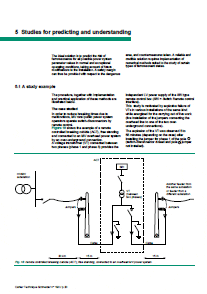
We have two 33kV incoming feeders to Consumer 1 Tenant and Consumer 2 Land Lord.
Tenant -HV 33kV Circuit PT Red phase(1 A)fuse Blow (other two yellow and Blue in good condition)
Found Red phase fuse Oxidized (Blow)
Action
IR test -Good
PT Earth wire Not loop to ground(Connected) floating
Replace all Three Phases new fuse and redo the Earth Connection- ok
Land Lord- HV 33kV Circuit PT Red phase(1 A)fuse Blow (other two yellow and Blue in good condition)
Found Red phase fuse Oxidized (Blow)
Action
IR test – Good
PT Earth wire connected–additional Earth loop improvement
Replace all Three Phases new fuse and redo the Earth Connection- ok
still don’t conclude the actual fault