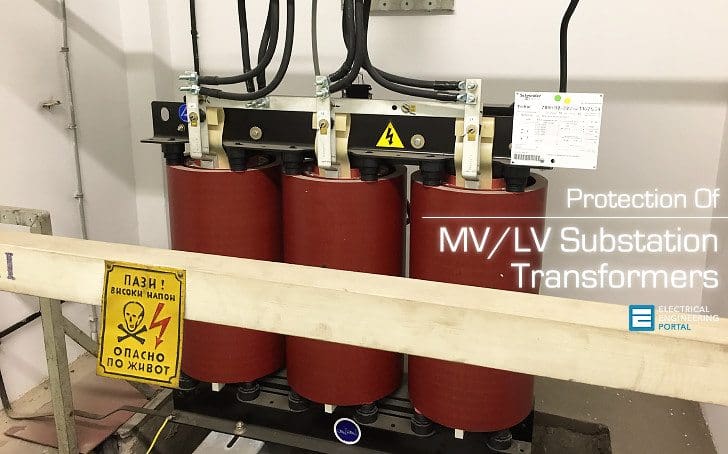
Choice of protection
The choices involved in the protection of MV/LV transformers can appear to be simple since they are often the result of usual practices of electrical network designers, or even of policy dictated by technical and economic considerations. In fact, the choices must be made as a function of the transformer technology, the type of loads that they are supplying, and above all the external environment that they are subjected to.
This “Cahier Technique” discusses the stresses to which the transformers are subjected during operation and the consequences of these stresses and goes on to present the various protection devices that can be used. It is necessarily simple, due to the large number of criteria and solutions that exist. Electrical engineers should however find this document provides the main information needed to make the right choices.
Stresses suffered by transformers
Transformers are subjected to many external electrical stresses from both upstream and downstream. The consequences of any failure can be very great in terms of damage as well as in terms of operating losses. Transformers must therefore be protected against attacks of external origin on one hand, and isolated from the network in case of internal failure on the other hand. The term “transformer protection” is very often associated with the action of disconnecting from the network, even though the transformer is already failing, and the amalgam is made between preventative measures (overvoltages, downstream faults, overloads, temperature) and corrective
measures to isolate the failed transformer.
Protection policy
It is the electrical network designer’s responsibility to define the measures to be implemented for each transformer as a function of criteria such as continuity and quality of service, cost of investment and operation and safety of property and people as well as the acceptable level of risk. The solutions chosen are always a compromise between the various criteria and it is important that the strengths and weaknesses of the chosen compromise are clearly identified. E.g., an operator and a utility can choose very different solutions for urban and rural network sections since the criteria of unit power, of cost and the consequences of an incident, are not the same.
The high reliability level of transformers is a decisive factor in the choices made by utilities, faced with the unit cost of the protection devices which can be associated with them. For example, it means that rather than looking to protect the transformer, in order to save the equipment, we seek to limit the consequences of a failure.
- “protection” exclusively targeted to “prevent the risk of explosion and safeguard the MV network” for transformers connected to the public distribution network,
- temperature monitoring for industrial or tertiary sector installation transformers in which load shedding arrangements can be implemented,
- non-monitoring of overloads for public distribution transformers; customer overlaying making overloading relatively unlikely and, moreover, load shedding only being possible to consider in the case of an incident. If the transformer supplies a uniform group of customers, a need arises for overload protection since there is no longer any overlaying.
Since these various choices are always the result of a technical-economic compromise together with policy considerations, it is impossible to offer a solution providing satisfaction in every case. Therefore, after briefly reviewing transformers and their characteristics, we will go on to examine the stresses to which transformers can be subjected and the various means of protection. The chosen solution remains the network designer’s responsibility, on a case by case basis.
AUTHOR: Schneider Electric expert | Didier FULCHIRON
| Title: | Protection of MV-LV substation transformers |
| Format: | |
| Size: | 0.2MB |
| Pages: | 37 |
| Download: | Please login first |

Subscribe to Monthly Download Updates
Don't miss anything!
Get EEP's updates without having to keep checking up on the portal to see if there is anything new. New FREE technical articles, electrical books, guides, software and other exclusive content you will receive via email. Pretty simple!