

Protecting against electrical hazards
Today, residual current devices (RCD) are recognized as the most effective means of protecting life and property against electrical hazards in low voltage systems.
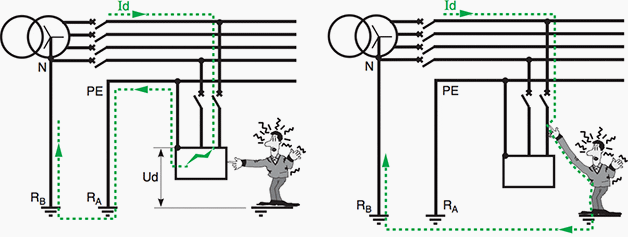
Their selection and optimum use require sound knowledge of the principles and rules governing electrical installations and in particular system earthing arrangements as well as existing technologies and their performance levels.
Introduction
Compared to other energy sources, electricity has many advantages, but also many risks. It is used on a daily basis by the general public and many accidents still occur, resulting in burns, fires and electrocution.
Dependable protective devices have been designed by carefully analysing the risks and consequences of equipment failures or incorrect use. Among these devices, RCDs (residual current devices) are recognised by international standardisation organisations as an effective means to protect life and property.
This document will present the subject in three steps:
- A description of the risks related to electrical currents,
- An overview of the protection techniques employed to limit those risks,
- An in-depth presentation of how RCDs operate.
Electrisation of persons
A person subjected to an electrical voltage is electrised. Depending on the level of electrisation, the person may be subjected to different pathophysiological effects:
- Disagreeable sensation,
- Involuntary muscular contraction,
- Burns,
- Cardiac arrest (electrocution).
These effects depend on various factors, including the physiological characteristics of the person, the environment (e.g. wet or dry conditions) and the characteristics of the current flowing through the body.
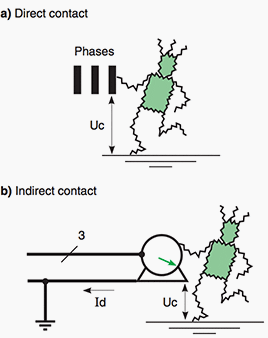
A person may be subjected to an electrical shock in two manners:
- Direct contact, e.g. the person touches an energised, bare conductor,
- Indirect contact, e.g. the person touches a metal part of an electrical machine or device with an insulation fault.
The dangerous aspect is the current (magnitude and duration) flowing through the human body and particularly near the heart.
AUTHOR: Schneider Electric expert | Jacques SCHONEK
| Title: | Residual current devices In LV – Schneider Electric |
| Format: | |
| Size: | 0.85MB |
| Pages: | 34 |
| Download: | Right here | Video Courses | Membership | Download Updates |

I have used this device on the site in Aramco Site. It is very safe device. But still it is not available in Pakistan. I have very good experience in this device.
The use of differential ( ground fault ) tripping on branch circuits in medical facilities is a practice that is common in Europe and other CE/IEC countries. The use is not uniform to all European CE countries and other CE countries such as in Brazil and South America.
The trip level of differential protection 30ma, 100ma or possibly other ratings seem to not be defined.
The location where the protection is located also seems to be up for discussion. I have see at the start of the feeder or at the last downstream panel. The use seems to be more prevalent in medical facilities.
In North America the codes require two levels of ground fault, service entrance main breaker and the next feeder. Emergency distribution systems in hospitals and a few other places where emergency systems are required by the code must be selective for all types of overcurrents including ground faults.
Latest NEC 2014 has a clarifying statement regarding selectivity. If you email me I will send it to you.
good site for electrical engineer
excellent