Low Voltage
What a ground fault circuit interrupter does and what it does not do
A ground fault circuit interrupter (GFCI) monitors the current balance between the ungrounded “hot” conductor and the grounded conductor. As soon as the current flowing through the “hot” conductor is in the range of 4 to 6 milli-amperes more than the… Read more
Sep 09, 2016 | By Edvard Csanyi

High Voltage
Commissioning of HV Panel – Operational and Functional Checkup
The main objective of the test is to check the proper operation function of the circuit breaker; in this test we do the following: This test is conducted by manual, Local and Remote. For the manual Operation test, we will… Read more
Jul 17, 2013 | By Edvard Csanyi

Low Voltage
Assemblies of switchgear and control panels (3)
Continued from 2nd part of article: Assemblies of switchgear and control panels (part 2) Now coverage of distribution panels and switchboards will be presented including molded case circuit breakers (MCCB), safety switches, panelboards, multimetering equipment, ground fault circuit interrupters. Most of the… Read more
Jun 30, 2012 | By Edvard Csanyi

Energy and Power
MCB – Miniature Circuit Breaker Construction
The miniature circuit breaker (MCB) plays an important role in providing overcurrent protection and a disconnect means in electrical networks. Recent advancements in circuit breaker technology has increased breaker performance and protection. A breaker is a device designed to isolate a circuit… Read more
Jun 07, 2012 | By Edvard Csanyi
Low Voltage
How Low-Voltage Air Circuit Breaker Works?
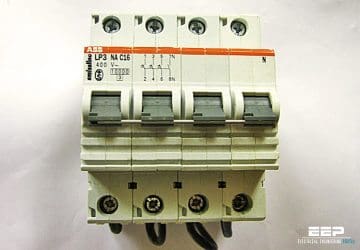
A low-voltage circuit breaker is one which is suited for circuits rated at 600 volts or lower. One of the most commonly used low-voltage air circuit breakers is the molded case circuit breaker (picture above). A circuit can be connected… Read more
Oct 23, 2011 | By Edvard Csanyi

Energy and Power
Time-Current Curves explained in details
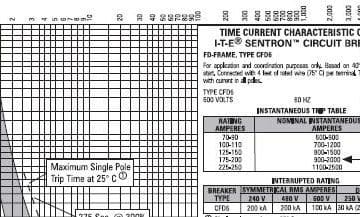
Time-current curves are used to show how fast a breaker will trip at any magnitude of current. The following illustration shows how a time-current curve works. The figures along the bottom (horizontal axis) represent current in amperes. The figures along… Read more
Dec 07, 2010 | By Edvard Csanyi