


Estimated Study Time: 15 minutes
Introduction to Transformer Vector Group
Three phase transformer consists of three sets of primary windings, one for each phase, and three sets of secondary windings wound on the same iron core. The vector group of the transformer is determined by the connection between the windings of the transformer. Separate single-phase transformers can be used and externally interconnected to yield the same results as a 3-phase unit.

The primary windings are connected in one of several ways. The two most common configurations are the delta, in which the polarity end of one winding is connected to the non-polarity end of the next, and the star, in which all three non-polarities (or polarity) ends are connected together.
The secondary windings are connected similarly. This means that a 3-phase transformer can have its primary and secondary windings connected the same (delta-delta or star-star), or differently (delta-star or star-delta).
It’s important to remember that the secondary voltage waveforms are in phase with the primary waveforms when the primary and secondary windings are connected the same way. This condition is called “no phase shift”. But when the primary and secondary windings are connected differently, the secondary voltage waveforms will differ from the corresponding primary voltage waveforms by 30 electrical degrees. This is called a 30 degree phase shift.
When two transformers are connected in parallel, their phase shifts MUST BE IDENTICAL, because if not, a short circuit will occur when the transformers are energized.
Basic Idea of Transformer Winding
Transformer windings comprise current-carrying conductors encircling the core sections, which must be adequately insulated, supported, and cooled to withstand all kinds of operational and testing conditions. The phrases “winding” and “coil” are utilized synonymously in this discourse. Copper and aluminum serve as the principal conductors in power-transformer windings.
An AC voltage applied to a coil will induce a voltage in a second coil where the two are linked by a magnetic path. The phase relationship of the two voltages depends upon which ways round the coils are connected. The voltages will either be in-phase or displaced by 180 degree.
When three coils are used in a three-phase transformer winding a number of options exist. The coil voltages can be in phase or displaced as above with the coils connected in star or delta and, in the case of a star winding, have the star point (neutral) brought out to an external terminal or not.
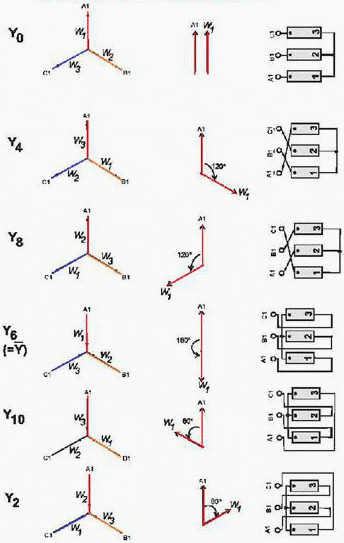
Six Ways to wire Star Winding:
Let’s see the diagrams of the following methods of wiring the Star winding: Y0, Y4, Y8, Y6, Y10 and Y2.
[highlighr2]Figure 1[/highlight2] – Connection diagrams of Star winding: Y0, Y4, Y8, Y6, Y10 and Y2
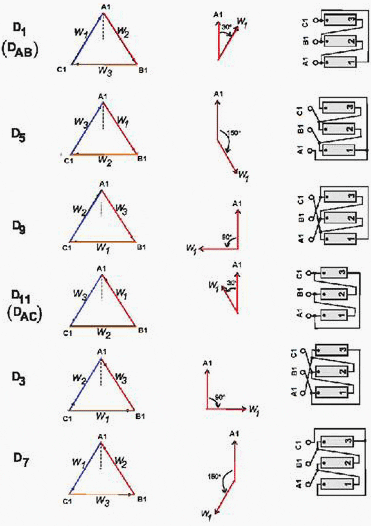
Six Ways to wire Delta Winding
Let’s see the diagrams of the following methods of wiring the Delta winding: D1, D5, D9, D11, D3, and D7.
Figure 2 – Connection diagrams of Delta winding: D1, D5, D9, D11, D3, and D7
Transformer Polarity
Polarity is crucial when connecting current transformers for relay protection and metering. The polarity of a transformer is determined by the winding direction of the coils around the core (either clockwise or counterclockwise) and the configuration of the leads.
Transformers are occasionally labeled at their terminals with polarity indicators. Polarity indicators are frequently represented as white paint dots (for positive) or plus-minus symbols on the transformer and on the nameplate. These marks indicate the points at which the input and output voltages (and currents) exhibit identical instantaneous polarity.
An AC voltage applied to a coil will induce a voltage in a second coil where the two are linked by a magnetic path. The phase relationship of the two voltages depends upon which way round the coils are connected. The voltages will either be in-phase or displaced by 180 degrees.
When Pair of Coil of a Transformer have same direction than voltage induced in both coil are in same direction from one end to other end. When two coil have opposite winding direction than Voltage induced in both coil are in opposite direction.
Figure 3 – Additive and substractive polarity of transformer

Winding Connection Designations
First Symbol – for High Voltage: Always capital letters
- D = Delta,
- S = Star,
- Z = Interconnected star,
- N = Neutral
Second Symbol – for Low voltage: Always Small letters
- d = Delta,
- s = Star,
- z = Interconnected star,
- n = Neutral.
Third Symbol – Phase displacement expressed as the clock hour number (1, 6, 11)
Vector Group Example (Often Used) – Dyn11
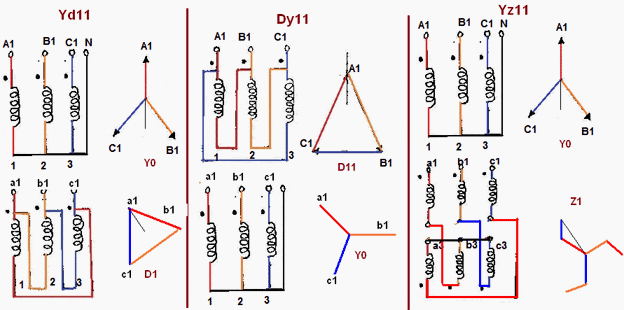
Transformer has a delta connected primary winding (D) a star connected secondary (y) with the star point brought out (n) and a phase shift of 30 deg leading (11).
The point of confusion is occurring in notation in a step-up transformer. As the IEC60076-1 standard has stated, the notation is HV-LV in sequence. For example, a step-up transformer with a delta-connected primary, and star-connected secondary, is not written as ‘dY11’, but ‘Yd11’. The 11 indicates the LV winding leads the HV by 30 degrees.
Transformers built to ANSI standards usually do not have the vector group shown on their nameplate and instead a vector diagram is given to show the relationship between the primary and other windings.
Recommended Course – Mastering Transformer Vector Groups: Learn How To Analyze and Draw Windings Connections
Mastering Transformer Vector Groups: Learn How To Analyze and Draw Windings Connections
Vector Group of Transformer
The three phase transformer windings can be connected several ways. Based on the windings’ connection, the vector group of the transformer is determined. The transformer vector group is indicated on the Name Plate of transformer by the manufacturer. The vector group indicates the phase difference between the primary and secondary sides, introduced due to that particular configuration of transformer windings connection.
The Determination of vector group of transformers is VERY IMPORTANT before connecting two or more transformers in parallel.
If two transformers of different vector groups are connected in parallel then phase difference exist between the secondary of the transformers and large circulating current flows between the two transformers which is very detrimental.
Useful Guide (PDF) – Loading Considerations When Paralleling Power Transformers
Phase Displacement Between HV and LV Windings
The vector for the high voltage winding is taken as the reference vector. Displacement of the vectors of other windings from the reference vector, with anticlockwise rotation, is represented by the use of clock hour figure. IS: 2026 (Part 1V)-1977 gives 26 sets of connections star-star, star-delta, and star zigzag, delta-delta, delta star, delta-zigzag, zigzag star, zigzag-delta. Displacement of the low voltage winding vector varies from zero to -330° in steps of -30°, depending on the method of connections.
Hardly any power system adopts such a large variety of connections. Some of the commonly used connections with phase displacement of 0, -300, -180″ and -330° (clock-hour setting 0, 1, 6 and 11).
The digits (0, 1, 11, etc.) relate to the phase displacement between the HV and LV windings using a clock face notation. The phasor representing the HV winding is taken as reference and set at 12 o’clock. Phase rotation is always anti-clockwise. (International adopted).
Use the hour indicator as the indicating phase displacement angle. Because there are 12 hours on a clock, and a circle consists out of 360°, each hour represents 30°. Thus 1 = 30°, 2 = 60°, 3 = 90°, 6 = 180° and 12 = 0° or 360°.
The minute hand is set on 12 o’clock and replaces the line to neutral voltage (sometimes imaginary) of the HV winding. This position is always the reference point.
Watch Video – How to draw phasor and winding diagram for any vector group notation
Example
- Digit 0 = 0° that the LV phasor is in phase with the HV phasor
Digit 1 = 30° lagging (LV lags HV with 30°) because rotation is anti-clockwise. - Digit 11 = 330° lagging or 30° leading (LV leads HV with 30°)
- Digit 5 = 150° lagging (LV lags HV with 150°)
- Digit 6 = 180° lagging (LV lags HV with 180°)
When transformers are operated in parallel it is important that ANY phase shift is the same through each. Paralleling typically occurs when transformers are located at one site and connected to a common bus bar (banked) or located at different sites with the secondary terminals connected via distribution or transmission circuits consisting of cables and overhead lines.
Table 1 – Phase shift through connections
| Phase Shift (Deg) | Connection | ||
| 0 | Yy0 | Dd0 | Dz0 |
| 30 lag | Yd1 | Dy1 | Yz1 |
| 60 lag | Dd2 | Dz2 | |
| 120 lag | Dd4 | Dz4 | |
| 150 lag | Yd5 | Dy5 | Yz5 |
| 180 lag | Yy6 | Dd6 | Dz6 |
| 150 lead | Yd7 | Dy7 | Yz7 |
| 120 lead | Dd8 | Dz8 | |
| 60 lead | Dd10 | Dz10 | |
| 30 lead | Yd11 | Dy11 | Yz11 |
The phase-bushings on a three-phase transformer are marked either ABC, UVW or 123 (HV-side capital, LV-side small letters). Two winding, three-phase transformers can be divided into four main categories
Table 1 – Three-phase transformer groups
| Group | O’clock | Transformer connection |
| Group I | 0 o’clock, 0° | delta/delta, star/star |
| Group II | 6 o’clock, 180° | delta/delta, star/star |
| Group III | 1 o’clock, -30° | star/delta, delta/star |
| Group IV | 11 o’clock, +30° | star/delta, delta/star |
| Minus indicates LV lagging HV, plus indicates LV leading HV | ||
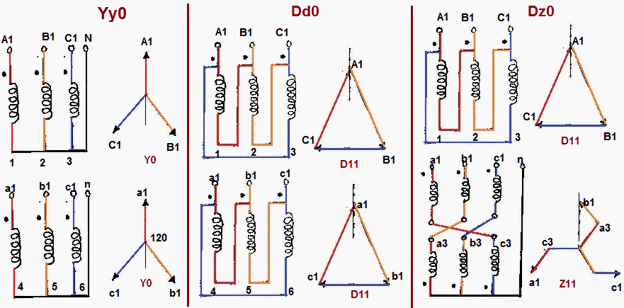
Vector Group Clock Notation 0 (Phase Shift 0)
Figure 4 – Vector Group Clock Notation 0 (Phase Shift 0)
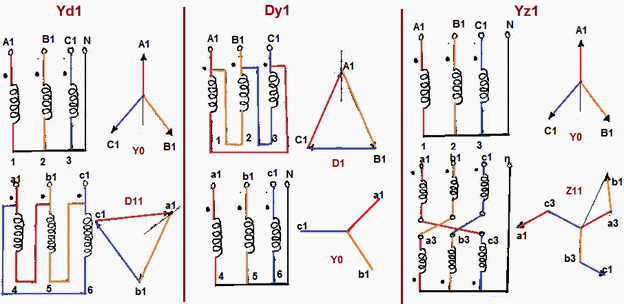
Vector Group Clock Notation 1 (Phase Shift -30)
Figure 4 – Vector Group Clock Notation 1 (Phase Shift -30)
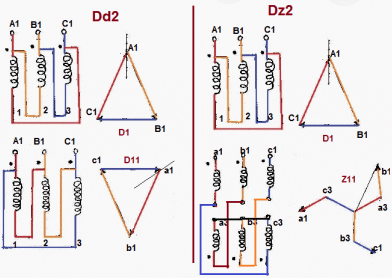
Vector Group Clock Notation 2 (Phase Shift -60)
Figure 5 – Vector Group Clock Notation 2 (Phase Shift -60)
Vector Group Clock Notation 4 (Phase Displacement -120)
Figure 6 – Vector Group Clock Notation 4 (Phase Displacement -120)

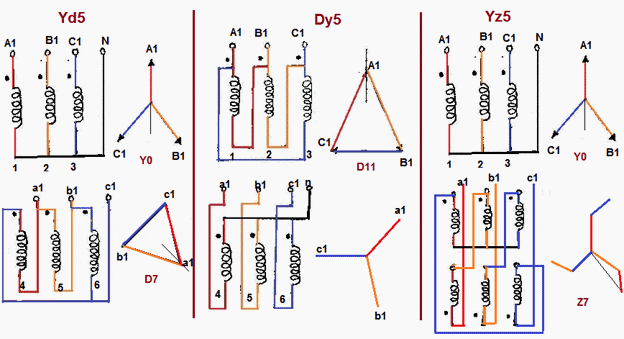
Vector Group Clock Notation 5 (Phase Displacement -150)
Figure 7 – Vector Group Clock Notation 5 (Phase Displacement -150)
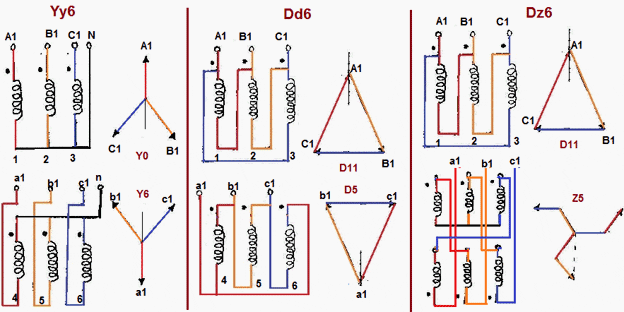
Vector Group Clock Notation 6 (Phase Shift +180)
Figure 8 – Vector Group Clock Notation 6 (Phase Shift +180)
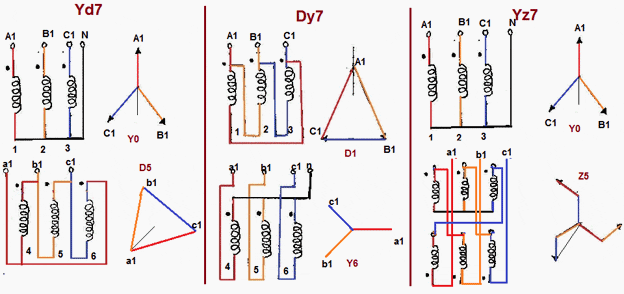
Vector Group Clock Notation 7 (Phase Shift +150)
Figure 9 – Vector Group Clock Notation 7 (Phase Shift +150)
Vector Group Clock Notation 11 (Phase Shift +30)
Figure 10 – Vector Group Clock Notation 11 (Phase Shift +30)
Keep reading the second part of this series: Understanding Vector Group of Transformer (2)
Related electrical guides & articles








Jignesh Parmar
Electrical Middle management professional having more than 22 years rich and dynamic experience in Project Execution / Project Management / Designing / Maintenance diversifies from Electrical Power Transmission (400KV/220KV/66KV)- Distribution(11KV/220V) to Lifts-HVAC-Ventilation-Fire Fighting-Fire Alarm-Lifts-CCTV-Stack Parking Works (High Rise Buildings, Townships, Shopping Complex, Commercial Complex, School, Temple).Profile: Jignesh Parmar


there is a mistake concerning to DYN5 u used phase b
and u considered phase sequence anticlockwise
this is very Helpful. It has answered quite a number of questions I had on vector grouping of transformers. nonetheless, what consideration is done when selecting the vector group and phase shift angle for transformers in different locations and Voltage levels.
Please share PDF file for the same
is there a source for this article?
Please send a source for this article.
Dear Sir ,
Please send Vector Group Condition Yd1 for 3 Ph. Step down Transformer
Dear All this is not connected to vector group, i could not find the place for request, Can we get circuit diagram/ connection drawing for the protection relays like,3OC/EF,Differenctial relay, master trip, motor protection, etc. otherwise any hand book is available please let me know. This is for we want to teach every protection relays working principle and connection to our trainee engineers.
Please support us thank you
This is very help full article; but what my question is what is the effect of vector group transformer on it’s function.
In situations of parallel operation, where more than one transformer has to be connected together, both or all of the connected transformers have to have same vector groups, else this results in circulating currents and other issues that could cause adverse operation of the system and subsequent failure.
Vector group was to find transformer winding configuration for two two transformer paralleling purpose. Both are identical means paralleling operation is smooth condition otherwise circulating current will form lead to damage transformers.
Hi Sir,
This is the very clear explanation about the vector groups, very nice,
And what is my question is why we needs to follow multiple vector groups, Commonly can follow only one vector group for each star and delta, what is the advantage of these multiple vector groups? if doing synchronization the vector group must be same, this is the condition, so we can follow any one group for delta and stat, why multiple phase shift used? what is the use of these?
Hi everyone, this article is really good and explain everything very detailed, but certainly there is something that I have tried many times to find without success about what is the criteria to select a group connection for a transformer, for instance a Step-up transformer could be YNd1 or YNd11 what would be the criteria to select whichever of this and how does affect the system (no transformer in parallel). There is something to take account for selecting a group connection?
Yd1 will be used in transmission at generating station to neutral the load angle of alternator which is in between 30 deg lag.
Dy11 will be used in that same system for distributing to balance the voltage so that user will get the same phase shift as gerating voltage and also in Dy11 the secondary side wil also eliminate zero sequence current or earth fault current by connecting the neutral to ground
Hello Fellows.
This the best explanation of the vector grouping.
Thanks.
is it possible to parallel YNyno and YNd11 Transformers. What will be happen if it paralled
In case we have step up transformer 400v/33KV 2,5 MVA is it correect the vector group Ynd-11
If HV side (Secondary side i.e. 33KV) is star winding and primary is in delta then YnD11 is OK.
One error though: “S=Star” is not correct. Instead, the symbol “Y” is used, aka “Wye”. Note that this configuration resembles a star, that is correct.
This is very helpful article for understanding and making of transformer.
One thing need to know.
If we need to connect two transformers in parallel with 2 different vector groups , what would be the sequence?
Very useful and helpful article, I am also an Electrical engineer and doing job in electrical maintenance in steel industries from last more than 18 years.
Dear Sir
Good morning.Your article is very good.
Sir I am intrested in panel designing and testing,can u send details regarding this on mail id.
Thank you, Jitendra. Try searching EEP for the terms “panel design”, I’m sure you will find a lot of resources (guides and articles).
dear let me ask some quarry about vector group of transformer.
lets assume a transformer having YNd11 VECTOR GROUP.
other one having YNd5 vector group .
so tell me where we will prefer to YNd11 at YNd5 ?
YNd11 Mostly used in generating transformer where HV connected(Y) to grid, N point to HV because surges for load protected by neutral point where CT, Relay and Trip ckt provided so that’s generation cannot be affect
Hello,
Is is possible to connect only two transformers with two different vector group to each other?
There would be no other transformers on the grid. Only to transformer connected to eachother but different vector groups…
Thank you
Sir,
If generator transformer vector group is Dyn1 and Distribution Transformer vector group is also Dyn1 i.e. phase displacement exist between generator and load voltage. Is there any problem in power flow if transformer paralleling is not required? What problems may arise from this phase displacement except transformer paralleling?
Their is also a vector group YNd9, but not told about this.
which vector group apply in 24 pulse furnace transformer
Dear sir,
#1 In Dy11 condition you have mention 330 deg lagging and 30 deg lead. How it is possible and when.?
#2 In practice Dy11 is connected to load which is mostly lagging power factor how the 30 deg lead is possible ?
Vector group has no relation with load power factor. Better you draw a clock marking with 1,2…upto12 and then highlight the point 11. Now if you count how far the Point 11 from 12. You will find that its 330 deg far but in clock wise direction and again only 30 deg far but this time in Anti clock wise direction. Thus 330 deg Lag = (360-330=) 30 deg Lead. Likewise 300 deg Lag= (360-300 =) 60 deg Lead and so on.
why neutral point not available in induction furnace transformer. The vector group is dy11. Ratio of transformer is 6000 KVA 11/0.690-0.690 kv
Dear Sir.
I would like to know if someone know about the conection of Ynad .
Please let me know to my email [email protected]
Many thanks.
Recently in one project we have found that system design as below
Source Power supply by 4nos. 1.5MW Generator ( output 415V, 50Hz) and generator are in star connection, for that use 4nos. step up transformer they use vector group YNd1 ( 415V / 11KV) and after 400M distance where they need power do Step down by 4nos. Transformer use vector group Dyn11 ( 11KV / 415V )
We ask them why they design like this, they informed us that at the time of step up it will be in lagging and at the time of step down it will be leading, so their will be no phase angel. it will work perfectly
Can any one guide us or clarify us more ?
Thanking you in advance for kind support
Best Regards
Mahmud
How you protect the earth fault at 11 KV cable.you should use any one side star Y connection for earth.if your 11KV cable ground then append. because you use delta connection on both side of 11 KV.
YNd1 is 30°lagging while Dyn11 is 330°lagging (which is similar to 30°leading according to the lecture above). So the resultant angle will be in phase…
Nice information…
Delta connection is provided on the generator side to avoid flow of 3rd harmonics on generator side. The other side may be Star or delta. The star side provides facility for detection of earth fault and operate ground fault protection.In case of delta connection, for ground fault detection ,Zig-zag transformer is required to be provided for creating artificial neutral for passage of current to earth.
In case of delta connection , each phase winding full insulation over the complete length of coil where as in case of Star connection for system above 66kV, the insulation on neutral side is reduced ans cost of transformer is reduced.
As regards selection of vector connection. the delta connection is always connected to generator side and other side connection is why for ground fault detection otherwise, additional Zig -Zag transformer is to be provided with delta connection for ground fault detection.
On load side, the phase angle of the existing bus is to be ascertained and then select the vector arrangement of new transformer. Under unavoidable circumstances, phase shifting transformer would be required to be provided to avoid unbalance voltages.
Neutral connection of star connected winding shall not be left unconnected/ floating from earth as this will cause unbalance phase voltages, avoid detection of ground fault current and may adversely effect the safety of operator/ public.
Dear Sir,
we are doing one power project in abrod middle east and capacity of 4Mwe*4. we choose the each generator 1250kva, 415v to 3.3kv transformer. we interest to avoid NGR. Please suggest transformer
Dear Sir,
We are going on one gas base power project of 6 MWe. power generation is LT 415V with synch. After step up 415 to 11KV. we plan to installation 5 transformer to each generator. we choose transformer capacity of 2000kva*2 and 1600*3. Please suggest vector group. we are not interest to use NGR.
Dear Sir’s
I need to synchronize a steam turbine 6.3 KV With the bus 11 KV
I need to request transformer step up 6.3 KV TO 11 KV
So what is the connection of the transformer should be Dd0 or Yy0 i don’t want any phase shifting.
any idea ?
Thank you
First of all Thanks for your Article on Vector Groups. All the Points are clear to understand. I’m little bit confused with Dy5 and Dy7 vector group diagrams. Can you please explain that alone for me.
Have a look at the Delta side, It’s different. The Star side is the same.
What is principal purpose/necessity of vector grouping for 3 phase transformer ?
Because I didn’t think only for the parallel operation is the main reason behind it but I can’t conclude it properly, so please help me to understand this matter…..
Thanks to the writer for his wonderful article.
How can I tell “Yd11″(which you have mentioned as a step-up) is not a step down transformer.Please explain
sir how can i connect the auto transformer at phase shifting of 40 degree for -20 and +20 degree for deferential delta connection
I am reading an AUTO transformer Name plate and it says;;;; YNa0d11
Can someone explain what does letter a and digit 0 stand for.
Thanks
“a” stands for auto-transformer.
Why Vector group Yd3, Dy3 are omitted however they are possible connections?
Sir. Why all the distribution transformers in India is generally Dyn11? Any specific reason for that? Why can’t other vector groups not preferred?
Hello Sir,
How shall we mention Vector Group for a 3-Phase LT Transformer 415V/30V with Open Delta configuration for both Primary & Secondary Sides. Phase shift shall be 0 Deg.
Am very happy and enjoy your thesis and details.
I work with power company ,please I will like to know how load balancing.On 500kva transformer if Red phase is 400A ,Yellow phase is 345A and Blue phase is 258A lastly Natural current is 211A. Please what do I do on such load balancing.I would be glad if I will get some magazine’s and small tools (instruments) to assist me on my work.
Thanks for your blessing.
My address is ECG Accra west , P.O.Box 6348.North Accra,West African Ghana.
Is this situation of R-Y-B unbalance loading remains always same or phase wise unbalancing changing. Means more load is sometime on R phase , sometimes on Y phase and so on . If unbalancing pattern is always same phase wise then it will be easy to balance by withdrawing single phase load from R and putting it on B phase.
But if unbalancing is randomly on different phases then segregate 3 phase and 1 phase load; identify the load causing unbalancing and try to divide the single phase load equally on three phases for this you need to modify your distribution on different electrical panels and may be some wiring changes are also required for distributing the load.
Really appreciated this article helped me greatly. Explained clearly. looking forward to getting more transformer theory explained
Can i connect Dyn11yn11 parallel with Dy11y11 – DeltaHV side Dual LV winding star connected? I have 7 dry transformers with Dyn11yn11 configration but we didn’t connect neutral with the transformer. Now i am thinking to order a new oil transformer of Dy11y11 configuration. According to my understanding, there won’t be any problem because the difference is just having neutral connection out or not?
When you want to go for parallel you have to check follows.
1)both transformer’s same vector group.
2)impedance volts % variation should be within 0.5 %of both transformer’s.
3) ‘0’ voltage should be measured in same phase of one transformer to the second transformer.
Example:TR-1 secondary ‘r’ phase to TR-2 secondary ‘r’ phase voltage should be ‘0’. and repeat for all phases.
ATT: SALES
Kindly quote us for the following;
Transformer
Voltage: 11KV/3.3KV
Rating: 1250KVA
Vector Group: DYn11
Regards,
Jacqueline
PLAGGMAN INVESTMENTS LIMITED
Plot # 1280 Timo Building
Freetown Road, Second Class
Light Industrial Area
Kitwe, Zambia
Office: +260 212 221128
Mobile: +260 963 465173
my colleague needed to fill out a form recently and located a web service that has a searchable forms database . If people are wanting it as well , here’s a https://goo.gl/5auDai
why we need phase shift at secondary side is it necessary if yes why?
Thanks a lot sir
Thanks Sir,
We need more …..
on what vector group a transformer is selected for a particular application.
I have a set up with one stepup transformer 1250 kVA 415 V/22 kV and then another step down transformer 600 m away 650 kVA 22 kV / 415 V. How should I choose the vector group for each transformer. The cos phi is >= .8. The application is for a resort hotel.
Thank you
Nice explanation on vector groups of transformers. Pl comment on doubts raised on the content as the explanation taken in right earnest by many engineers. Also pl explain the significance of 30 degree multiple. Thanks a lot to the author for helping many engineers in learning Electrical Engineering in a layman’s style. My best wishes for many more contributions
Very good explanation, but one question rises: what’s the reason for all that variety of vector groups (I mean, why is it required to have that many phase shifts combinations, for what use)? Thanks.
When we try connect different transformer in parallel
thanks a lot to your your discussion very good thanks a lot
How to confirm which vector group one three phase transformer belongs to, please explain calculations & connections made for
different vector groups for testing
Can we have common grounding/earthing for neutral of two or more power transformers and DG sets (at industrial units). If not then why. Also can we have common earthing for neutral and body of transformer.
dear sir, i want to know why it is so important to build vector group in a transformer, why we not use a transformer without any vector group
I will convert 360-380v to 415 v. What will be vector group for that. Both windings are Star.
connect 2 -360 in series and have those be connected in delta, then the secondary should be connected in star and it will give you a 415 volts
If you say the rotation anti-clock then TR. Dyn11 LV lags HV by 30 degree and Dyn1 LV leads HV by 30 degree . I think clock – wise is correct
Generally direction is taken as anticlockwise.
Why the transformers are not designed at Higher impedance (>20%) even though current density suits the short circuit temperature(Asper IEC—180 degrees )?Please clarify the doubt ?
As far as you increase the impedance, short circuit current reduces but at the same time efficiency decreases.
My question is ‘why did we need different types in the first place?’
Thanks for your explanation about vector group. I would like that you verify this affirmation. If i have a transformer Dy11 step down (33/0.415kV) connected in series with a transformer Dy11 step up (11/0.415kV), we are going to have 0 degrees of difference between 33kV and 11kV sides.
Thanks
thank you very much for your preamble
Hi
I was working in a project and I have seen that there are two different power transformers has been connect in parallel even they were have different primary and secondary connection.
one was Dy11 and the other was Yd5.
any one can explain how this performed.
Dear Sir,
I have faceting problem in testing of Transformer Vector Group DY11Y11Y11Y11,(380VX4/33000V for solar Plant) I have ask to client for factory test report but he is not providing me.
You are requested please help me, I am electrical engineer and working for solar power plant first time.
Hello sir,
I have design 480kva trx.Dry type.On primary side Delta connection & on secondary side Star connection.
& both have 2 layers of winding.
I want vector group Dy1 then what is connection (both delta & star)plz guide me.my email [email protected] you
Vector diagram is least understood by many. Most important is how you draw vector diagram when trafo are connected in any manner and how to draw conclusion on phase shift. can u develop some OR if it is OK I can try my hand at it
Sir
what in the mean of Lio vector group and why we can you the other vector group in place of this vector group.
sir, we have to need ans of diff between vector group of dy1 and dy11 and als0 dy1 is used instead of dy11?
your explanation is very good
Dear Sir We need Phase Shifting Transformer Design details
very good explanation and great mind
From the Vector group YznII of a particular transformer, how would you know that the Ratio test on the HV side of a transformer has failed? ie from which range(the input to the output should be before you can say it has failed )
what is the use of vector group (phase displacement) in distribution transformer. can i use that transformer which have no phase displacement in voltage b/w praimary and secendry w/d.
it is a good collection and enjoy reading and for working practical experience in international market.
3ph ac magnetic mutual indexon vector groups and clock position super
This info is realy useful because the connections of vector groups r confusing me very much but now i understand
What i need if will install synchronizer generator to bus if VT sensing at before and after transformer ?. The transformer vector is Yd11.
thanks for giveing above electricle information for vecter group
Very useful, but often these articles remind me of my university days where the real world application of the information is missed.
Can you please explain why and when you would use these different vector groups on a transformer?
Thanks
Mostly a good article except Winding Connection Designation for star is Y not S. But more importantly most of the clock notation vector diagrams are wrong. Please fix these I have had two people this week give me wrong vector diagrams because they copied your errors.
Kindly tell which diagrams are wrong & explain.
How to find out Different vector group ?
Thank you. when it will be continued?
whats the difference between Dyn11 and Dyn5 in 3-phase transformers, which connection better.
thx
Why it does not have Yy4 (120 lagging) ?
High voltage winding; use Y0
and Low voltage winding; use Y8
after i read your article. i think my above connection we can get Yy4 (120 lagging)
Please advise.
thanks a lot for that article.
very nice
Why do dd and yy winding cannot have 30 or 60 degree phase shift in vector group formation.
Very nice article
but I think your Additive and Substractive diagram is not right.
:)
Dear Jignesh
This is an article well explained in common mans language.I have been an avid reader of many an article published by you and every article is just great.Thanks for sharing all this.
Radhakrishnan K A
Please check the additive polarity symbolic daigram
I have a Delta/Star Step down transformer with a vector group Dyn11 written on the name plate. From the article here I understood that secondary side winding is phase shift by 30 degrees with respect to primary side winding. They also say that this configuration eliminates third harmonics in the system. I don’t clearly understand how it is helping to eliminate the third harmonics. I would appreciate if some one could give a better explanation on this with graph or equations if possible. Thanks a lot..
simple and excellent … great work jignesh !!!!
realy great effort sir
dear jignesh sir
your are really a great contributor in EEP.your all articles are mindblowiing.
thanking you
from yogesh parmar
really it is wonderful effort…..thanks so much
really it is wonderful effort.
thanx
This is the far best explanation of vector group meaning and usage! Thank you very much Jignesh!
Is the two GENSET Transformers with a vector group (Dyn11 and YNd11) are acceptable for synchronization at the HV side.