


Estimated Study Time: 20 minutes
When fault-clearing system fail…
All elements in the fault-clearing system do not always operate correctly. Protection relays may fail to operate or may operate unwantedly. Switching devices may fail to interrupt the fault current. Common practice is to use several protection systems operating in parallel.
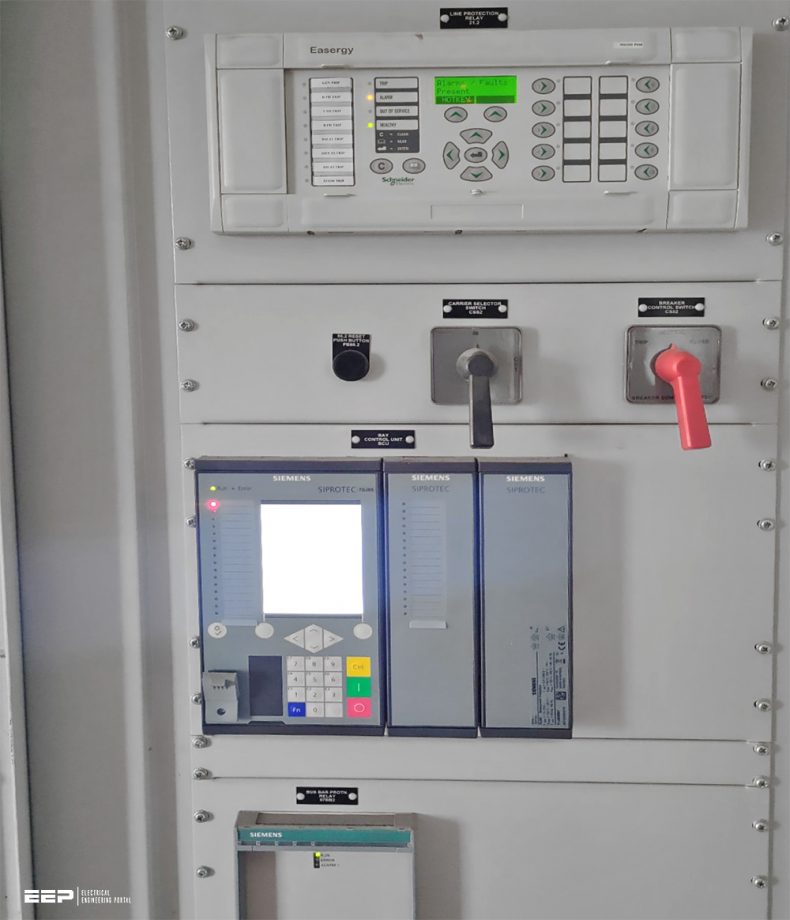 How backup protection is used to improve fault-clearing system in EHV networks (photo credit: Kamran Ansari via Linkedin)
Backup protection is intended to operate when a power system fault is not cleared or abnormal condition not detected in the required time because of failure or inability of other protection to operate or failure of the appropriate circuit-breaker(s) to trip.
In the USA and other countries, the term backup protection designates a form of protection that operates independently of specified devices in the main protection system. The backup protection may duplicate the main protection or may be intended to operate only if the main protection system fails or is temporarily out of service.
In case of local backup, there’s a distinction between substation local backup and circuit local backup. A circuit local backup protection senses the same current and voltage as the main protection. A substation local backup protection uses another current transformer than the main protection.
Ideal backup protection would be completely independent of the main protection. Current transformers, voltage transformers, auxiliary tripping relays, trip coils and auxiliary DC supply systems would be duplicated. This ideal is rarely attained in practice.
The following compromises are typical:
- There is only one current transformer but it has several cores. One core and its associated secondary winding energize each protection. Sometimes one CT secondary winding feeds more than one protection.
- Common voltage transformers are normally used because duplication would involve a considerable increase in cost, both because of the voltage transformers themselves and because of the increased accommodation that would have to be provided.Since the security of the VT-output is vital, it is desirable that the supply to each protection should be separately fused and continuously supervised by a relay that will give alarm on failure of the supply and, where appropriate, prevent an unwanted operation.
- Trip supplies to the two protections should be separately fused. Duplication of tripping batteries and trip coils on circuit-breakers is sometimes provided.
Let’s discuss now the five most common backup protections:
- Remote Backup Protection
- Substation Local Backup Protection
- Circuit Local Backup Protection
- Duplicated Main Protections
- Breaker Failure Protection
1. Remote Backup Protection
Remote backup protection is the ideal form of backup protection when it works. Remote backup protection is completely independent of the protection relays, current transformers and voltage transformers of the main protection system. It is also independent of the auxiliary DC supply system and the breakers in the substation.
In many utilities, there is one group that is responsible for relay planning, fault analysis, setting and calibration of the main protection and the backup protection. This group of people may introduce systematic errors in both the main protection and the backup protection.
Figure 1 shows the single-line diagram for a network with a remote backup protection.

Here, a shunt fault occurs at F on the power line to C, and the line protection 2 at substation B fails to operate. The line protections 5, 7 and 8 have to detect the shunt fault at F. They also have to trip the breakers at A, D and E.
Next is given a specific example to illustrate the concept of remote backup protection.
The Figure 2 shows a network protected by distance protections without telecommunication. The distance protection uses the current and voltage measured at one end of the line. The protection uses these measurements to decide if the fault lies within the zones of the distance protection.
Zone-1 of the distance protection covers about 85% of the line.

Zone-2 of the distance protection at A must cover the entire line from A to B, including remote substation B. Zone-3 of the distance protection at A must cover the entire line from B to C, including the next substation C. Zone-1 of the distance protection at B and Zone-2 of the distance protection at A both detect a fault close to B on the line from B to C.
Zone-2 of the distance protection at B and Zone-3 of the distance protection at A both detect the fault close to substation C on the line from B to C.
To obtain a rapid fault clearing, the distance protections should operate instantaneously when the fault occurs within Zone-1. To obtain selectivity, the tripping for faults within Zone-2 and Zone-3 has to be delayed.
Zone-2 of the distance protection at A must cover the entire power line from A to B. Zone-2 of the distance protection at A must not reach beyond Zone-1 of the distance protection at B. Zone-2 of the distance protection at A backs up the distance protection at B.
However, this is true for only one part of the power line from B to C. Zone-3 of the distance protection at A provides backup for the rest of the power line from B to C. The tripping from Zone-3 of the distance protection at A has to be delayed more than the tripping from Zone-2 of the distance protection at B.
Related electrical guides & articles





Edvard Csanyi
Hi, I'm an electrical engineer, programmer and founder of EEP - Electrical Engineering Portal. I worked twelve years at Schneider Electric in the position of technical support for low- and medium-voltage projects and the design of busbar trunking systems.I'm highly specialized in the design of LV/MV switchgear and low-voltage, high-power busbar trunking (<6300A) in substations, commercial buildings and industry facilities. I'm also a professional in AutoCAD programming.
Profile: Edvard Csanyi
Comments are closed on this post.