

Electrical Lectures
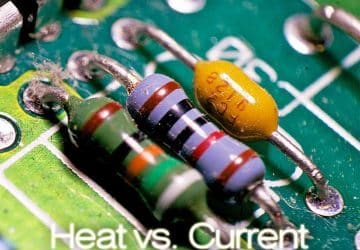
Heat vs. Current in a Resistor
It is converted from one form to another. One of the most familiar forms of energy is heat. When a current (I) is forced through a resistor (R) by applying a potential (V), the electrical energy is converted to heat… Read more
Oct 04, 2013 | By Edvard Csanyi
Electrical Lectures
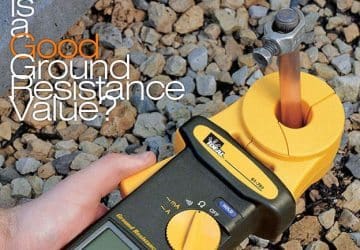
What Is a Good Ground Resistance Value?
The goal in ground resistance (or earth resistance) is to achieve the lowest ground resistance value possible, that makes sense economically and physically, when contacting the earth, also known as the soil/ground rod interface. Ideally, a ground should be zero… Read more
Oct 02, 2013 | By Edvard Csanyi
Electric Motor
Sizing The DOL Motor Starter Parts (Contactor, Fuse, Circuit Breaker and Thermal Overload Relay)
In this technical article we’ll calculate the size of each part of DOL motor starter for the system voltage 415V, 5HP three phase household application induction motor, code A, motor efficiency 80%, motor RPM 750, power factor 0.8 and overload… Read more
Sep 11, 2013 | By Jignesh Parmar

Electrical Lectures
Electrical Thumb Rules You MUST Follow (3)
Continued from second part: Electrical Thumb Rules You MUST Follow (Part 2) For Motor Size of Capacitor = 1/3 Hp of Motor ( 0.12x KW of Motor) For Transformer < 315 KVA 5% of KVA Rating 315 KVA to 1000… Read more
Sep 02, 2013 | By Jignesh Parmar

Electrical Lectures
Electrical Thumb Rules You MUST Follow (2)
Continued from first part: Electrical Thumb Rules You MUST Follow (Part 1) For Sinusoidal Current: Form Factor = RMS Value/Average Value = 1.11 For Sinusoidal Current: Peak Factor = Max Value/RMS Value = 1.414 Average Value of Sinusoidal Current (Iav)… Read more
Aug 28, 2013 | By Jignesh Parmar

Electrical Lectures
Electrical Thumb Rules You MUST Follow (1)
This technical article deals with the electrical thumb rules related to cable capacity, current capacity of equipment, earthing resistance, minimum bending radius of a cable, insulation resistance, transformer and lightning arrestor parameters, diesel generator, and current transformer (CT). Cable Capacity… Read more
Aug 23, 2013 | By Jignesh Parmar

Electrical Lectures
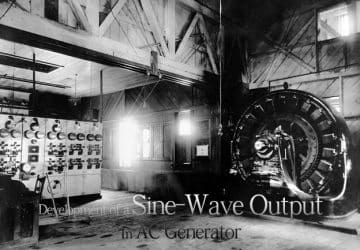
Development of a Sine-Wave Output In AC Generator
The elementary AC generator (Figure 1) consists of a conductor, or loop of wire in a magnetic field that is produced by an electromagnet. The two ends of the loop are connected to slip rings, and they are in contact with two… Read more
Jul 08, 2013 | By Edvard Csanyi
Electric Motor
Three Phenomenons In The Iron Of AC Machines
Most of our practical AC machines (motors, generators ad transformers) depend heavily on the magnetic field for operation. The core iron of the machine provides a path for the magnet field. There are a number of phenomena in the iron… Read more
May 29, 2013 | By Edvard Csanyi

Electrical Lectures
How to Determine Correct Number of Earthing Electrodes (Strips, Plates and Pipes) – part 1
Earthing Resistance and the number of earthing electrodes are both dependent on the resistivity of the soil as well as the amount of time it takes for fault current to pass through (one second or three seconds). The number of… Read more
Apr 05, 2013 | By Jignesh Parmar

Electrical Lectures
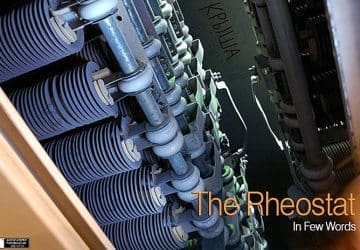
The Rheostat In Few Simple Words
A variable resistor can be made from a wirewound element, rather than a solid strip of material. This is called a rheostat. A rheostat can have either a rotary control or a sliding control. This depends on whether the nichrome… Read more
Mar 20, 2013 | By Edvard Csanyi
Electrical Lectures
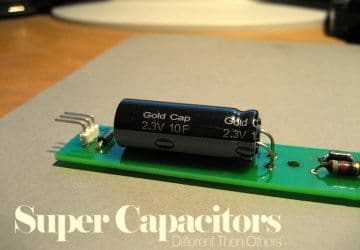
Super Capacitors – Different Than Others (part 1)
Capacitors store electric charge. Because the charge is stored physically, with no chemical or phase changes taking place, the process is highly reversible and the discharge-charge cycle can be repeated over and over again, virtually without limit. Electrochemical capacitors (ECs) variously… Read more
Feb 23, 2013 | By sravankumarpadala
Electrical Lectures
Water-and-Pipe Analogy for Ohm’s Law
Ohm’s Law also makes intuitive sense if you apply it to the water-and-pipe analogy. If we have a water pump that exerts pressure (voltage) to push water around a ”circuit” (current) through a restriction (resistance), we can model how the three… Read more
Aug 15, 2012 | By Edvard Csanyi
Electrical Lectures
Electric Shock Current, Where Does It Go?
As we’ve already know, electricity requires a complete path (circuit) to continuously flow. This is why the shock received from static electricity is only a momentary jolt: the flow of electrons is necessarily brief when static charges are equalized between… Read more
Aug 13, 2012 | By Edvard Csanyi

Electrical Lectures
Fundamental Concepts of Insulation Testing
Probably 80% of all testing performed in electrical power systems is related to the verification of insulation quality. This technical article briefly describes the fundamental concepts of insulation testing including – insulation behavior, types of tests, and some test procedures…. Read more
Jul 07, 2012 | By Edvard Csanyi

Electrical Lectures
Voltage vs. Current in a Resistor, Capacitor or Inductor
Elements in an electrical system behave differently if they are exposed to direct current as compared to alternating current. For ease of explanation, the devices have often been compared to similar every day items. Resistors in electrical systems are similar… Read more
Jul 03, 2012 | By Edvard Csanyi
