Electrical Lectures
Types of neutral earthing in power distribution (part 1)
In the early power systems were mainly Neutral ungrounded due to the fact that the first ground fault did not require the tripping of the system. An unscheduled shutdown on the first ground fault was particularly undesirable for continuous process… Read more
Feb 06, 2012 | By Jignesh Parmar

Electrical Lectures
About Permeability And Permitivity
The strength of electric field or electrostatic force strength or intensity of field (all synonymous terms) is measured & expressed in terms of force experienced by unit positive charge placed in sphere of influence of another source charge, which has… Read more
Feb 01, 2012 | By Asif Eqbal

Electric Motor
Synchronous Motor Construction
Synchronous motors convert electrical power to mechanical power and synchronous generators convert mechanical power to electrical power; and synchronous condensers supply only reactive power to stabilize system voltages. Synchronous motors, generators, and condensers perform similarly, except for a heavy cage winding on the… Read more
Jan 14, 2012 | By Edvard Csanyi

Electrical Lectures
What Is The Potential Difference?
Potential difference is the term used to describe how large the electrostatic force is between two charged objects. If a charged body is placed between two objects with a potential difference, the charged body will try to move in one direction, depending upon the polarity of the object. If… Read more
Jan 13, 2012 | By Edvard Csanyi

Electrical Lectures
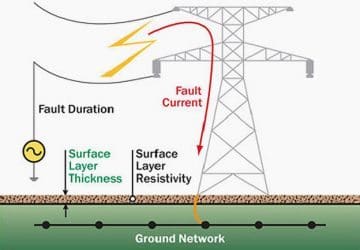
Earthing in electrical network – purpose, methods and measurement
The main reason for doing earthing in electrical network is for the safety. When all metallic parts in electrical equipment are grounded then if the insulation inside the equipment fails there are no dangerous voltages present in the equipment case…. Read more
Dec 19, 2011 | By Jignesh Parmar
Electrical Lectures
What is the resonance phenomena?
The use of both capacitive and inductive devices in distribution systems leads to resonance phenomena, resulting in extremely high or low impedance values. These variations in impedance modify the current and voltage in the distribution system. Here we will discuss… Read more
Dec 09, 2011 | By Edvard Csanyi

Electrical Lectures
What is the difference between MCB, MCCB, ELCB, and RCCB
This technical article briefly describes the most common breaker-related protection devices in low-voltage applications: MCB, MCCB, ELCB, and RCCB. We’ll describe their main characteristics and limitations and try to solve some misunderstandings and differences that many young engineers mix up…. Read more
Oct 25, 2011 | By Jignesh Parmar
Electrical Lectures
The Need for Reactive Power Compensation
Except in a very few special situations, electrical energy is generated, transmitted, distributed, and utilized as alternating current (AC). However, alternating current has several distinct disadvantages. One of these is the necessity of reactive power that needs to be supplied… Read more
Nov 19, 2010 | By Edvard Csanyi