

Transformer Overview
The transformers used in industry and in commercial buildings are generally less than about 1500 kVA in rating, although some may be up to 2500 kVA. However size and space limitations keep them to typically the 1000 kVA level. For interior use in buildings they are all naturally cooled apart from, in some cases, some rudimentary additional fan-cooling systems which may be installed some time after installation as an adjunct, perhaps to try to increase the maximum short–time rating of older transformers.

Table 1 gives details of the range of distribution substation transformer ratings as used by Energy Australia. Note that the substations listed are not necessarily restricted to indoor types.
Because of the potential danger from fire in enclosed spaces, such as substations in buildings, the type of insulation of transformers in such installations is often somewhat different to that used in outdoor applications. Such outdoor transformers use oil-impregnated paper as the basic dielectric.
This paper is then impregnated with a dry liquid dielectric to exclude any air bubbles, to keep moisture out of the paper and to provide good thermal circulation for heat dissipation.
Table 1 – Range of standard substation transformers

For outdoor applications the main liquid insulation in transformers is petroleum-based mineral oil, with the windings being encased in a tank of such oil. The problem is that such oil is highly flammable and, if used in a building in an enclosed location, could represent a serious fire hazard.
If mineral oil insulated transformers are used in buildings then the room must be fitted with automatic fire extinguishers and there must be a bund structure at the base of the transformer to contain all of the oil should it be discharged from the transformer.
Liquid insulated transformers are generally limited to the Class A materials temperature rise limits of about 60-70°C. Higher temperature rises can cause more rapid deterioration
of the cellulose (paper) insulation on the windings and also deterioration of the oil itself.
The lack of forced cooling and the relatively low insulation temperature limits put some constraints on the thermal ratings of such transformers for use in buildings.
Figure 1 – Oil insulated distribution transformer ONAN cooled type (Oil Natural Air Natural)
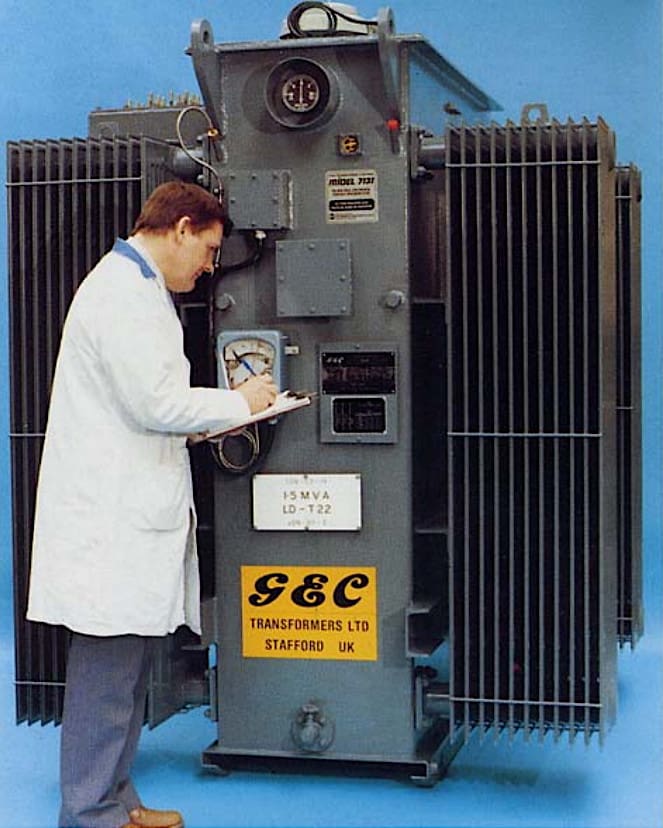
Because of the potential for deterioration of the transformer insulation with temperature and possible contaminants it needs to be tested at regular intervals to determine the insulation efficacy and whether any deterioration has occurred. This is generally done in mineral oil transformers by dissolved gas analysis to monitor both oil and paper insulation and by Dielectric Dissipation Factor (DDF) testing.
These diagnostics will be covered in more detail later in the Study.
There are two basic types of non-flammable transformers in use:
- Liquid insulated type, using synthetic oil and
- Dry type which uses solid resin insulation or varnished insulation to replace the oil.
Synthetic liquid insulation materials
1. Askarel
The initial move away from mineral oil (in the 1930s) was to the use of askarel liquid insulation. Askarel, which is essentially a polychlorinated biphenyl (PCB), is an artificial insulating oil which is almost non-flammable. It was used for many years in a large number of electrical applications, but although it is a very insulant it has some toxic effects, particularly if heated or burnt.
2. Silicone Oil
Silicone insulating fluid, which is tetrachloro-benzyl toluene with about 40% trichlorobenzene, is essentially non-flammable and has no toxicity problems. It is the most favoured synthetic transformer insulating oil.
It has a higher viscosity than mineral oil and askarel, and so its convective heat dissipation coefficient is not so good but its other electrical properties are very similar to those of mineral oil, although it is quite a bit more expensive and for this reason its use is not widespread.
Figure 2 – Dry-type cast resin transformer

Dry Type insulation
Because of the cost of silicone oil and the need to provide expensive bund structures to hold the oil in case of a leak, there has been a very substantial move to dry-type transformers for use in buildings and in some industry sites (such as mines) in recent years. Dry types have no fluid impregnation, as the name implies.
See Figure 2 above.
This type of material is self-extinguishing if subjected to a flame from a fire.
There are two different generic forms of dry-type transformers:
- Open winding type, and
- Epoxy cast-resin type.
| Title: | Guidelines to Distribution Transformers for Industrial And Commercial Electrical Supply |
| Format: | |
| Size: | 1.6 MB |
| Pages: | 55 |
| Download: | Here 🔗 (Get Premium Membership) | Video Courses | Download Updates |
Recommended Guide – Design overview and analysis of 11/0.415 kV, 500 kVA power substation in Nigeria
Design overview and analysis of 11/0.415 kV, 500 kVA power substation in Nigeria