


Estimated Study Time: 19 minutes
Common Distribution Faults
There are numerous possible reasons for electrical power to go out. This story presents the interesting facts about the eight most common faults in the MV and LV distribution systems, which include vehicles hitting poles, trees touching or falling on mains, pollution failures, pole-top fires, animals, and a variety of other unknown causes.
 Eight Most Common Distribution Network Faults
Single-phasing, drop out fuses failing to clear (flashover) and faults on pole top switches also are mentioned.
A fault has been defined as any abnormal condition that degrades the fundamental insulation strength between phase conductors, or between phase conductors and the earth, or any earthed screens covering the conductors.
Consequently, an increased level of pollution on an insulator string reduces the insulation strength of the faulted phase; however, it is not considered a fault until it induces a flashover across the string, subsequently resulting in excessive current or another discernible anomaly, such as atypical current in an arc-suppression coil.
Now, let’s discuss the following most important and common distribution faults!
- Vehicles Hitting Poles
- Trees Touching or Falling on Mains
- Pollution Failures
- Pole Top Fires
- Animals
- Transient Faults
- Single-phasing Faults (Loss of one MV phase)
- Feeder Faults – Drop Out Fuses Failing to Clear
- BONUS (PDF) 🔗 Download ‘Power System Analysis Handbook – Practice Problems, Methods, and Solutions’
1. Vehicles Hitting Poles
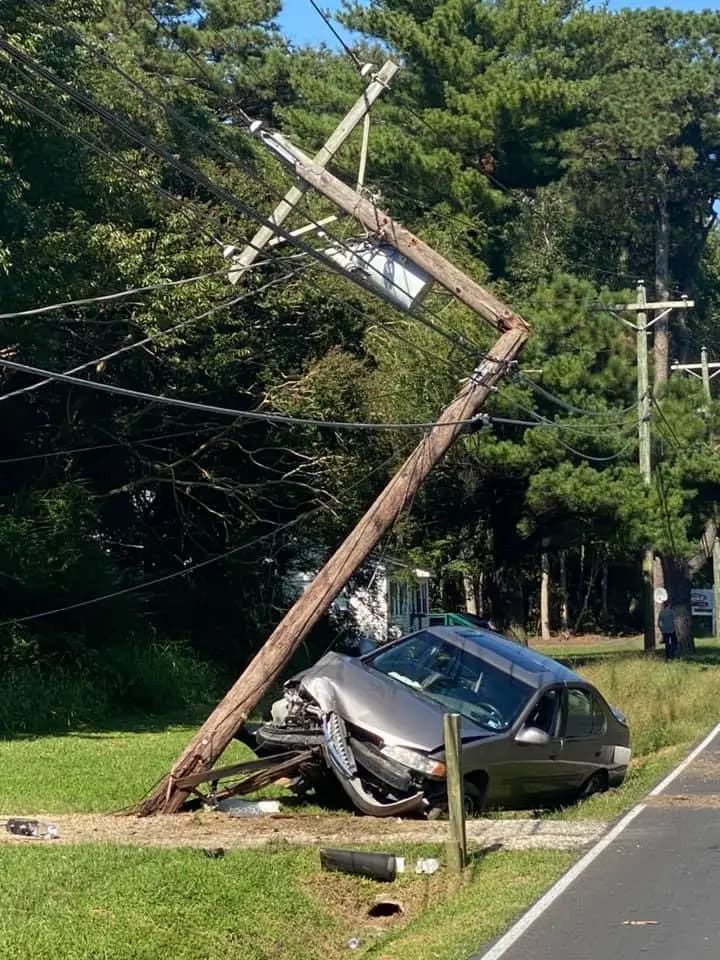
When a vehicle hits a pole, a power failure may occur due to the conductors clashing or shorting to earth. At times, the feeder successfully recloses. Damage to utility poles can disrupt the electrical grid they serve. Outages may occur unexpectedly due to disconnections or short circuits in power lines. The extent of these disruptions is determined by the location of the pole within the network.
The speed and weight of the vehicle, the angle of impact, and the pole’s composition are some of the factors that determine the outcome of a collision. Under tremendous pressure, wooden poles might split or crack, resulting in their accidental breakage upon collision.
Damage from downed lines and other debris can make repairs more difficult and pose a greater threat to public safety if a failure occurs suddenly.
When it comes to impact forces, modern ductile iron poles operate differently. The pole can absorb energy and bend because to the special qualities of ductile iron. Minimizing debris and strain on connecting wires and neighboring structures is achieved through a controlled response from the pole.
There is a secondary collision risk due to the potential scattering of pole and vehicle debris across the road. As roads close to the scene of the accident work to secure the area, traffic congestion is a common consequence.
Emergency medical personnel responding to the site must proceed with utmost caution in order to prevent electrical dangers that could postpone the delivery of life-saving treatment to those who are hurt.
Figure 1 – Car hits electric distribution pole
2. Trees Touching or Falling on Mains
Foliage and wet limbs of trees touching the mains can conduct electricity and cause short circuits between conductors. This may result in a circuit breaker tripping or a medium voltage fuse blowing. Falling or swaying trees, and their limbs, may also damage or break conductors, resulting in live wires falling or hanging dangerously.
The occurrence of fire under transmission lines is responsible for a great number of line outages in many countries. Faults are mainly due to conductor to ground short circuit at mid-span or phase-to-phase short circuit depending on line configuration and voltage level.
Another problem arising from such burning is the contamination of the insulators due to the accumulation of particles (soot, dust) on its surfaces. In this case, the line insulation requirements should be determined in such a way that the outages under fire could be reduced to a minimum.
Watch video – This is how power line causes tree fire!
3. Pollution Failures
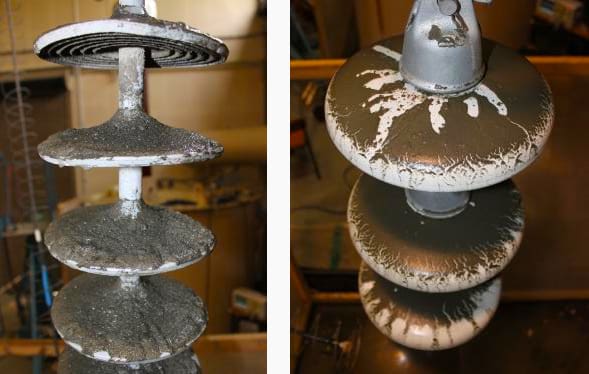
The pollution from industrial areas and exposed coastal areas may result in flashovers, pole top fires or radio interference. In the matter of fact, pollution is typically generated by accumulated soot or cement dust in industrial regions, and by salt deposited by wind-driven sea spray in coastal zones.
A significant level of pollution on an insulator string weakens the insulation strength of the impacted phase but is not considered a fault until it induces a flashover across the string, eventually leading to excessive current or other obvious anomalies, such as abnormal current in an arc-suppression coil.
Figure 2 – Polluted power line insulators
4. Pole Top Fires
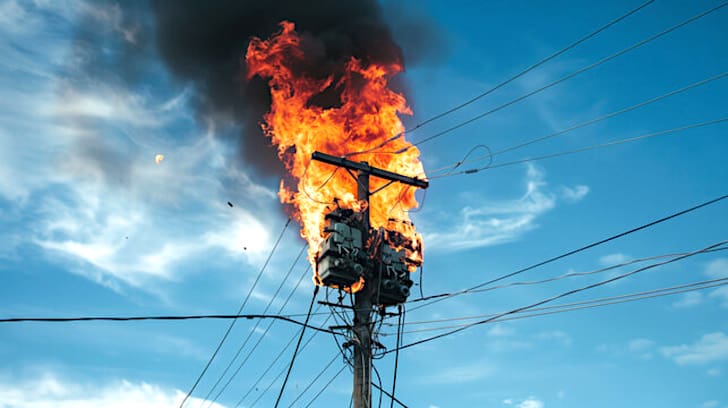
Pole top fires normally occur on those structures that have loose connections or are poorly bonded. Pollution, lightning damage and rain also contribute. Fires are more frequent with the first light rains following a long dry summer and also occur with high humidity at the end of summer.
The fires are caused by leakage from, or damage to, the insulator. As a result, the current may track down the insulator to earth, or flow between the conductors. The tracking current through the wooden pole and wooden crossarm will heat the wood and may eventually, set them on fire.
Figure 3 – Fire on electric pole
5. Animals
Both domestic animals and wild life may interfere with mains by short-circuiting the phases. Cats, birds and flying foxes may create problems. Animals that climb, dig, fly and slither create numerous problems for electric utilities, both in rural and suburban areas. Tree squirrels, for example, are one of the most common causes of animal-related service interruptions.
These squirrels devise elaborate routes through their territory, and they will single-mindedly follow these routes, even when shorter or safer paths are available.
Squirrels’ teeth grow between 6 inches and 10 inches a year. Unfortunately, they have a tendency to use those teeth to chew just about anything, including the insulating material of electric power lines and parts of transformers. One fascinating behavioral quirk—every 20-30 years, huge populations of squirrels migrate, ignoring every obstacle in their paths.
Some birds are actually attracted to and will swallow the fine gravel used in some substations as ground cover. The gravel helps to break down the tough fibers and grain they eat.
Woodpeckers, which strike tree trunks at speeds of up to 24 km/h, cause enormous damage to utility poles. Some bird species, like European Starlings and English Sparrows, will nest in just about any opening, which can put them in contact with energized equipment and grounded surfaces. Nesting activity also will sometimes cause short circuits.
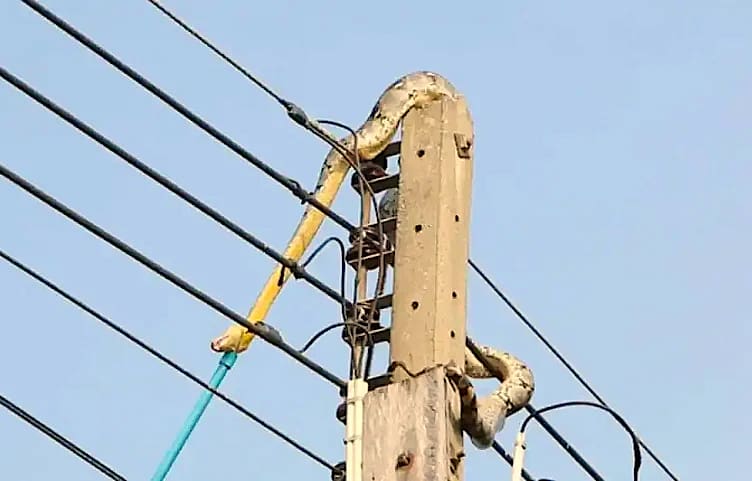
And where there are birds and eggs—there will be snakes. In fact, snakes are the second leading cause of animal-related outages in substations.
Figure 4 – Snake crawling on the electric distribution pole
6. Transient Faults
Faults with no known cause may trip a feeder that then successfully recloses. These are called transient faults. On the other hand, a feeder may trip and lock out. Switching operators will then be called upon to patrol and then sectionalise the line to determine the position of the fault.
For recurrent transient faults, the relevant part of the feeder or spur must be patrolled.
Transient faults may be caused by the following situations:
Situation #1 – High Winds Touching Trees
High winds cause tree limbs to come into contact with mains. This problem may be observed by the burning ends of branches and dead leaves. The switching operator should find, cut and remove the problem limbs of trees using suitable safety procedures.
Situation #2 – High Winds & Conductors Swinging
High winds and slack bays of mains may result in conductors swinging together and clashing. When patrolling lines, the switching operator should look for burn marks or pitting on the conductors.
Watch Video – Tangled conductors due to strong wind
Situation #3 – Hot Weather & Line Sag
Hot weather may cause excessive sag in long bays. Lines may touch trees in the heat of the day but be quite clear early in the morning or at night. When patrolling, the switching operator should carefully examine the height of trees near the middle of long bays.
Watch Video – Why do Electric Wires Sag in Summers?
Situation #4 – Overheated Conductors
Heavily loaded conductors carrying excessive current (amps) become heated and droop. They may come into contact with trees or other conductors.
Situation #5 – Vehicle Hitting Pole or Lines
Vehicles hitting poles may stretch street light circuits, customer services, stays and mains. Lines may become so taut that they break, whip up into the MV mains, cause a short circuit and then fall clear. These accidents may also break conductor ties or split crossarms.
Close checking of pole tops is required here.
Watch Video – Truck unloads earth and touches live lines
Situation #6 – Birds Again!
Faults near water and grain storage areas may be caused by birds that fly into exposed lines, especially at dusk or sunrise. The switching operator should look for signs of dead wildlife or feathers when patrolling the line.
Situation #7 – Vandals Doing Stupid Things
Vandals constantly cause faults by throwing wires or rubbish over mains. These may be difficult to detect. The switching operator should carefully observe the area and make local enquiries.
Good Reading on Vandals – Best practice in hard times: How to safeguard the hundreds and thousands of substations
Best practice in hard times: How to safeguard the hundreds and thousands of substations
Situation #8 – Insulation Failures
Insulation failures may be transient. Surge diverters may be faulty but look perfectly normal. Pin insulators may puncture beneath the conductor and trip the line when moisture fills the puncture.
These faults are extremely difficult to find.
Situation #9 – Lightning Strike
Faults caused by lightning may be only transient. Lightning strikes do not have to strike a line directly to cause an outage! Strikes in close proximity can induce high currents in lines, which trip the controlling circuit breakers.
Over fifty percent of faults on overhead power transmission lines are attributed to lightning. The primary common methods for mitigating lightning flashover faults on electrical lines include reducing footing resistance, utilizing numerous shielding wires, and implementing differential insulation.
The arrester must have sufficient strength to withstand excessive lightning strikes.
Further Study – Transient behavior of substation grounding grids under lightning surges
Transient behavior of substation grounding grids under lightning surges
Situation #10 – Bush Fires
Bush fires beneath lines send up dense clouds of smoke containing conductive particles. These particles may cause outages due to a flashover between conductors or the conductor and earth.
7. Single-phasing Faults (Loss of one MV phase)
In a three-phase system, single-phasing faults are caused by the open circuiting of one MV phase. This causes abnormal voltages on the LV side of distribution transformers and is commonly reported by customers as a ‘dim supply’ or ‘partial supply’.
The open circuiting of one MV phase will not operate feeder circuit breaker protection, because of the balanced current on the healthy two phases.
Most of these faults on a three-phase system are caused by the following:
- MV drop out fuse has blown
- Tap may burn off at a pole top switch, a corner tapping pole, or a termination.
- Contacts on a pole top switch may overheat and burn so badly that the contacts become highly resistive. They may also melt away from each other resulting in an open circuit.
- Broken conductor caused by weather conditions or mechanical damage.
Such complaints may indicate the fault current from the previous fault has also caused an open circuit MV conductor or a blown MV fuse.
Further Study – Relay Coordination Study: Calculation of the protective relays setting value to obtain selectivity
Relay Coordination Study: Calculation of the protective relays setting value to obtain selectivity
8. Feeder Faults – Drop Out Fuses Failing to Clear
Sometimes faults occur on fused spurs or circuits that feed transformers. A whole feeder may trip for the following reasons:
- The fuse operates too slowly, because it may be incorrectly sized or have been hard wired.
- The expulsion tube (in which the arc extinguishes) fails to function correctly.
A flashover then results, causing the feeder to trip instead of the drop out fuse (DOF).
Recommended Course – Practical Course for Designing LV Distribution Systems in Houses and Commercial Buildings

9. Attachment (PDF): Power System Analysis Handbook – Practice Problems, Methods, and Solutions
Download: Power System Analysis Handbook – Practice Problems, Methods, and Solutions (for premium members only):
Source: Switching Operator’s Manual by Horizon Power
Related electrical guides & articles








Edvard Csanyi
Hi, I'm an electrical engineer, programmer and founder of EEP - Electrical Engineering Portal. I worked twelve years at Schneider Electric in the position of technical support for low- and medium-voltage projects and the design of busbar trunking systems.I'm highly specialized in the design of LV/MV switchgear and low-voltage, high-power busbar trunking (<6300A) in substations, commercial buildings and industry facilities. I'm also a professional in AutoCAD programming.
Profile: Edvard Csanyi