


Estimated Study Time: 35 minutes
Digital Substation Automation Systems
This article gives a systematic and pragmatic look into Substation Automation Systems, dealing with the constraints of traditional (now old) SCADA-based substations and advancing to modern SAS systems. We’ll discuss the strong arguments and field practice in moving from hardwired automation, panel-centric configurations, to communication-oriented, system-centric solutions. Sounds good!
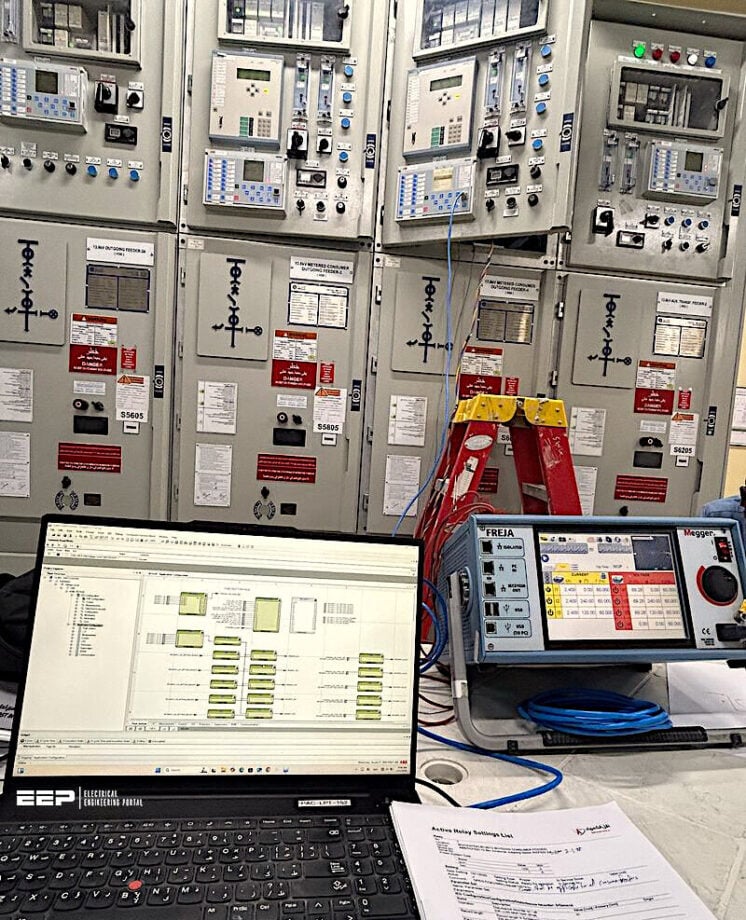 Field practice in moving from an old SCADA-based to a modern substation automation system (SAS) (photo credit: Odai Yousif Mahmud via Linkedin)
Modern power systems are undergoing a fundamental transformation driven by increasing network complexity, higher reliability expectations, and the need for efficient remote operation. Substations, once designed as locally operated and heavily hardwired installations, are now required to function as intelligent, remotely supervised nodes within a highly interconnected grid. This shift has given rise to the widespread adoption of Substation Automation Systems (SAS).
A Substation Automation System (SAS) is an integrated framework that enables monitoring, control, protection, data acquisition, and communication within a substation using digital technologies and standardized communication protocols.
Rather than relying on extensive copper wiring and local-only operation, SAS combines Intelligent Electronic Devices (IEDs), high-speed communication networks, and centralized software platforms to deliver safe, reliable, and efficient substation operation.
The functional architecture of SAS spanning process, bay, and station levels is explored in detail, along with the critical role of Bay Control Units (BCUs) and Local Control Cubicles (LCCs) in modern substations.
By combining theoretical concepts with real-world operational experience, this article provides engineers and students with a clear understanding of how Substation Automation Systems are designed, implemented, and operated in modern power networks.
Ok, let’s dive into the details!
- What is a Substation Automation System (SAS)?
- Disturbance Monitoring and Power Quality
- Engineering Access – A Major Evolution in SAS
- Remote Engineering and Operational Flexibility Enabled by SAS:
- IEC 61850 – The Real Breakthrough in SAS
- Conventional (Old) Substations:
- SAS Functional Architecture:
- Bay Control Units (BCUs) and Local Control Cubicles (LCCs) in Substation Automation Systems:
- Local Control Cubicle – Concept and Purpose
- Evolution of LCCs from Conventional to Automated Systems
- Role of the Bay Control Unit
- Control and Interlocking Philosophy
- BCU Human–Machine Interface
- Operational Flexibility and Maintenance Features
- Rear Panel Configuration and Inputs
- Communication and Networking
- Time Synchronization and Event Accuracy
- Attachment (PDF) 🔗 Download ‘Design Guide for Generating Power Stations and Industrial Plants’
1. What is a Substation Automation System (SAS)?
A Substation Automation System (SAS) is an integrated system that enables monitoring, control, protection, data acquisition, and communication within a substation using digital technologies and standardized communication protocols.
Rather than relying on extensive hardwiring and local-only operation, SAS brings together intelligent electronic devices (IEDs), communication networks, and centralized software platforms to allow power substations to operate safely, efficiently, and remotely.
As you probably noticed, power substations worldwide becomes strongly based on fast changing technologies. This reality may be incompatible with the traditional (old) trend of utilities in terms of systems standardization. The integration tendency in function/devices calls for a revision of professional staff profiles, in particular the old figures of dedicated protection engineer or control engineer.
New SAS functionality includes information and means useful for replacing time‐based maintenance with the more reasonable condition‐based maintenance practice (e.g., number of operations of primary switchgear and self‐supervision of IEDs)
Figure 1 – Engineer managing substation automation system (SAS)

1.1 Why Do We Need Substation Automation Systems?
To understand the need for SAS, engineers and students must first understand how modern substations are operated. Most substations nowadays are remotely located, unmanned or minimally manned, and spread across large geographical areas. At the same time, manpower costs are continuously increasing, and utilities cannot afford to staff every substation locally.
This creates a strong requirement that:
- Substations must be controlled remotely.
- Equipment must be monitored continuously.
- Faults must be detected and analyzed without physical presence.
This is exactly where Substation Automation Systems play a critical role.
Figure 2 – Substation Automation System (SAS)

2. Disturbance Monitoring and Power Quality
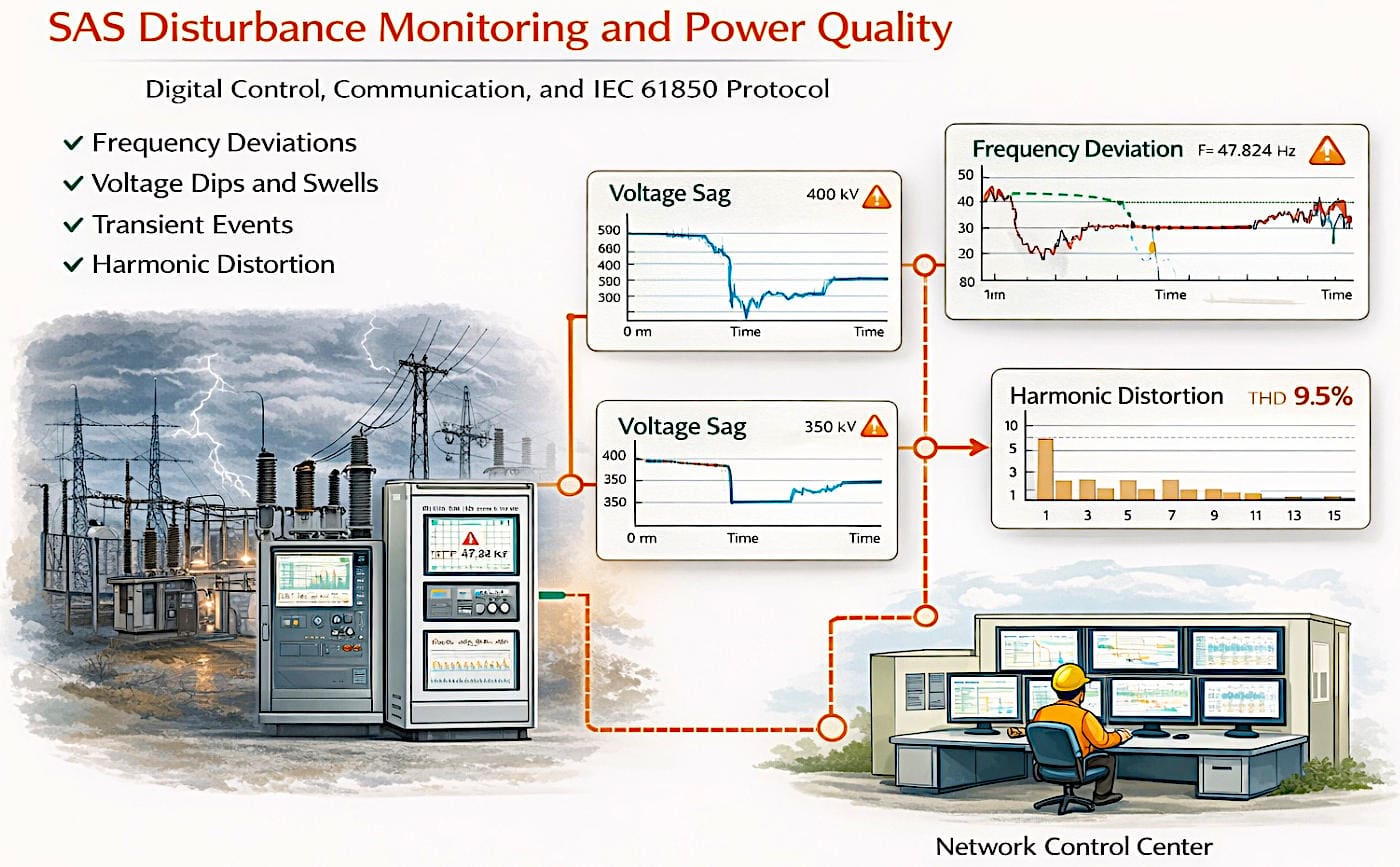
Another major advantage of SAS is the ability to monitor and analyze system disturbances, such as frequency deviations, voltage dips and swells, transient events, or harmonic distortion.
All of this can be done without visiting the substation.
Figure 3 – SAS System Monitoring
3. Engineering Access – A Major Evolution in SAS
One important evolution I have personally observed during my career in the Middle East is the increasing integration of Engineering Workstations (Engineering PCs) into Substation Automation Systems.
Traditionally, engineering access to protection relays was only available locally at the substation. Today, in many advanced utilities engineering PCs are connected to the SAS network. Secure communication links extend this access to remote locations, including control centers.
This means engineers can:
- Download fault records from protection relays
- Retrieve disturbance and event files
- Reset relays
- Update or modify protection settings remotely
This capability significantly improves response time, efficiency, and operational flexibility.
4. Remote Engineering and Operational Flexibility Enabled by SAS
4.1 A Practical Operating Scenario
Consider a realistic operating scenario frequently encountered in modern power systems. An engineer, while away from the substation, observes that repeated protection operations are occurring on a feeder or transformer.
Simultaneously, system loading has increased due to evolving network conditions, and it becomes apparent that the existing protection settings originally configured for lower load levels are now overly sensitive.
More About Loading – Loading issue that seriously affects transformer operation
4.2 Limitations of Conventional Substation Operation
In a conventional substation environment, addressing such a situation would typically require a physical site visit. Engineers would need to travel to the substation to retrieve fault records, review disturbance data, and implement any corrective adjustments.
This approach not only increases response time but also leads to higher operational costs and prolonged system instability.
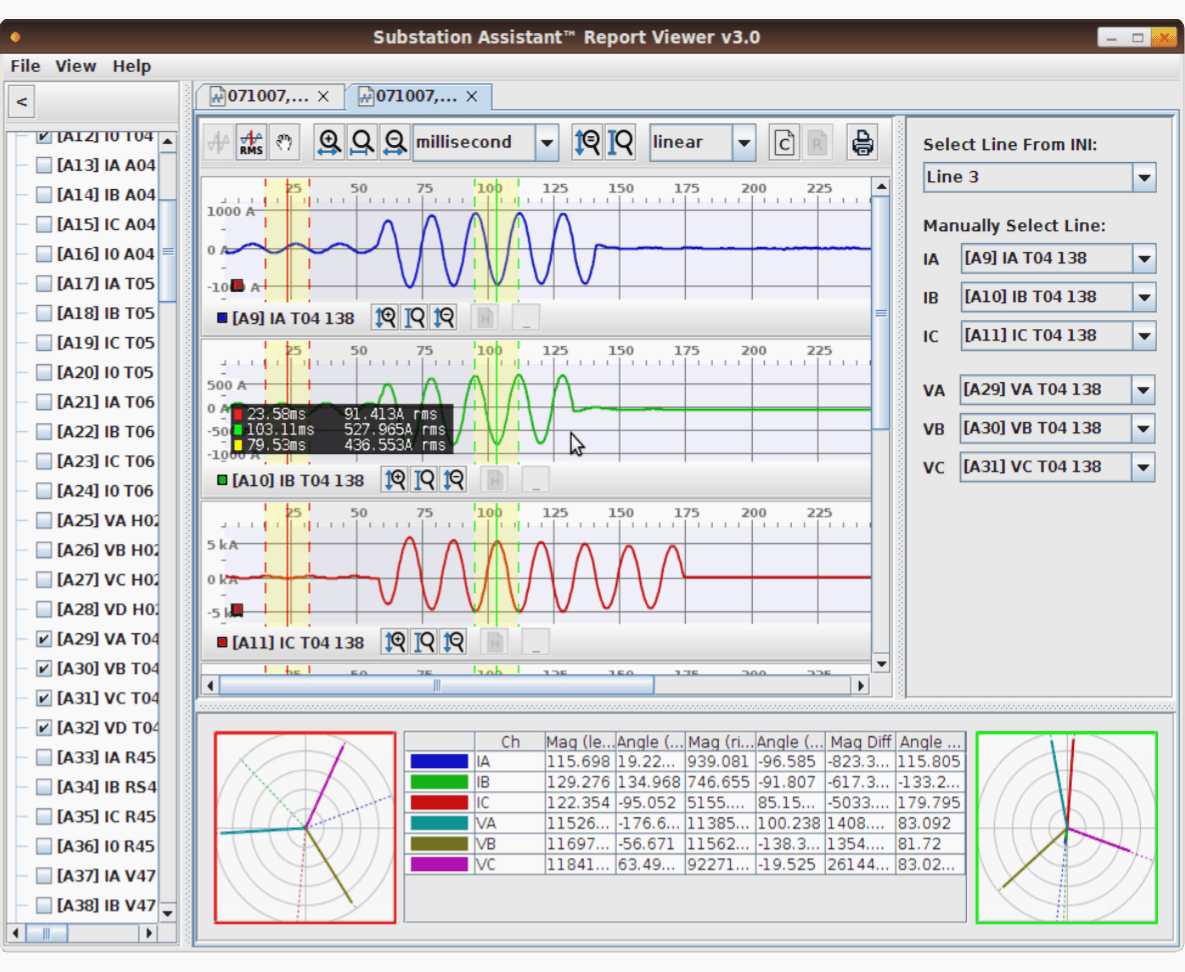
Figure 4 – Substation disturbance analyser desktop-based user interface in available in mobile version
4.3 Remote Analysis Using Substation Automation Systems
In contrast, a substation equipped with a properly engineered Substation Automation System enables rapid and informed decision-making from a remote location.
Through secure engineering access, the engineer can review real-time loading conditions, access detailed fault and disturbance records stored within protection relays and accurately diagnose the root cause of repeated protection operations.
Related electrical guides & articles



Muhammad Kashif
Muhammad Kashif Shamshad is an Electrical Engineer and has more than 17 years of experience in operation & maintenance, erection, testing project management, consultancy, supervision, and commissioning of Power Plant, GIS, and AIS high voltage substations ranging up to 500 kV HVAC & ±660kV HVDC more than ten years experience is with Siemens Saudi Arabia.Profile: Muhammad Kashif