


Estimated Study Time: 18 minutes
Earthing is not just ‘Earthing’
This article will analyse some of the most important safety issues related to design and use of LV electrical installations. Besides explanation of relevant terms in this field defined by IEC standards, some misinterpretations and confusions which may be seen in practice will be illustrated and clarified.
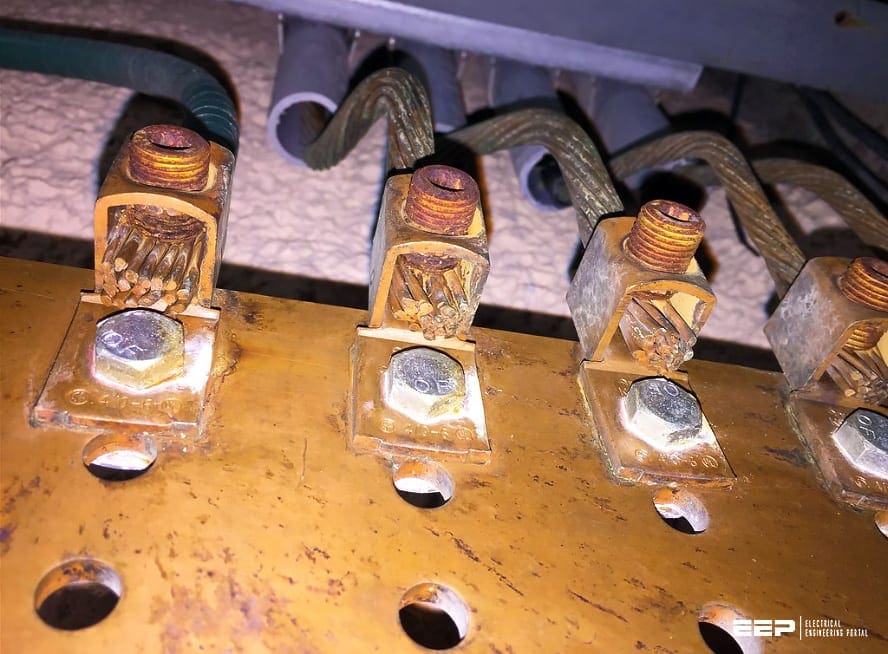 When can we say that earthing arrangement is safe for people? (on photo: An old earthing bar in LV switchgear; photo credit: Richard Cadena)
- Introduction and basic terms
- Earthing arrangements and efficiency of protection
- Additional comments and FAQs
1. Introduction and basic terms
The only electrical shock caused by indirect contact as a life hazard will be considered, while the safety of the equipment will not be a subject of this article. We can say that some part of the electrical installation is safe for people if inside that part of installation human life cannot be jeopardized by any unintentional action or technical fault.
A short survey of occurrences that may be potentially dangerous to human life, including definition and protective measures, is given below.
1.1 Lightning strike
Definition: Atmospheric electrical discharge into structures on the ground. Additional voltage induced by this discharge shall also be considered.
Safety risk: Electric shock may be caused by increased voltage which is a consequence of direct or indirect lightning discharge. Both touch and step potential differences may be critical. Thermal effects of discharge current flowing through conductors or creating electric arc may also be dangerous.
Protective measures: Installation of efficient external and internal lighting protection system. This subject was analysed within one of the previous articles. However, more about this topic you can read below:
5 most important aspects of external protection against the effects of lightning
1.2 Electric arc
Definition: Arc created by increased current caused by some fault inside installation, usually a short circuit.
Safety risk: Large amount of heat and light emission may cause serious injuries if there are people nearby, even if fault current is not flowing through human body.
Protective measures: Proper selection of overcurrent devices, conductors, and switchgear assembly, above all adequate separation (segregation) form. The use of personal protective equipment (shoes, gloves, eyeglasses) during interventions.
This subject will not be analysed within this article. However, more about this topic you can read below:
14 terms of particular importance when discussing arc flash hazards
1.3 Direct contact
Definition: Physical contact between human body and conductive parts with potential higher than earth potential during normal operation. These parts are so called “live parts” and usually we are talking about bare conductors, switchgear terminals and cable terminations.
Safety risk: Electric shock may be caused by increased voltage which is a consequence of potential difference between live part and earth. In the case of LV networks, usually touch voltage is critical.
Protective measures: Use of safety low voltage, physical barriers, increased insulation, placing of live parts outside human reach.
This subject will not be analysed within this article.
1.4 Indirect contact
Definition: Physical contact between human body and conductive parts with potential no higher than earth potential during normal operation. These parts are sometimes called “exposed conductive parts” or also “non live conductive parts” and usually we are talking about metallic cubicles and supporting structures, protective busbars, and other earthed structural parts inside or outside cabinets.
Safety risk: If galvanic connection (short circuit) between live part and exposed conductive part is established because of a fault, electric shock may be caused by increased voltage which is a consequence of potential difference between faulty conductive part and earth. In the case of LV networks, usually touch voltage is critical.
Protective measures: Use of overcurrent protective devices (usually circuit breakers and RCDs) and nonconductive cubicles. Note that, unlike direct contact, indirect contact assumes a fault to occur and cause potential danger to human life.
However, this subject will be analysed in the rest of this article, but if interested, you can learn more below:
Proper selection and overcurrent coordination of LV/MV protective devices
2. Earthing arrangements and efficiency of protection
In this article, the term “earthing arrangement” will assume the principle of:
- Transformer’s or generator’s neutral point earthing (first letter in earthing arrangement designation)
- Connection between exposed conductive parts within installation and transformer’s neutral (second letter in earthing arrangement designation)
Protection against indirect contact is considered to be efficient if, in the case of a fault, protective device prevents exposure of human body to dangerous amount of increased voltage.
Related electrical guides & articles






Miodrag Kokotovic
Graduated from Faculty of Electrical Engineering, within University of Belgrade, in the field of electrical power systems. Expert in electrical part of tender preparation, design, procurement, construction and commissioning of treatment plants and pumping stations, electrical power quality and energy management.Profile: Miodrag Kokotovic