


Estimated Study Time: 30 minutes
Changing Substation Maintenance Philosophy
This article explores the complete spectrum of substation maintenance philosophies from Corrective and Preventive Maintenance to Predictive, Condition-Based, and ultimately Risk-Based Maintenance (RBM). It explains how each approach evolved, where it fits within modern substations, and how utilities can transition toward data-driven and risk-informed asset management models.
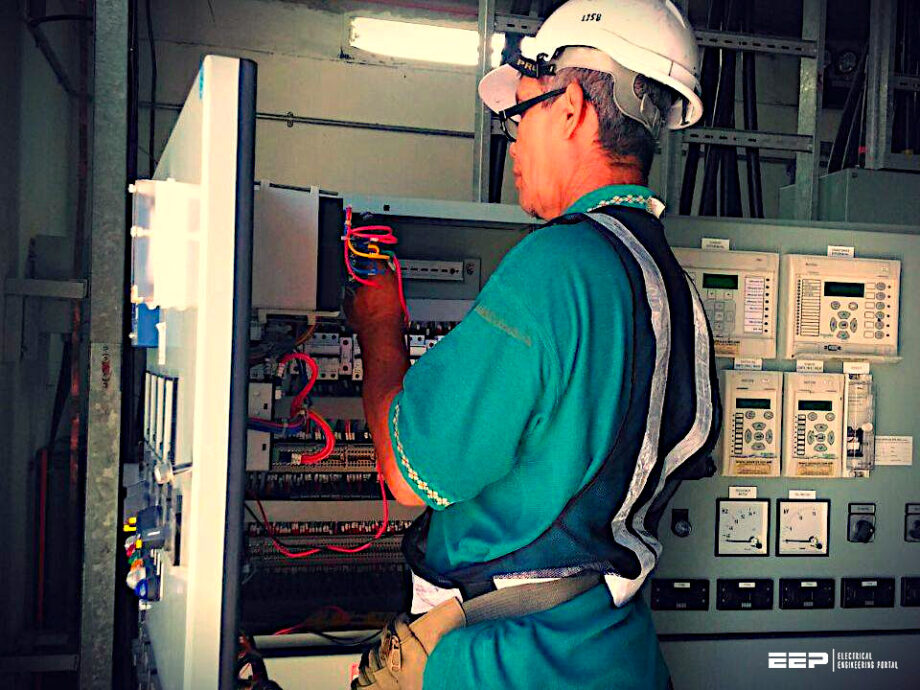 Substation Maintenance Transition Toward Clever Data-driven Asset Management (photo credit: Warna RS Sdn. Bhd.)
Particular focus is given to EHV substations, where asset failure consequences are severe impacting grid stability, public safety, regulatory KPIs (SAIDI/SAIFI), and financial performance.
The article also examines Asset Criticality Ranking, a foundational element in implementing effective RBM frameworks aligned with ISO 55000 asset management principles.
In modern power systems, substations are not merely switching points, they are strategic reliability hubs that determine the stability, safety, and availability of the entire grid.
Whether operating at distribution level or at EHV and HVDC transmission voltages, the maintenance philosophy adopted for substation assets directly influences system resilience, operational expenditure, and long-term asset health.
Historically, utilities relied heavily on reactive maintenance, addressing failures after they occurred. While this approach may have been acceptable in less complex networks, today’s interconnected grids, renewable integration, high fault levels, and regulatory performance targets demand a far more structured and intelligent maintenance strategy.
Ok, let’s dive into details!
- Approaches (or Logics) in Substation Maintenance:
- Corrective Maintenance (Reactive Maintenance)
- A Real-World Experience: Transformer Fire Incident (2004)
- Preventive Maintenance (Time-Based Maintenance)
- Predictive Maintenance (Data-Driven Maintenance)
- Condition-Based Maintenance (CBM)
- Risk-Based Maintenance (RBM) in EHV Substations
- Understanding Risk in the Substation Context
- Why RBM Is Critical in EHV Substations
- Implementation of RBM in EHV Substations
- Practical Examples in EHV Environment
- Benefits of Risk-Based Maintenance (RBM):
- Strategic Outlook
- Substation Asset Criticality Ranking:
- What Is Asset Criticality?
- Why Asset Criticality Ranking Is Essential?
- Key Factors in Determining Asset Criticality
- Developing a Criticality Scoring Model
- Criticality Categories in EHV Substations
- Integration with Risk-Based Maintenance
- Criticality and Asset Lifecycle Management
- Common Mistakes in Criticality Ranking
- Strategic Importance in Modern Grids
- ATTACHMENT (PDF) 🔗 Download ‘A Guide to Substation Equipment Maintenance and Checkings’
1. Approaches (or Logics) in Substation Maintenance
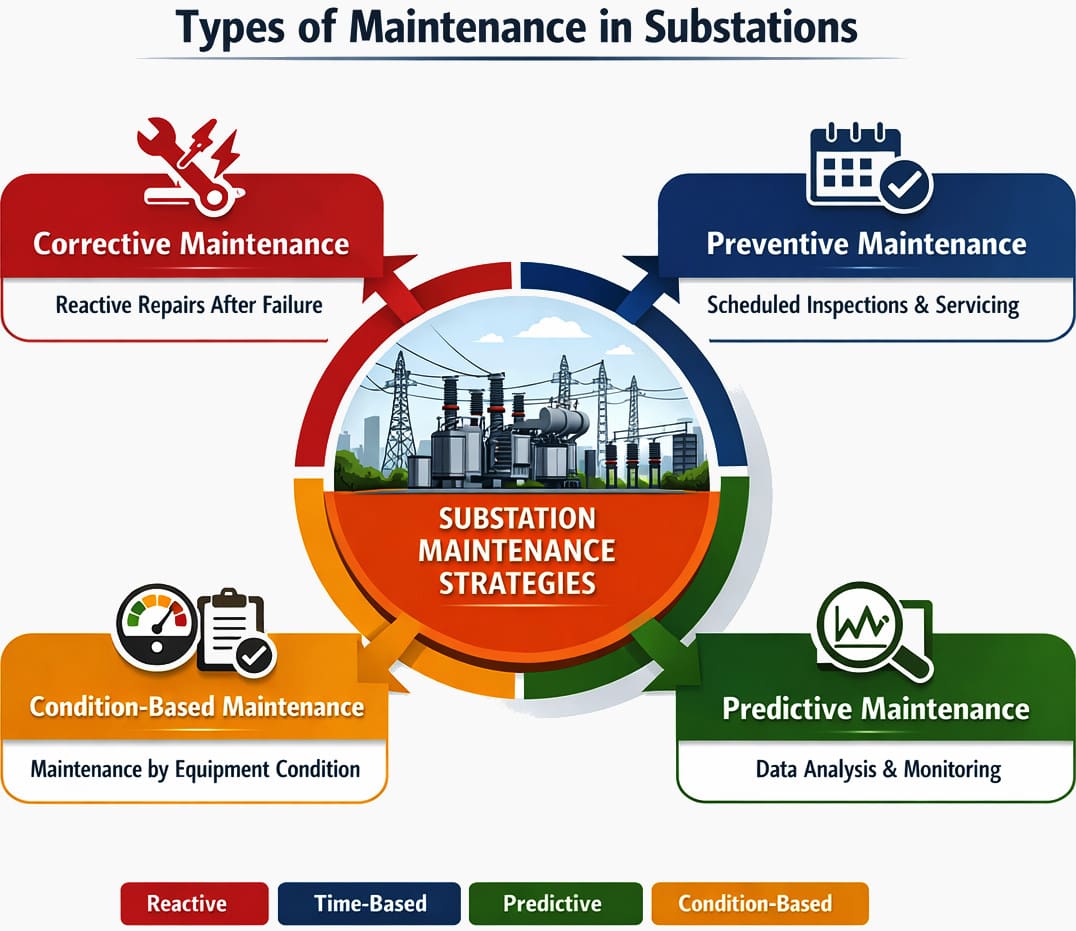
Substation maintenance strategies have evolved significantly over the past decades. What once began as reactive fault rectification has now transformed into structured, data-driven asset management. Understanding the different types of maintenance is essential for utilities to optimize reliability, safety, and lifecycle costs.
The failure of any substation equipment should be treated seriously. A comprehensive analysis of each failure should be conducted to aid in the mitigation or termination of recurrent failures of a similar nature.
It is a common observation that, despite regular maintenance, equipment failure cannot be completely avoided.
Broadly, maintenance strategies in substations can be categorized into four primary types:
- Corrective Maintenance
- Preventive Maintenance
- Predictive Maintenance
- Condition-Based Maintenance (CBM)
Each approach has its role, advantages, limitations, and suitability depending on asset criticality and system design philosophy.
Figure 1 – Types of Maintenance in Substations
1.1 Corrective Maintenance (Reactive Maintenance)
Corrective maintenance, often referred to as reactive maintenance, is performed after a failure has already occurred. Under this approach, equipment is allowed to operate until a defect manifests, and maintenance actions are initiated only once malfunction or breakdown is detected.
Historically, many substations, particularly in earlier decades operated largely under this model. Equipment was run until failure, and repairs were carried out when operational problems became evident.
1.1.1 Typical Examples in Substations:
Corrective maintenance activities in substations may include:
- Replacing a failed circuit breaker trip coil after malfunction.
- Repairing a transformer bushing following flashover.
- Rectifying a protection relay that failed to operate during a fault.
- Replacing deteriorated DC battery cells after loss of capacity.
- Repairing burnt auxiliary wiring following short circuits.
These actions are typically urgent, unplanned, and often executed under system pressure.
Advantages:
- No upfront maintenance cost.
- Simple planning.
- Suitable for non-critical or redundant systems.
Disadvantages:
- High risk of unplanned outages.
- Increased downtime.
- Potential cascading failures.
- Safety hazards.
- Higher emergency repair costs.
Corrective maintenance is best described as a failure-driven approach. While simple, it exposes utilities to higher operational risks.
Watch Video – The art of a substation maintenance
1.2 A Real-World Experience: Transformer Fire Incident in 2004
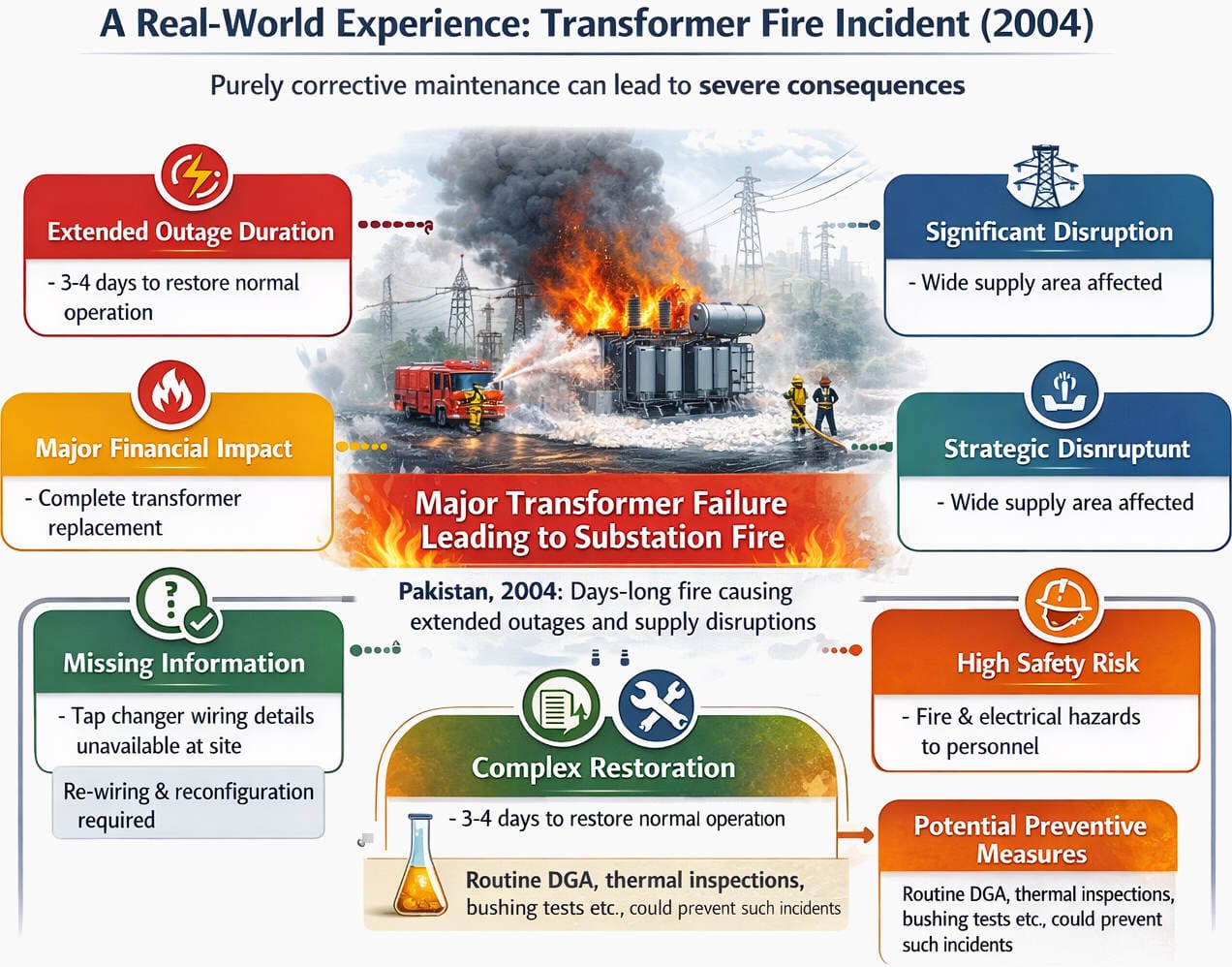
The risks of purely corrective maintenance become clear when observing real operational failures. In 2004, while working in Pakistan at 500kV DADU substation, I witnessed a major transformer failure in a substation that resulted in a fire outbreak.
The transformer caught fire and emergency firefighting services had to be called immediately. Specialized chemical-based foam was required to control the blaze. Despite the response, the fire continued intermittently for two to three days. The transformer was completely damaged.
The incident did not only result in equipment loss, it led to:
- Extended outage duration.
- Significant operational disruption.
- Affected supply area.
- Major financial impact.
- High safety risk to personnel.
The corrective restoration activity alone took approximately three to four days before stable operation could be achieved. The affected area experienced significant supply disruption during this period.
While transformer failures can occur due to multiple technical reasons are insulation breakdown, internal faults, moisture ingress, overload conditions in many cases, early preventive interventions such as:
- Routine oil testing (DGA)
- Thermal inspections
- Bushing health monitoring
- Periodic tap changer inspection could potentially detect degradation trends before catastrophic failure.
This incident clearly demonstrated the limitations and dangers of relying solely on corrective maintenance.
Figure 2 – Transformer Fire Incident in Pakistan, 2004
1.3 Preventive Maintenance (Time-Based Maintenance)
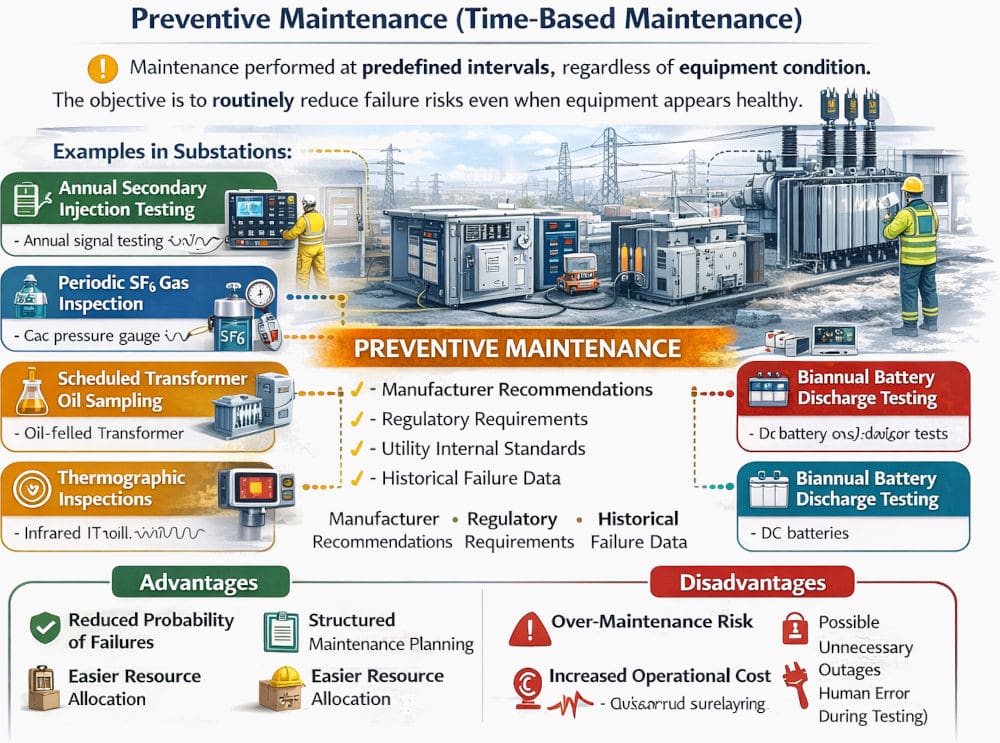
Preventive maintenance is performed at predefined intervals, regardless of equipment condition. The objective is to reduce the probability of failure by conducting routine inspections, testing, and servicing.
This approach became standard practice as utilities recognized the limitations of reactive strategies.
Examples in power substations:
- Annual secondary injection testing of protection relays.
- Periodic SF6 gas pressure inspection.
- Scheduled transformer oil sampling.
- Routine thermographic inspection.
- DC battery discharge testing every two years.
Preventive maintenance schedules are typically defined based on:
- Manufacturer recommendations.
- Regulatory requirements.
- Historical failure data.
- Utility internal standards.
Advantages:
- Reduced probability of unexpected failures.
- Structured maintenance planning.
- Easier resource allocation.
- Improved safety.
Disadvantages:
- Over-maintenance risk.
- Increased operational cost.
- Possible unnecessary outages.
- Maintenance-induced failures (human error during testing).
Preventive maintenance is therefore a time driven approach, effective but not always optimized.
Figure 3 – Preventive maintenance
1.4 Predictive Maintenance (Data-Driven Maintenance)
Predictive maintenance uses real-time or periodic data analysis to predict when equipment is likely to fail, allowing maintenance to be scheduled just before deterioration reaches critical levels.
Unlike preventive maintenance, predictive maintenance is not based on time but on measurable performance indicators.
Related electrical guides & articles

Muhammad Kashif
Muhammad Kashif Shamshad is an Electrical Engineer and has more than 17 years of experience in operation & maintenance, erection, testing project management, consultancy, supervision, and commissioning of Power Plant, GIS, and AIS high voltage substations ranging up to 500 kV HVAC & ±660kV HVDC more than ten years experience is with Siemens Saudi Arabia.Profile: Muhammad Kashif