

Electric Motor
Selection of Induction Motors for Industrial Applications (part 3)
Continued from first part: Selection of Induction Motors for Industrial Applications (part 2) The different rotor class, i.e. KL7, KL10, KL13, KL16, KLp, etc. are available in case of the motor to fulfil the functional torque requirements of the driven… Read more
May 06, 2013 | By Ashok Parikh
Electric Motor
Selection of Induction Motors for Industrial Applications (part 2)
Continued from first part: Selection of Induction Motors for Industrial Applications (part 1) Though standard motors are now available with a better efficiency, this factor (motor efficency) requires due attention when making the selection of the motor for a specific… Read more
May 04, 2013 | By Ashok Parikh
Industrial Automation
Benefits and Potential Drawbacks of VSDs
VSDs (Variable Speed Drives) offer several benefits, some of which are relatively easy to quantify, and others of which are less tangible, but there are some potential drawbacks, which must be avoided. With rotodynamic pump installations, savings of between 30%… Read more
Apr 03, 2013 | By Edvard Csanyi
Electric Motor
How to determine motor torque and speed requirements
The desired speed range may be difficult to achieve depending on the type of application. In general, depending on motor size and load type, very wide ranges may require a special motor. Operation at very low speeds, requiring the motor… Read more
Mar 29, 2013 | By Edvard Csanyi
Electric Motor
Starting Motor With Auto-transformer
An auto-transformer starter makes it possible to start squirrel-cage induction motors with reduced starting current, as the voltage across the motor is reduced during starting. In contrast to the star-delta connection, only three motor leads and terminals are required. On… Read more
Mar 18, 2013 | By Edvard Csanyi

Electric Motor
Torque Of Three-Phase Induction Motor Explained
The rotating force that a motor develops is called torque. Due to the physical laws of inertia, where a body at rest tends to remain at rest, the amount of torque necessary to start a load (starting torque) is always much greater than… Read more
Mar 16, 2013 | By Edvard Csanyi
Low Voltage
Defining Size and Location of Capacitor in Electrical System (2)
Continued from part 1: Defining Size and Location of Capacitor in Electrical System (2) Size of circuit breaker (CB), fuse and conductor of capacitor bank: A. Thermal and magnetic setting of a circuit breaker B. Fuse selection C. Size of… Read more
Mar 11, 2013 | By Jignesh Parmar
Energy and Power
Working principle of thermal motor protection relay
Thermal motor protection relays contain three bimetal strips together with a trip mechanism in a housing made of insulating material. The bimetal strips are heated by the motor current, causing them to bend and activating the trip mechanism after a… Read more
Mar 09, 2013 | By Edvard Csanyi
Energy and Power
An Overview Of Short Circuit Current (part 2)
Continued from previous technical article: An Overview Of Short Circuit Current (part 1) Sub transient reactance Xd” is the apparent reactance of the stator winding at the instant short circuit occurs, and it determines the current flow during the first… Read more
Feb 27, 2013 | By Asif Eqbal
Electric Motor
How Motor Really Works?
The basic working of a motor is based on the fact that when ‘a current carrying conductor is placed in a magnetic field, it experiences a force’. If you take a simple DC motor, it has a current-carrying coil supported… Read more
Feb 08, 2013 | By Edvard Csanyi

Electric Motor
Classes, Speed Control and Starting of DC motors
D.C. motors are divided into three classes, as follows: series-wound motor, shunt-wound motor and compound-wound motor. Let’s take a word about each of motor class. In this type (Figure 1) the field is in series with the armature. This type… Read more
Dec 04, 2012 | By Edvard Csanyi
Protection
Surge Protection for Frequency Converters
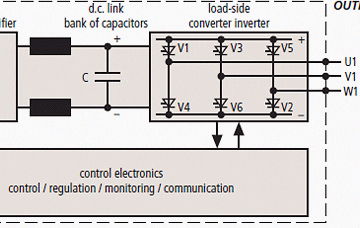
In principle a frequency converter consists of a rectifier, a d.c. link converter, an inverter and of the control electronics (Figure 1 above). At the input of the inverter the single phase or interlinked, three-phase a.c. voltage is changed into a… Read more
Nov 26, 2012 | By Edvard Csanyi
Electric Motor
Stator Overheating Protection
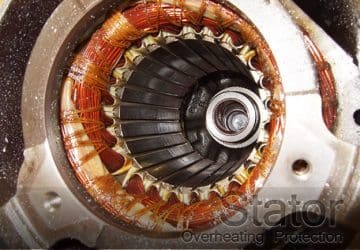
All motors need protection against overheating resulting from overload, stalled rotor, or unbalanced stator currents. For complete protection, three-phase motors should have an overload element in each phase. This is because an open circuit in the supply to the power… Read more
Nov 19, 2012 | By Edvard Csanyi
Electric Motor
Motors for Hazardous Areas
Electrical drives/motors that are operated in hazardous areas must be built and engineered so that they cannot become an ignition source. This applies not only to normal operating and starting, but also in case of faults, for example at stalled rotor. The… Read more
Nov 02, 2012 | By Edvard Csanyi

Electric Motor
LT / Medium / HT VFD Used In the Industry (1)
In modern plants, there are number of drives like Milling Plant Drive, Hydraulic Drive, DC Motor Drive and AC Motor Drive of adequate capacities are available. There is lot of scope for improving the overall efficiency and saving the energy… Read more
Sep 10, 2012 | By sprabakar22

