

Metering
Voltage Instrument Transformer (VT) – Introduction
Instrument transformers are primarily used to provide isolation between the main primary circuit and the secondary control and measuring devices. This isolation is achieved by magnetically coupling the two circuits. In addition to isolation, levels in magnitude are reduced to… Read more
Feb 20, 2012 | By Edvard Csanyi
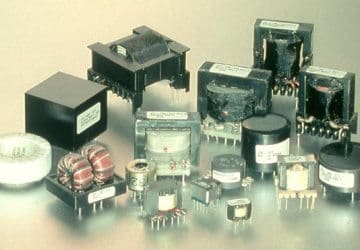
High Voltage
Protection Of Generators And Transformers
As Generators and transformers are major components of a power system, so it is quite necessary to take all the preventive measures for the protection of transformers and generators. These are the following ways (ANSI codes) we use to protect… Read more
Feb 11, 2012 | By Bipul Raman

Transformers
12 Main Classes Of Power Transformer
Transformers are used for a wide variety of purposes, with the complete range of voltage and power ratings as well as many special features for particular applications. The following covers the main types: Transformers for electronic circuits or for low-voltage… Read more
Jan 08, 2012 | By Edvard Csanyi
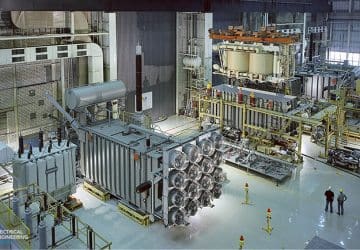
Transformers
Sources of Sound in Transformers
Unlike cooling-fan or pump noise, the sound radiated from a transformer is tonal in nature, consisting of even harmonics of the power frequency. It is generally recognized that the predominant source of transformer noise is the core. The low frequency,… Read more
Nov 09, 2011 | By Edvard Csanyi

Transformers
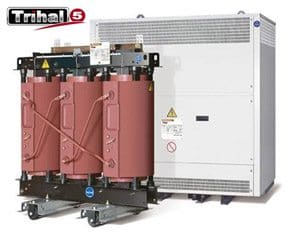
Forced ventilation cycles in Trihal transformers
Transformers, when in operation, are subject to no-load losses and load losses. This energy causes a rise in the temperature of the transformer’s active part, i.e. the magnetic core and the windings. It is therefore normal for the transformer to… Read more
Oct 22, 2011 | By Edvard Csanyi
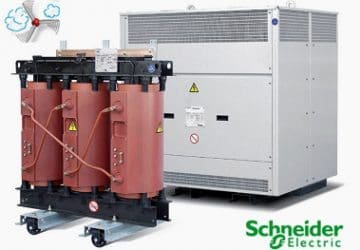
Energy and Power
Difference between Power Transformer and Distribution Transformer
Power transformers are used in transmission network of higher voltages for step-up and step down application (400 kV, 200 kV, 110 kV, 66 kV, 33kV) and are generally rated above 200MVA. On the other hand, distribution transformers are used for… Read more
Aug 27, 2011 | By Jignesh Parmar

Transformers
Life Cycle Cost of Transformers
To perform the economical analysis of transformer, it is necessary to calculate its life cycle cost, sometimes called total cost of ownership, over the life span of transformer or, in other words, the capitalised cost of the transformer. All these… Read more
Aug 06, 2011 | By Edvard Csanyi

Power Substation
Electrical substation introduction and elements
An power substation is a subsidiary station of an electricity generation, transmission and distribution system where voltage is transformed from high or medium to low or the reverse using transformers. Electric power flows through several substations between generating plant and… Read more
Apr 29, 2011 | By Edvard Csanyi
Transformers
What Are Partial Discharges On Cast Resin Transformers?
Partial discharges are electrical discharges occuring in insulating materials. The electrical discharge’s path only spans part of the insulating distance separating the conductors. The problem of partial discharges, whilst not existing in Low Voltage, is found in High and Very… Read more
Jan 17, 2011 | By Edvard Csanyi
Transformers
Parallel Operation Of Transformers
Most transformers installed in parallel have the same kVA, turn ratios, and impedances, which can make it difficult for power engineers in industrial and commercial facilities to understand circulating currents and load sharing. As systems change over time, and transformers… Read more
Jan 05, 2011 | By Edvard Csanyi
Medium Voltage
Aluminum vs. Copper: Conductors in Low Voltage Dry Type Transformers
In North America, aluminum is the predominant choice of winding material for low-voltage, dry-type transformers larger than 15 kilovolt-amperes(kVA). In most other areas of the world, copper is the predominant winding material. The primary reason for choosing aluminum windings is… Read more
Oct 27, 2010 | By Edvard Csanyi

