


Estimated Study Time: 21 minutes
Learn From Other Operator’s Mistakes
Operating an electrical substation leaves a zero margin for error. The critical mistakes operators make, from bypassing interlocks and improper grounding to rushing and ignoring PPE — rarely stem from a lack of skill. Instead, they represent breakdowns in procedure, communication, and human psychology under stress.
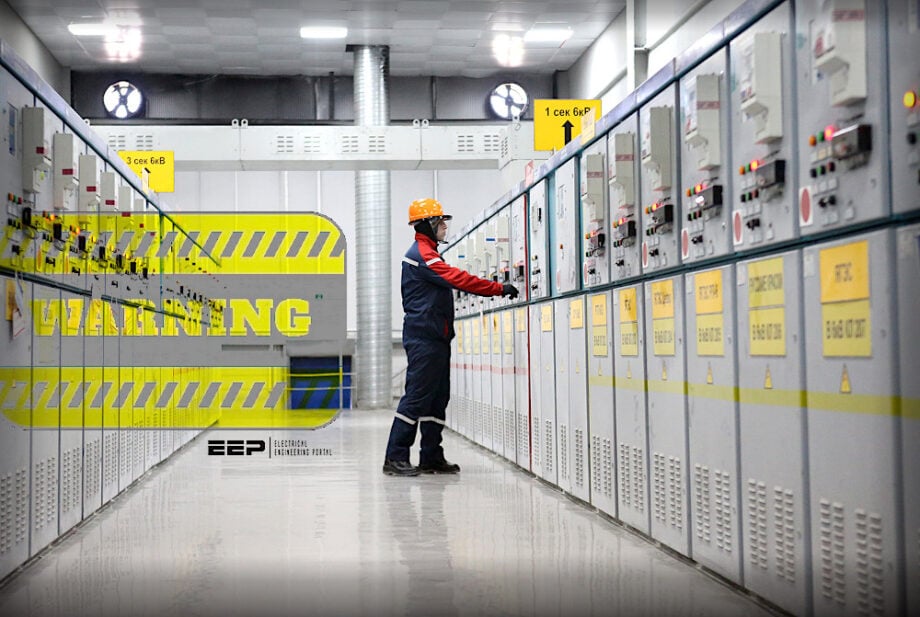 The Biggest Mistakes Substation Operators Make
Preventing these potentially fatal errors requires more than advanced technology; it demands a deeply ingrained safety culture. Utilities must enforce strict adherence to protocols, prioritize continuous training, and empower every operator to stop work if a situation feels unsafe. In the high-voltage environment of a substation, unwavering patience and strict procedure are the ultimate lifesavers.
Operating a substation requires a deep understanding of electrical systems, a rigorous commitment to safety protocols, and an unwavering attention to detail.
While technological advancements like Supervisory Control and Data Acquisition (SCADA) systems and advanced relays have improved safety and reliability, the human element remains the most unpredictable variable.
This technical article explores the biggest, most consequential mistakes that substation operators make, analyzing the technical reasons behind these errors and the protocols designed to prevent them.
- Bypassing or Defeating Interlocks (Mechanical and Electrical)
- Inadequate Verification of Isolation (Failure to Prove Dead)
- Improper Grounding Practices
- Miscommunication During Switching Operations
- Over-Reliance on SCADA and Neglecting Visual Inspections
- Rushing During Emergency Restoration (The “Hero” Complex)
- Failing to Respect Arc Flash Boundaries and PPE Requirements
- Misinterpreting Relay Targets and Alarms
- Conclusion
- BONUS (PDF)! 🔗 Relay Protection Book – Theory and Applications
1. Bypassing or Defeating Interlocks (Mechanical and Electrical)
One of the most dangerous and common mistakes an operator can make is deliberately or accidentally bypassing interlocks. Substations are designed with a series of mechanical (e.g., Kirk Key systems) and electrical interlocks.
These systems are meant to prevent out-of-sequence switching operations that could lead to catastrophic failures.
The Technical Danger
The classic example is attempting to open a disconnect switch while the circuit is still under load. Circuit breakers are designed to interrupt fault currents and load currents; they have specialized mechanisms (like SF6 gas, vacuum bottles, or oil) to quench the massive electrical arc that forms when contacts separate.
Disconnect switches, however, are essentially giant metal blades. They are designed ONLY to provide visual isolation once the current has already been interrupted by the breaker.
The resulting arc flash can destroy the switchgear and instantly vaporize nearby metals, posing a lethal threat to the operator.
The Root Cause
Operators usually bypass interlocks out of a misplaced desire for efficiency or because they believe the interlock is malfunctioning. In older substations, mechanical linkages can become stiff or misaligned due to weather or lack of maintenance, tempting operators to force the mechanism or override the logic to “get the job done“.
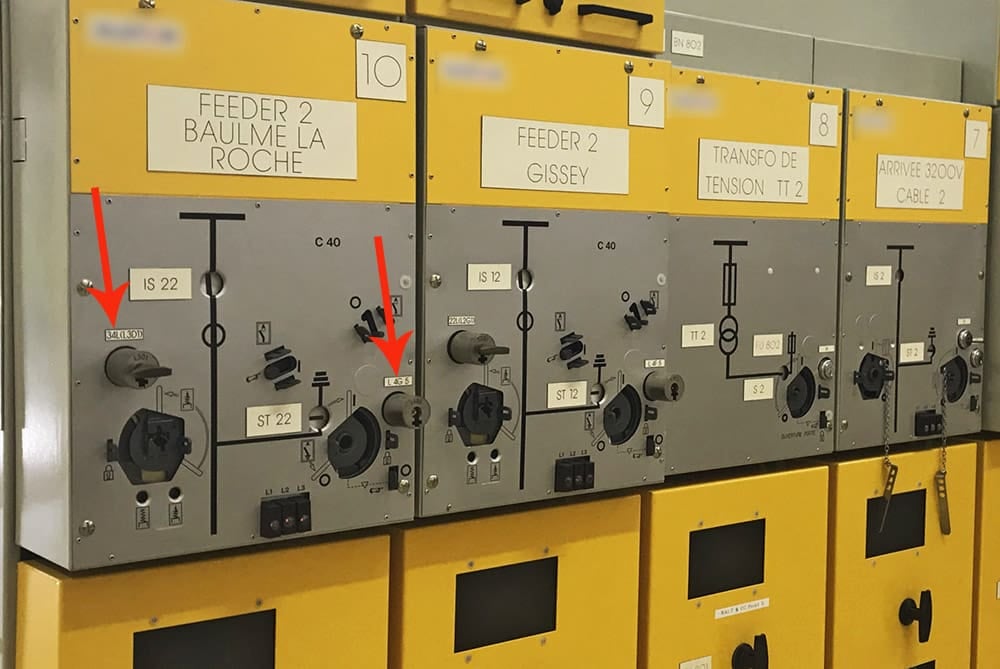
An example is a Kirk Key interlock system on a high-voltage disconnect switch.
Figure 1 – Locking Mechanism for Feeder Disconnector and Earthing Switch in Open or Closed Positions
2. Inadequate Verification of Isolation (Failure to Prove Dead)
The golden rule of electrical work is: “It is not dead until it is proven dead.” Failing to properly verify that a circuit is de-energized before applying grounds or beginning work is a lethal mistake.
The Technical Danger
Operators often assume that because they opened a breaker and a disconnect switch, the line is safe to touch. However, substations are subject to complex electrical phenomena. Even if a line is physically disconnected from its primary source, it can still hold a lethal charge due to:
Capacitive Coupling: High-voltage lines running parallel to each other act like the plates of a giant capacitor. A live line can induce a deadly voltage on an adjacent, physically isolated line.
Backfeeding: Voltage can flow backwards through distribution transformers if a generator (even a small residential solar setup or backup generator) is improperly connected to the grid.
Trapped Charge: Highly capacitive equipment, like capacitor banks or long underground cables, can hold a DC charge for hours or days after being disconnected.
The Correct Protocol
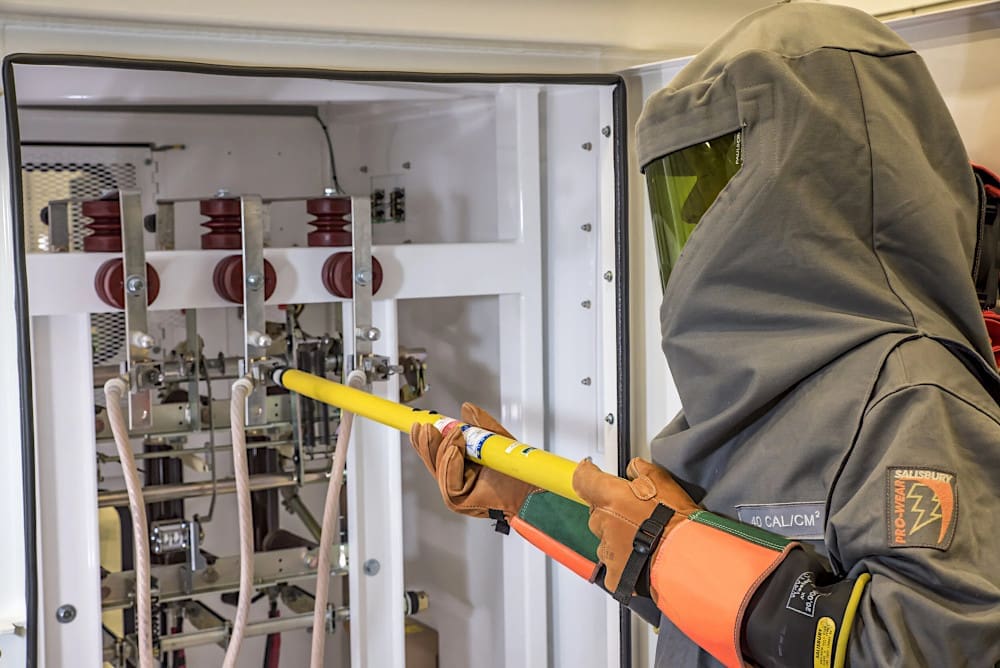
Operators must use a high-voltage detector (often mounted on a hot stick) using the “Live-Dead-Live” test.
- Test the detector on a known live source to ensure it is working.
- Test the isolated line to prove it is dead.
- Test the detector on the known live source again to ensure it didn’t break during step 2.
Skipping any part of this verification process is a critical failure in human performance.
Figure 2 – A substation operator in full arc-flash PPE using a hot stick and high-voltage detector to test a busbar
3. Improper Grounding Practices
Once a line is proven dead, it must be grounded before any maintenance can occur. Grounding mistakes are frequent and varied, ranging from applying grounds in the wrong sequence to forgetting to remove them before re-energizing the system.
The Technical Danger
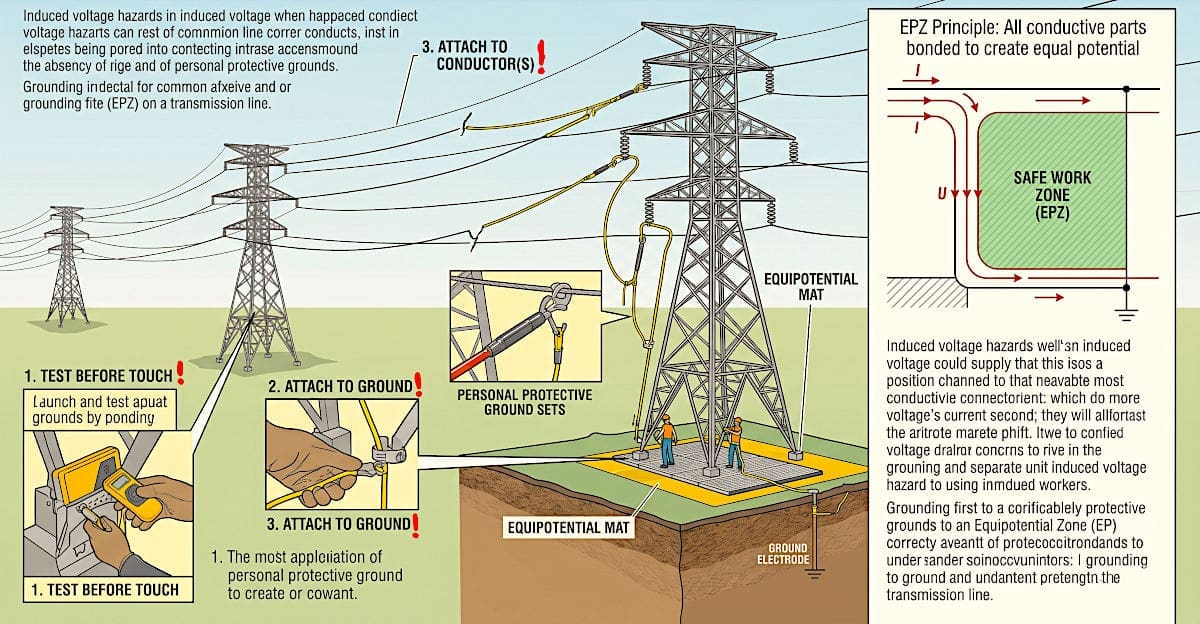
The purpose of personal protective grounding is to create an Equipotential Zone (EPZ). If a line is accidentally re-energized (e.g., by a lightning strike, induced voltage, or switching error), the grounding cables provide a near-zero-resistance path to earth, causing the circuit breakers to trip instantly and preventing the voltage across the worker’s body from reaching a lethal threshold.
Common grounding mistakes include:
Wrong Sequence: The cardinal rule of applying grounds is “Ground first, phase second.” The clamp must be firmly attached to the substation ground grid before the other end is attached to the phase conductor.
Inadequate Grounding Cables: Using cables with insufficient current-carrying capacity for the substation’s available fault current. If a fault occurs, an undersized ground cable will melt and whip violently, destroying the EPZ.
Leaving Grounds Attached: Forgetting to remove grounding cables before closing the disconnects and breakers. When the system is re-energized, this creates an immediate, massive short circuit, resulting in severe equipment damage and grid instability.
Figure 3 – The correct application of personal protective grounds to create an Equipotential Zone (EPZ) on a transmission line (click to zoom)
4. Miscommunication During Switching Operations
Substation switching rarely happens in a vacuum. It requires tight coordination between the field operator physically in the substation and the system dispatcher or control center operator monitoring the wider grid.
Breakdowns in this communication loop are a leading cause of switching errors.
The Technical Danger
Switching errors—such as opening the wrong breaker, shedding load inadvertently, or re-energizing a line where a crew is working—often stem from simple misunderstandings. Substations are noisy environments, and operators often communicate via radio or cell phone.
Mistakes happen when:
Non-Standard Terminology is Used: Referring to a breaker by a colloquial name rather than its specific operational designation (e.g., saying “Open the main breaker” instead of “Open 115kV Breaker 52-A”).
Failure to Use Three-Way Communication: In a high-reliability environment, the dispatcher must issue the command, the operator must repeat the command verbatim, and the dispatcher must confirm the repetition is correct before any action is taken. Failing to execute this loop allows assumptions to override facts.
Confirmation Bias: An operator expects to be told to open Breaker A, so when the dispatcher says “Open Breaker B,” the operator’s brain hears “Breaker A” and executes the wrong action.
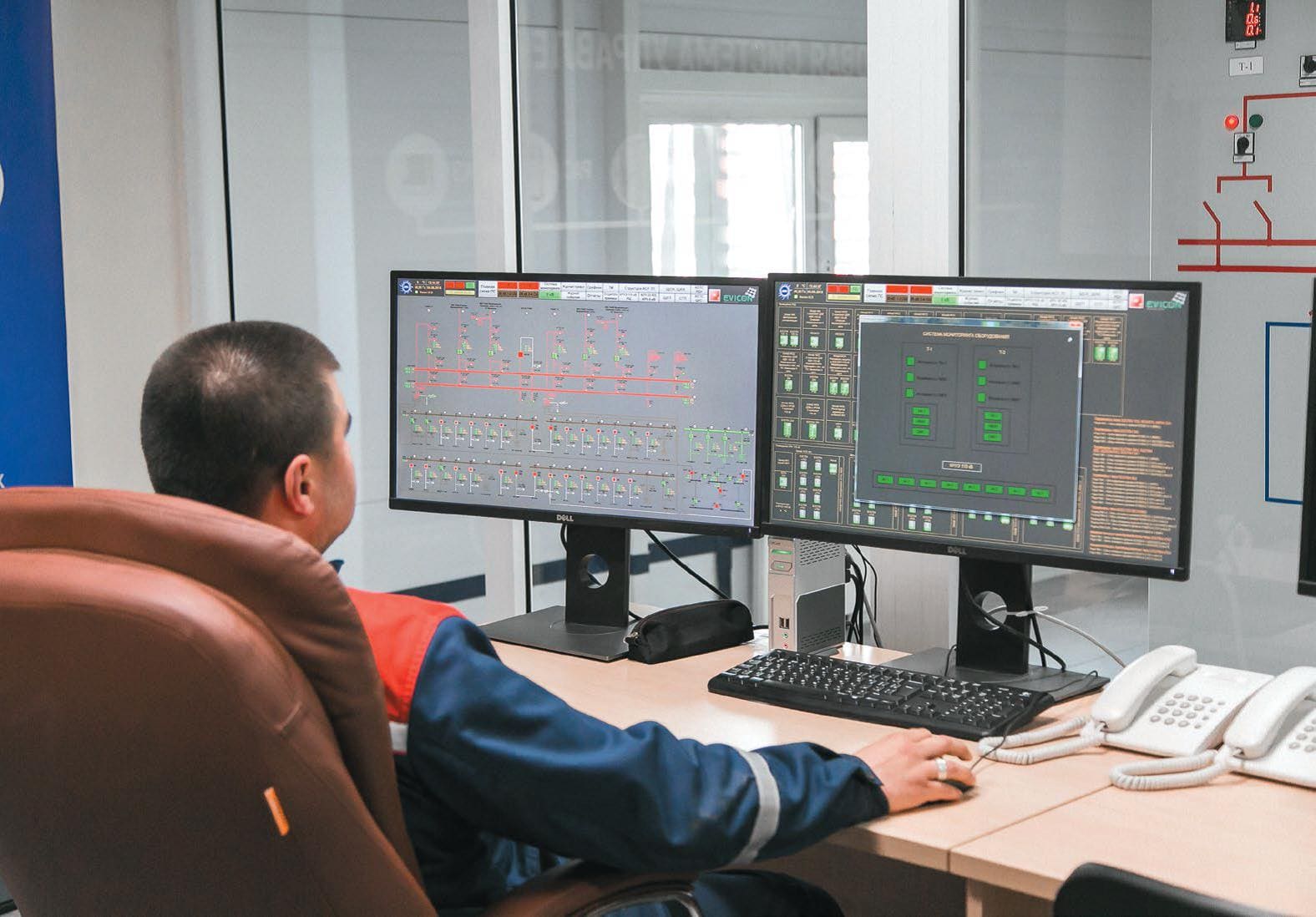
Figure 4 – A control room operator at a multi-screen SCADA console, representing the other end of the communication line with the field operator
5. Over-Reliance on SCADA and Neglecting Visual Inspections
SCADA (Supervisory Control and Data Acquisition) systems provide incredible visibility into the state of the grid. However, operators make a massive mistake when they treat the SCADA screen as absolute truth, neglecting physical, visual verification.
The Technical Danger
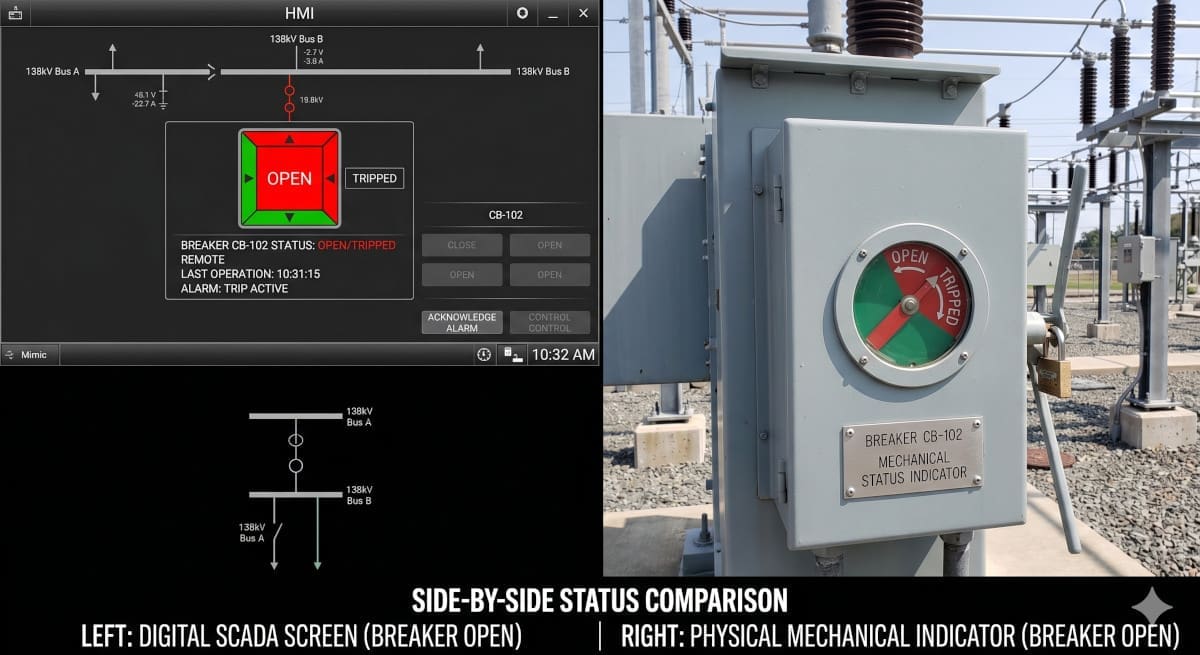
SCADA systems rely on transducers, microswitches, and communication networks. These components can fail. A microswitch on a circuit breaker might stick, sending a signal to SCADA that the breaker is “OPEN” when mechanically, the contacts are still welded shut.
If an operator trusts the SCADA screen without walking out to the switchyard to verify the mechanical target or visually confirm that the physical blades of a disconnect switch are fully separated, they could walk into a death trap.
Relying solely on digital dashboards strips the operator of their most valuable diagnostic tools: their own senses.
Figure 5 – A side-by-side comparison image: on the left, a digital SCADA screen showing a breaker status; on the right, the physical mechanical indicator on the actual breaker in the yard
6. Rushing During Emergency Restoration (The “Hero” Complex)
When a storm hits or a major fault occurs, plunging thousands of customers into darkness, the pressure on substation operators is immense. Utilities face heavy fines for prolonged outages, and public pressure mounts by the minute.
Under this stress, operators often fall victim to the “hero complex,” rushing to restore power.
The Technical Danger
Stress and adrenaline severely impair cognitive function, leading to a phenomenon known as “tunnel vision.” Operators rushing to close breakers might skip critical steps in the switching program, fail to wear proper PPE, or ignore warning alarms.
During fault restoration, an operator might repeatedly try to close a breaker into a fault (a practice sometimes called “banging the line”) without investigating the cause of the initial trip.
The safest, fastest way to restore power is methodically. Incorporating Human Performance Improvement (HPI) tools like STAR (Stop, Think, Act, Review) is essential to counteract the dangerous impulse to rush.
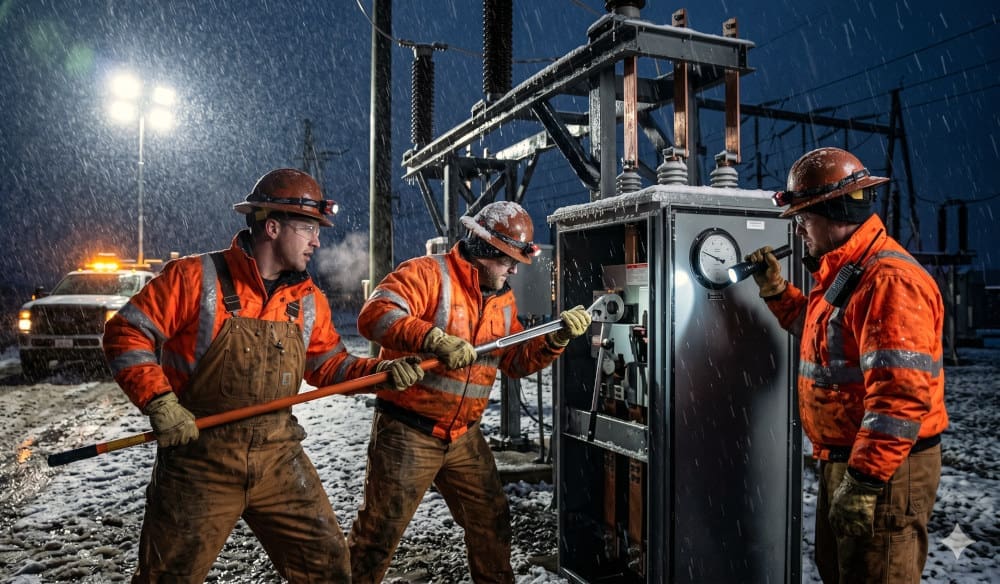
Figure 6 – A substation at night under heavy rain illustrating the harsh and stressful conditions operators face during emergency restorations
7. Failing to Respect Arc Flash Boundaries and PPE Requirements
Familiarity breeds contempt. Operators who have spent decades in substations without incident often become complacent regarding Personal Protective Equipment (PPE) and arc flash boundaries.
The Technical Danger
An arc flash is an explosive release of energy caused by an electrical arc. The temperatures can reach 35,000°F (19,400°C)—hotter than the surface of the sun. This heat instantly vaporizes copper and aluminum conductors, expanding their volume by up to 67,000 times, creating a concussive blast wave that can throw operators across a room, rupture eardrums, and collapse lungs.
Mistakes include:
Improper Dress: Wearing non-arc-rated clothing (like synthetic fibers that will melt into the skin) or failing to button up FR (Flame Resistant) shirts fully.
Leaving the Face Shield Up: An operator might wear the correct suit but leave the arc-flash hood or face shield lifted because it is hot or fogs up their vision. If a flash occurs, their face and airway take the full brunt of the thermal energy.
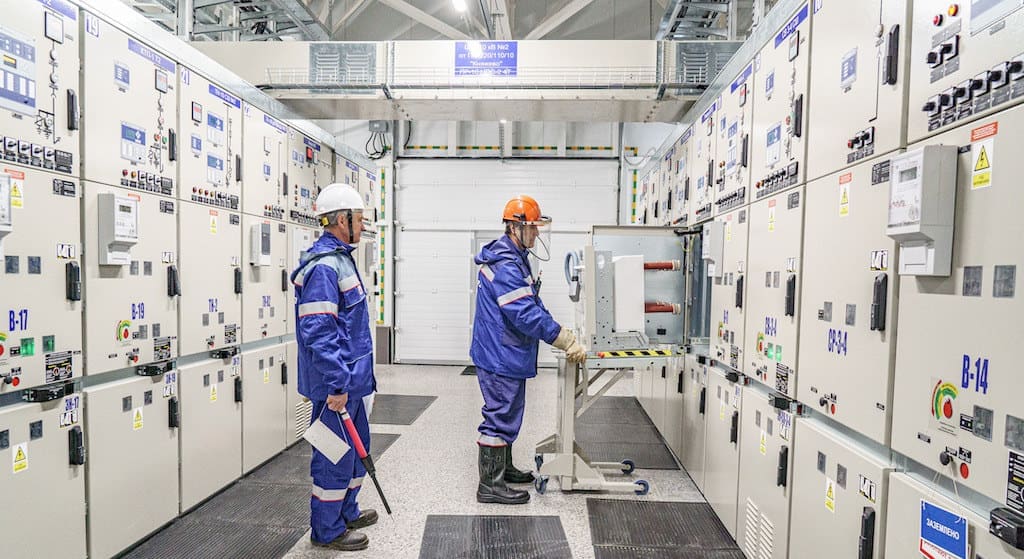
Standing in the “Line of Fire”: When manually racking in a breaker or operating a switch handle, operators often stand directly in front of the equipment. If the equipment fails catastrophically upon operation, the door will blow off directly into the operator. Proper practice involves standing to the side, utilizing remote racking devices where possible, and keeping the body out of the blast trajectory.
Figure 7 – A worker fully outfitted in a Category 4 Arc Flash suit (flash hood, face shield, heavy FR suit, and insulated gloves) racking MV circuit breaker
8. Misinterpreting Relay Targets and Alarms
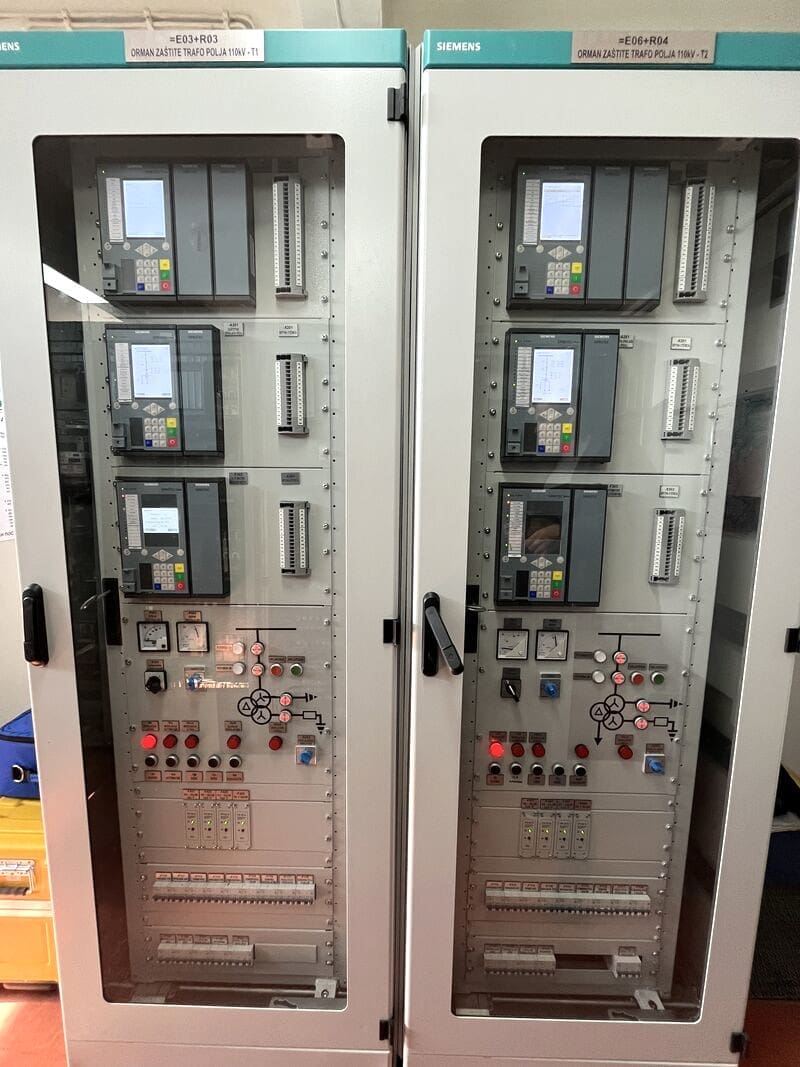
Protective relays are the “brains” of the substation. When a fault occurs, relays detect the anomaly and command the breakers to trip. Modern digital relays provide an overwhelming amount of data regarding the nature of the fault.
The Technical Danger
A common mistake operators make is resetting relay targets (alarms) without fully understanding or documenting them. If a line trips on a differential relay target (indicating a fault within the substation zone itself) and the operator misinterprets it as an overcurrent target (indicating a fault out on the transmission line), they might attempt to re-energize the bus.
Closing a breaker onto a solid bus fault will result in immediate, severe damage to the substation infrastructure.
Ignoring an SF6 low-gas pressure alarm before operating a breaker, for example, means operating a device that has lost its arc-quenching medium, guaranteeing an explosion.
Figure 8 – A close-up of a modern microprocessor-based protective relay panel inside a substation control house, showing various LEDs and a digital display screen
9. Conclusion
The operation of an electrical substation is an unforgiving profession where the margin for error is effectively zero. The mistakes outlined above—bypassing interlocks, failing to prove dead, improper grounding, miscommunication, over-reliance on SCADA, rushing, ignoring PPE, and misinterpreting data—are rarely the result of a lack of intelligence.
More often, they are failures of procedure, communication, and human psychology in high-stress or highly routine environments.
In the high-voltage labyrinth of a substation, procedure and patience are the ultimate lifesavers.
Recommended Course -Phasing in Power Substations: Principles, Techniques, and Real-World Applications
10. Relay Protection Book – Theory and Applications
Download: Relay Protection Book – Theory and Applications (for premium members only):
Related electrical guides & articles


Edvard Csanyi
Hi, I'm an electrical engineer, programmer and founder of EEP - Electrical Engineering Portal. I worked twelve years at Schneider Electric in the position of technical support for low- and medium-voltage projects and the design of busbar trunking systems.I'm highly specialized in the design of LV/MV switchgear and low-voltage, high-power busbar trunking (<6300A) in substations, commercial buildings and industry facilities. I'm also a professional in AutoCAD programming.
Profile: Edvard Csanyi