


Estimated Study Time: 32 minutes
Get Used to Digital Substations
The transition from conventional electrical substations to fully digital substations represents one of the most profound technological shifts in the power delivery industry. By replacing miles of copper wiring with fiber optic cables and utilizing the IEC 61850 standard for communication, utilities can achieve smaller physical footprints, enhanced safety (by removing dangerous high-energy analog signals from the control house), and unprecedented levels of system diagnostics.
 The Curse of a Digital Substation: So Advanced and Fragile
However, this transition is not merely a hardware upgrade; it is a fundamental shift in how protection, automation, and control (PAC) systems operate. The migration from hardwired analog logic to highly synchronized, packet-based local area networks (LANs) introduces a new frontier of engineering challenges.
In medium and high-voltage applications, digital relay units represent a fundamental shift in how protection and control are handled. Unlike conventional substations that rely on kilometers of heavy copper wiring carrying analog signals directly from current and voltage transformers to the control house, digital substations utilize the IEC 61850 standard.
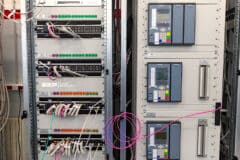
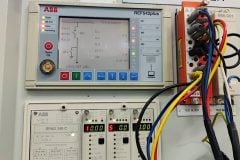
Out in the switchyard, Merging Units (MUs) digitize the analog measurements from the primary equipment. These digitized values, known as Sampled Values (SV), are then transmitted over fiber-optic cables—the Process Bus—directly to the digital relays shown in the picture.
To better illustrate how these components interact during a system event, I’ve created an interactive visualization of the IEC 61850 communication flow.
Figure 1 – Visualization of the IEC 61850 communication flow
When a power substation transitions from hardwired copper analog signals to a fully digital architecture, the fundamental nature of its vulnerabilities shifts. You are no longer just protecting physical switchgear from environmental hazards; you are protecting the logical network pathways that command that switchgear.
By converging IT networks with OT environments, standard IT cyber threats—like ransomware, credential theft, and hypervisor exploits—suddenly gain the potential to cause kinetic, physical damage to the power grid.
Below is an in-depth technical analysis of the ten biggest problems and challenges currently facing the deployment and operation of digital substations.
- Cybersecurity Vulnerabilities and the IT/OT Convergence
- Extreme Dependency on Precision Time Synchronization:
- Network Traffic Management and Broadcast Storms:
- The Myth of Seamless Interoperability
- Immense Engineering and Configuration Complexity
- The Hardware Lifecycle Mismatch
- Environmental Degradation of Outdoor Electronics
- The Critical IT/OT Skills Gap
- Firmware Management and Version Control
- The Complexity of Redundancy Protocols (PRP and HSR)
- Conclusion
- Attachment (PDF) 🔗 Download ‘Field Guide to Operation and Maintenance of High Voltage Circuit Breakers’
1. Cybersecurity Vulnerabilities and the IT/OT Convergence
In a conventional substation, protection relays are hardwired and physically isolated. In a digital substation utilizing an IEC 61850 Process Bus, critical tripping commands and voltage/current measurements are converted into ethernet packets, specifically:
- Generic Object Oriented Substation Event (GOOSE) messages and
- Sampled Values (SV).
The introduction of Ethernet-based routable and non-routable protocols expands the attack surface significantly. While GOOSE and SV messages operate at OSI Layer 2 (MAC level) and are not inherently routable across the wider internet, the convergence of IT/OT networks means that a compromised station bus or gateway could allow lateral movement into the process bus.
This makes the system theoretically vulnerable to internal Man-in-the-Middle (MitM) attacks or rogue packet injection if an attacker gains physical or network access.
Figure 2, 3, 4 and 5 depict a network topology diagram highlighting the IT/OT boundary, showing the Station Bus (IEC 61850-8-1), the Process Bus (IEC 61850-9-2), and the points of vulnerability where external intrusion or rogue devices could inject malicious GOOSE/SV packets.
Let’s take a look at an interactive simulation demonstrating the digital substation network architecture and specific points of vulnerability for malicious packet injection.
1.1 Vulnerability Points and Malicious Packet Injection
Understanding where unauthorized access or malicious activities can occur is vital for substation security. Here are key points of vulnerability:
1.1.1 IT/OT Boundary (Lateral Movement):
External Intrusion: An attacker compromises the corporate IT network and leverages weaknesses in firewall configurations, VPNs, or outdated software at the gateway to gain access to the substation Station Bus.
Lateral Movement: From a compromised gateway or HMI on the Station Bus, attackers can move across the network, potentially finding routes to other IEDs or even to network devices that bridge to the Process Bus.
Figure 2 – External Intrusion: Boundary breach: Lateral movement from IT network
1.1.2 Station Bus (Internal Rogues & Intrusion):
Rogue Device Injection: A malicious actor (insider threat or external intruder with physical access) could physically connect an unauthorized device (e.g., a laptop, rogue IED, or network tap) directly to a Station Bus switch port.
This device could then capture sensitive communication, inject malicious MMS commands, or, more critically, launch a GOOSE Injection attack.
Compromised IED/HMI: An existing IED, HMI, or workstation on the Station Bus could be compromised, acting as a base for internal network sniffing and attacks, including packet injection.
Figure 3 – Malicious unauthorized GOOSE message detected on Station Bus
1.1.3 Process Bus (Critical Injection Points)
Compromised Merging Unit/Rogue MU: If an attacker can compromise a legitimate Merging Unit or somehow connect a rogue device that masquerades as an MU, they could execute SV Manipulation attacks.
By injecting falsified Sampled Values (representing incorrect voltage or current readings), they could manipulate protection IEDs to misinterpret power system conditions and operate incorrectly (e.g., false trip on non-existent overcurrent).
Compromised Process Bus Switch: Similar to the Station Bus, a compromised switch in the Process Bus or physical access to Process Bus ports allows for traffic monitoring and the injection of rogue packets, specifically malicious GOOSE messages for critical primary equipment control (e.g., open breaker command) or the injection of false SV streams.
Physical access points in the switchyard (remote kiosks, etc.) are particularly vulnerable if not properly secured physically.
Figure 4 – Compromised Process Bus switch injecting trip commands
1.1.4 Process Bus Switches / Bridges (Lateral Movement into Process Bus)
Bridging Vulnerabilities: While the Station and Process Buses should be logically (and often physically) separate, vulnerabilities in switches or bridge devices that are improperly configured or possess backdoors/exploitable flaws could allow an attacker on the Station Bus to cross into the highly sensitive Process Bus.
From there, they could execute critical control commands or falsify vital measurement data.
To help visualize this, here is the visualization of demonstrating the digital substation network architecture and specific points of vulnerability for malicious packet injection.
Figure 5 – False SV Injection: Sampled Value spoofing detected from Merging Unit
2. Extreme Dependency on Precision Time Synchronization
Unlike conventional systems that measure analog waveforms continuously, digital substations rely on Non-Conventional Instrument Transformers (NCITs) and Stand Alone Merging Units (SAMUs) to digitize waveforms at the primary equipment. These devices stream Sampled Values (SV) to Intelligent Electronic Devices (IEDs) in the control room.
For differential protection algorithms to function correctly, the SV streams from multiple merging units must be perfectly time-aligned. If the samples from the incoming line and the outgoing line are out of phase due to a clocking error, the relay will calculate a false differential current and trip the breaker.
Related electrical guides & articles




Edvard Csanyi
Hi, I'm an electrical engineer, programmer and founder of EEP - Electrical Engineering Portal. I worked twelve years at Schneider Electric in the position of technical support for low- and medium-voltage projects and the design of busbar trunking systems.I'm highly specialized in the design of LV/MV switchgear and low-voltage, high-power busbar trunking (<6300A) in substations, commercial buildings and industry facilities. I'm also a professional in AutoCAD programming.
Profile: Edvard Csanyi