


Estimated Study Time: 39 minutes
Power Engineering Languages
This technical review analyzes the core programming languages, hardware description languages, and configuration syntaxes utilized in contemporary power engineering. Emphasis is placed on their application in Intelligent Electronic Devices (IEDs), Supervisory Control and Data Acquisition (SCADA) systems, and digital substation architectures operating under the IEC 61850 standard.
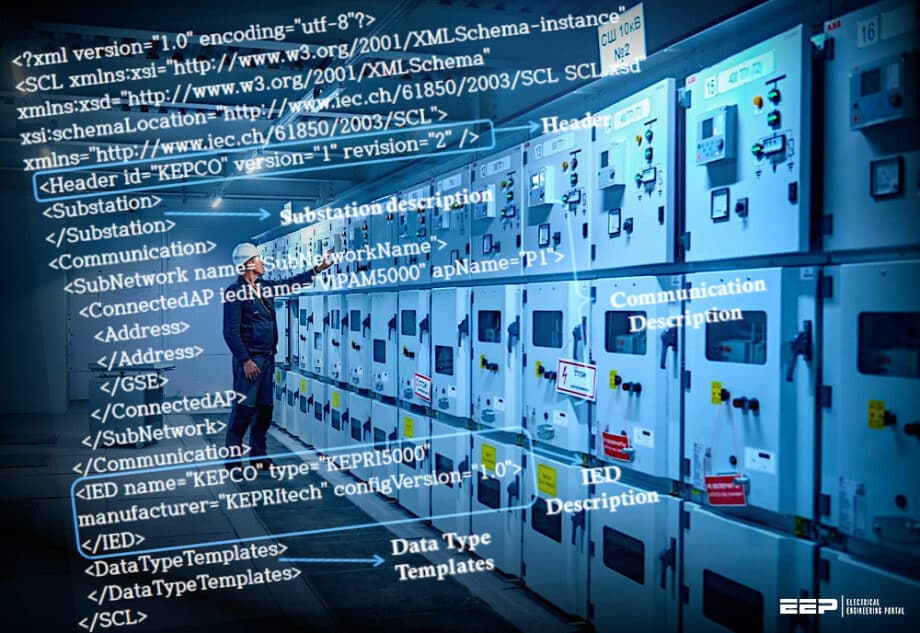 Top Programming Languages in Power Engineering Worth Learning
The modernization of electrical power systems and substation automation relies entirely on rigorous software engineering principles and the strategic deployment of specialized programming languages. From the deterministic, real-time execution required for high-voltage protection algorithms to the object-oriented data models governing grid interoperability, specific computational syntaxes serve highly distinct functions.
The analysis encompasses C/C++, IEC 61131-3 standards, MATLAB/Simulink, Substation Configuration Language (SCL), Hardware Description Languages (VHDL/Verilog), Python, and enterprise-level object-oriented languages (C#/Java).
Grab a coffee, settle in, and let’s get started!
- Introduction
- C and C++: Real-Time Determinism and Embedded Systems:
- IEC 61131-3 Languages: Industrial Control Standardization:
- MATLAB and Simulink: System Modeling and Algorithm Synthesis:
- SCL / XML: The Architecture of Digital Substations (IEC 61850):
- VHDL and Verilog: Hardware Acceleration for Critical Latency:
- Python: Data Analytics, Automation, and Testing Protocols:
- C# and Java: SCADA Backend and Enterprise Integration:
- Conclusion
- Attachment (PDF) 🔗 Download Book: MATLAB and Simulink in Power Engineering: Principles and Simulations
1. Introduction
The operational paradigm of modern power engineering has shifted from purely electromechanical mechanisms to highly integrated, microprocessor-based digital control architectures. This transition demands a comprehensive understanding of the software ecosystems that dictate system behavior, ensure grid stability, and execute protection
protocols.
The functionality of a modern power grid is determined by the algorithmic implementation within its constituent devices, ranging from low-level logical controllers to advanced supervisory platforms.
Protection relays require microsecond execution deterministic loops, necessitating low-level languages. Substation configuration requires standardized markup syntaxes for interoperability. Data analytics and automated testing protocols benefit from high-level, dynamically typed scripting languages.
This study provides an academic examination of these programming environments, delineating their structural advantages and specific use cases within power engineering and automation.
2. C and C++: Real-Time Determinism and Embedded Systems
In the domain of power systems protection and control, C and C++ remain the foundational languages for embedded software development. The fundamental requirement of an Intelligent Electronic Device (IED) or a digital protection relay is absolute determinism.
When a fault occurs on a high-voltage transmission line, the protection algorithm—such as differential protection (ANSI 87) or distance protection (ANSI 21)—must execute within strict temporal parameters, often measured in milliseconds or microseconds.
C provides direct memory access, precise control over hardware registers, and minimal abstraction overhead, which is critical for Real-Time Operating Systems (RTOS) like VxWorks or FreeRTOS utilized in IEDs.
C++ introduces object-oriented paradigms, allowing for the modularization of complex protection logic and communication stacks without significantly compromising execution speed.
Figure 1 – Architectural abstraction of C/C++ execution within an embedded Real-Time Operating System (RTOS) environment
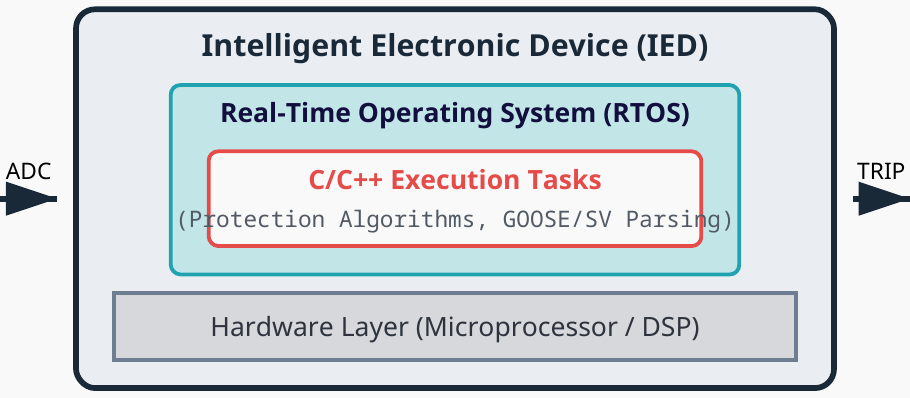
The processing of Generic Object Oriented Substation Event (GOOSE) messages and Sampled Values (SV) streams in a digital substation operates at the Data Link Layer (Layer 2) of the OSI model. Parsing these Ethernet frames with maximum efficiency requires the low-level pointer manipulation and bitwise operations inherent to C.
The implementation of redundancy protocols, such as Parallel Redundancy Protocol (PRP) and High-availability Seamless Redundancy (HSR), which require continuous duplication and discarding of frames with zero recovery time, is exclusively programmed in C or C++ to meet processing constraints.
Furthermore, DSP (Digital Signal Processing) algorithms utilized for power quality monitoring, such as Fast Fourier Transforms (FFT) to calculate harmonic distortion, are typically implemented in highly optimized C code to run continuously on specialized microprocessors within the IED.
2.1 What is the Best way to Learn C and C++?
Begin by mastering raw C, focusing intensely on pointers and bitwise operations to directly manipulate data at the hardware register level. Transition next to programming a bare-metal ARM Cortex microcontroller to understand interrupt service routines and hardware peripherals without any operating system interference.
Once comfortable, integrate a Real-Time Operating System (RTOS) like FreeRTOS to master strict task scheduling and priority preemption, which are the true foundations of deterministic execution.
Evolve your architecture by adopting “zero-cost abstraction” C++, utilizing classes and compile-time polymorphism while strictly avoiding dynamic memory allocation to prevent execution latency.
2.2 Useful Links and Books
Here are the direct links to the best resources:
1. Mastering Raw C and Hardware Interaction
Book: “Test-Driven Development for Embedded C” by James W. Grenning.
Link: Pragmatic Bookshelf – Test-Driven Development for Embedded C
Book: “Understanding and Using C Pointers: Core Techniques for Memory Management” by Richard M. Reese.
Link: Google Books – Understanding and Using C Pointers
2. Bare-Metal Microcontroller Architecture (ARM Cortex)
Video Courses: FastBit Embedded Brain Academy (by Kiran Nayak).
Link: FastBit EBA Official Site
3. Real-Time Operating Systems (RTOS) and Determinism
Official PDF Book: “Mastering the FreeRTOS Real Time Kernel – A Hands-On Tutorial Guide”
Link: FreeRTOS Official Books and Manuals Page (You can download the latest PDF version for offline reading directly from this page).
4. Hardware Specific to Power Electronics
Texas Instruments C2000 Microcontrollers:
Link: TI C2000 Real-Time Control MCUs (Check the “Technical Documentation” and “Application Notes” sections for practical implementations of grid-focused DSP logic).
Good Reading – Brainstorming the 24kV Switchgear Schematics
Brainstorming the 24kV Switchgear Schematics (Secondary Wiring and Automation)
3. IEC 61131-3 Languages: Industrial Control Standardization
While embedded devices rely on C/C++, broader automation logic, particularly for auxiliary systems, relies on the IEC 61131-3 standard. This standard defines the programming syntaxes for Programmable Logic Controllers (PLCs) and Programmable Automation Controllers (PACs), which manage cooling systems, tap changer operations, interlocking logic, and overall plant automation.
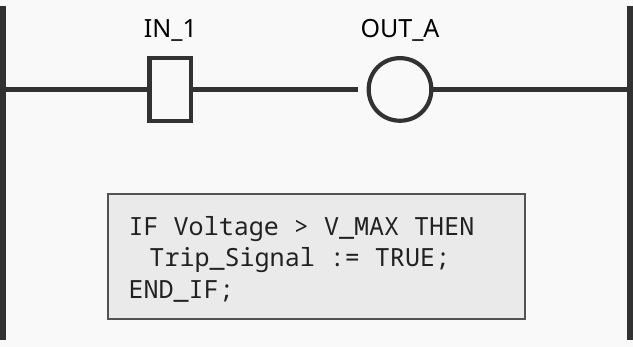
The standard specifies five languages, but two are predominantly utilized in power engineering: Structured Text (ST) and Ladder Diagram (LD). The paradigm of PLC programming is characterized by cyclic execution; the controller reads inputs, executes the programmed logic, and writes outputs in a continuous loop.
This guarantees a predetermined response time, essential for industrial stability.
Figure 2 – Representation of IEC 61131-3 logic, contrasting visual Ladder Diagram structures with Structured Text (ST)
3.1 Structured Text (ST)
Structured Text is a high-level, block-structured programming language syntactically similar to Pascal.
It is particularly effective for implementing complex mathematical algorithms, data manipulation, and conditional branching that would be cumbersome in graphical languages. In power automation, ST is heavily utilized for regulating algorithms (such as PID controllers for synchronous generator excitation systems) and complex state machines governing automated switching sequences.
3.2 Continuous Function Chart (CFC) and Function Block Diagram (FBD)
Graphical representations like FBD and CFC allow control engineers to visually link standardized functions (timers, counters, logic gates) and complex pre-programmed blocks.
This visual representation aligns closely with traditional engineering schematics, facilitating code review and maintenance by personnel who may not possess formal software engineering backgrounds.
3.3 What is the Best way to Learn IEC 61131-3 Languages?
The best way to learn the IEC 61131-3 languages is to start by grasping the fundamental concepts of cyclic execution and the physical architecture of Programmable Logic Controllers (PLCs) before diving into specific code syntaxes.
You should initially focus on Ladder Diagram (LD) to understand traditional, visual relay logic, and then transition to Structured Text (ST) for handling the complex mathematical algorithms and state machines common in modern automation.
Finally, apply your knowledge to real-world power engineering scenarios by programming simulated sequences for equipment like tap changers, interlocking logic, or cooling systems.
3.4 Useful Links and Books
1. Essential Books:
“PLC Controls with Structured Text (ST)” by Tom Mejer Antonsen: This is widely considered the best modern textbook specifically focused on mastering Structured Text and best practices within the IEC 61131-3 standard. (Apple Books Link)
“IEC 61131-3: Programming Industrial Automation Systems” by Karl-Heinz John and Michael Tiegelkamp: This is the definitive, comprehensive guide to the concepts, syntax, and semantics of all the languages defined by the standard. (Springer Link)
2. Software & Practice Platforms:
CODESYS Development System: The industry standard, free-to-download software that provides an integrated development environment (IDE) for all five IEC 61131-3 languages, complete with a built-in SoftPLC simulator. (CODESYS Official Site)
RealPars: An excellent online learning platform that offers highly practical, video-based courses on PLC programming, including specific paths for CODESYS and Structured Text. (RealPars Official Site)
Good Reading – Biggest Mistakes in Analyzing Modern Substation Schematics
4. MATLAB and Simulink: System Modeling and Algorithm Synthesis
Before any C code is deployed to a protection relay, the underlying algorithms must be rigorously modeled, simulated, and validated. MATLAB, coupled with its graphical simulation environment Simulink (and specialized toolboxes like Simscape Electrical), constitutes the primary computational environment for power system analysis and algorithmic synthesis.
The mathematical language of MATLAB is optimized for matrix operations, which are fundamental to power flow analysis, short-circuit calculations, and transient stability studies.
Engineers utilize MATLAB to model the entire power network, including generation units, transmission lines, power transformers, and nonlinear loads.
In the context of automation, Simulink enables Model-Based Design (MBD). Protection engineers can construct block diagrams of novel protection algorithms and subject them to simulated fault conditions (e.g., single-line-to-ground faults, inter-turn transformer faults).
Furthermore, MATLAB environments are instrumental in Hardware-in-the-Loop (HIL) testing, where a real-time simulator (such as an RTDS or OPAL-RT system) executes the power system model while interfaced with physical IED hardware.
Related electrical guides & articles





Edvard Csanyi
Hi, I'm an electrical engineer, programmer and founder of EEP - Electrical Engineering Portal. I worked twelve years at Schneider Electric in the position of technical support for low- and medium-voltage projects and the design of busbar trunking systems.I'm highly specialized in the design of LV/MV switchgear and low-voltage, high-power busbar trunking (<6300A) in substations, commercial buildings and industry facilities. I'm also a professional in AutoCAD programming.
Profile: Edvard Csanyi