


Estimated Study Time: 20 minutes
Voltage drop considerations
What we call “voltage drop” is really just the differential in voltage between where the installation started and where the receptor was connected. The primary concern with voltage drop is that, under steady-state conditions of typical load, the voltage at the usage equipment must be acceptable.
 Voltage drop calculation methods with examples explained in details
The NEC advises that feeders and branch circuits should be sized to ensure that the highest voltage drop in either does not surpass 3%, while the cumulative voltage drop for both should not exceed 5%, to maintain operational efficiency.
In addition to steady-state conditions, voltage drop under transient conditions, with sudden high-current, short-time loads, must be considered.
In many cases, reduced-voltage starting of motors to reduce inrush current will be necessary.
- The Voltage Variation Recommendations and Their Limits:
- Motor Starting Problems:
- Faster Approach to Voltage Drop Calculation:
- Voltage drop formulas:
- Voltage drop tables
- Calculations:
- Suggested Video Course
1. The Voltage Variation Recommendations and Their Limits
1.1 Lighting Problems:
Flicker in lighting due to voltage dips can be significant; lumen output decreases approximately threefold relative to the voltage reduction. A 10% reduction in voltage will lead to a 30% decrease in light output. The reduction in lumen output of fluorescent lights is approximately proportionate to the decrease in voltage.
Nevertheless, a voltage dip of approximately 25% will cause the lamp to extinguish momentarily before restriking.
Voltage fluctuations in these regions should be maintained between 2 to 3% during motor-starting or other transient circumstances.
What do you think? – What’s the worst source of fluctuations on a power supply?
What’s the worst source of fluctuations on a power supply system?
1.2 Problems with Computers:
The increasing prevalence of data processing and microprocessor-controlled manufacturing has become voltage sensitivity in computers a critical factor. Brief, significant voltage drops can lead to a computer “crash,” resulting in a total shutdown, while other voltage fluctuations from motor activation and deactivation may induce data-processing mistakes.
Although voltage drops should be minimized, computers often necessitate specialized power-conditioning equipment for optimal operation.
1.3 Problems with Manufacturing Facilities:
In locations with large motors and relatively small unit substation transformers, voltage dips of up to 20% may be acceptable in certain instances, provided they do not occur with excessive frequency. Illumination is typically provided by different transformers and is mostly resistant to voltage fluctuations in the power systems.
Nevertheless, it is often advisable to restrict declines to a maximum of 5 to 10%. A significant factor is that a substantial voltage dip can result in the disengagement of magnetic motor contactors and control relays.
Although most starters can withstand a significant voltage dip before failing, restricting the dip to 15% is the sole method to guarantee uninterrupted performance in all scenarios.
Related Job – Wanna be an electrical commissioning engineer?
The Challenging Job of an Electrical Commissioning Engineer (Activities and Real World Examples)
1.4 Problems with Medical Diagnostic Equipment:
Medical X-ray and other medical diagnostic apparatus, such as CAT scanners, have high sensitivity to low voltage. They impose a minor, consistent strain on the system until the moment the x-ray tube is activated. This indicates a transient yet significantly high instantaneous load. In certain contemporary x-ray apparatus, the radiation release is executed in fast succession to generate multiple pictures.
Voltage regulation must be sustained within the manufacturer’s specifications, typically 2 to 3%, throughout these transient loads to guarantee appropriate x-ray exposure.
2. Motor Starting Problems
The inrush current of the motor during startup must be constrained to reduce voltage fluctuations. Table 1 will assist in selecting the appropriate motor starter for different motors and in choosing generators of sufficient capacity to mitigate voltage dip.
2.1 Utility Networks and Motor Inrush Problems
When electricity is provided by a utility network, the motor inrush can be considered negligible relative to the system capacity, and the voltage at the source can be regarded as constant during motor starting. The voltage dip caused by motor starting can be determined by assessing the voltage drop in the conductors connecting the power source to the motor, attributable to the inrush current.
In areas with constrained utility systems, the utility frequently defines the maximum allowable inrush current or the highest horsepower motor permitted for direct-on-line starting.
Further Study – Direct On Line (DOL) Motor Starter
2.2 Transformer Considerations
If the power source is a transformer, and the inrush kVA or current of the motor being started is small compared to the full-rated kVA or current of the transformer, the transformer voltage dip will be small and may be ignored. When the motor inrush is a substantial fraction of the transformer’s full-load rating, an estimation of the transformer’s voltage drop must be included with the conductor voltage drop to determine the overall voltage drop to the motor.
It would be difficult to calculate the voltage drop accurately since it would depend on a number of factors, including motor inrush current, power factor, reactance, impedance, and transformer and conductor resistance.
The allowable motor inrush current is determined by the total permissible voltage drop in transformer and conductors.
Table 1 – Factors Governing Voltage Drop

2.3 Engine Generator Systems:
With an engine generator as the source of power, the type of starter that will limit the inrush depends on the characteristics of the generator. Although automatic voltage reguientre are usually used with all AC engine-generators, the initial dip in voltage is caused by the inherent regulation of the generator and occurs too rapidly for the voltage regulator to respond. It will occur whether or not a regulator is installed.
Consequently, the percent of initial voltage drop depends on the ratio of the starting kVA taken by the motor to the generator capacity, the inherent regulation of the generator, the power-factor of the load thrown on the generator, and the percentage load carried by the generator.
Assume that a 100 kVA, 80% PF engine-type generator is supplying the power and that the voltage drop should not exceed 10%. Can a 7-1/2 hp, 220 V, 1750 rpm, three-phese, squirrel-cage motor be started without exceeding this voltage drop?
Starting ratio = (Percent voltage drop × gen. kVA × 1000) / (F.L. amperes × volts × √3 × reg. of gen.)
From the nameplate data on the motor, the full-load amperes of a 7-1/2 hp. 220 V, 1750 rpm, three-phase, squirrel-cage motor is 19.0 A. Therefore:
Starting current (%F.L.) = (10 × 100 × 1000) / (19.0 × 220 × √3 × 40) = 3.45 or 345%
From Table 1 – a NEMA design C or NEMA design D motor with an autotransformer starter gives approcimately this starting ratio. It could also be obtained from a properly set solid-state adjustable reduced voltage starter.
IMPORTANT NOTE: If a resistance starter were used for the same motor terminal voltage, the starting torque would be the same as that obtained with autotransformer type, but the starting current would be higher, as shown.
Important to Learn – What is negative sequence current and how does it affect generator work
What is negative sequence current and how does it affect generator work
3. Faster Approach to Voltage Drop Calculation
Column 7 in Table 1 has been worked out to simplify checking. The figures were obtained by using the formula above and assuming 1 kVA generator capacity and 1% voltage drop.
3.1 Example:
Taking into consideration a project with a 1000 kVA generator, where the voltage variation is required to be kept below 10%. Is it possible to start a 75 hp, 1750 rpm, 220 V, three-phase squirrel-cage motor without experiencing noticeable light bulb flickering or a 10% loss in voltage?
From tables in the circuit protective devices reference section, the full-load amperes of this size and type of motor is 158 A. To convert to same basis as column 7, 158 A must be divided by the generator capacity and a voltage drop percentage, or:
158 / (100 × 10) = (0.0158 A per kVA / per 1% voltage drop)
Checking against the table, 0.0158 falls within the 0.0170 – 0.0146 range. This indicates that a general-purpose motor with autotransforrner starting can be used. Keep in mind that engine generator manufacturers are a good source for designers looking for calculated information. The calculation gives cautious conclusions. The engineer is responsible for informing the engine-generator vendor of the starting kVA load and starting sequence of all motors connected to the generator.
The maximum permissible drop should also be specified by the engineer.
When using closed-transition autotransformer low voltage starters or soft-start solid-state starters, the engineer should ask the engine-generator vendor to take the appropriate generator size into account in order to get the most cost-effective installation approach.
Important to Learn – Motor Control Schematics Course For True Engineers
4. Voltage Drop Formulas
Let’s see two most common methods for calculation of voltage drop – approximate and exact methods:
4.1 Approximate Method
Voltage drop EVD = IR cosθ + IX sinθ where abbreviations are same as below “Exact Method”.
4.2 Exact method #1
If sending end voltage and load PF are known.

where:
- EVD – Voltage drop, line-to-neutral, volts
- Es – Source voltage, line-to-neutral, volts
- I – Line (Load) current, amperes
- R – Circuit (branch, feeder) resistance, ohms
- X – Circuit (branch, feeder) reactance, ohms
- cosθ – Power factor of load, decimal
- sinθ – Reactive factor of load, decimal
If the receiving end voltage, load current and power factor (PF) are known.

ER is the receiving end voltage.
4.3 Exact Method #2
If receiving or sending mVA and its power factor are known at a known sending or receiving voltage.
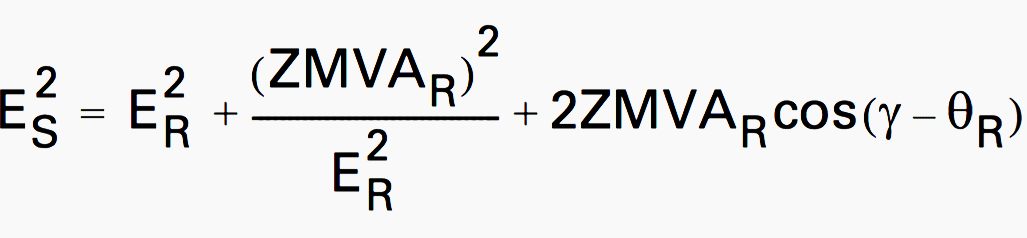
or
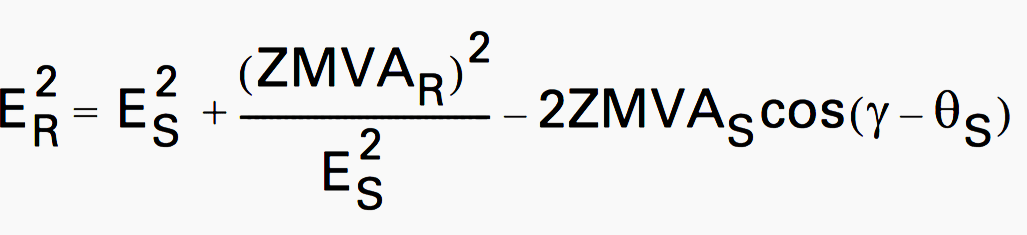
where:
- ER – Receiving line-line voltage in kV
- ES – Sending line-line voltage in kV
- MVAR – Receiving three-phase mVA
- MVAS – Sending three-phase mVA
- Z – Impedance between and receiving ends
- γ – The angle of impedance Z
- R – Receiving end PF
- S – Sending end PF, positive when lagging
5. Voltage Drop Tables
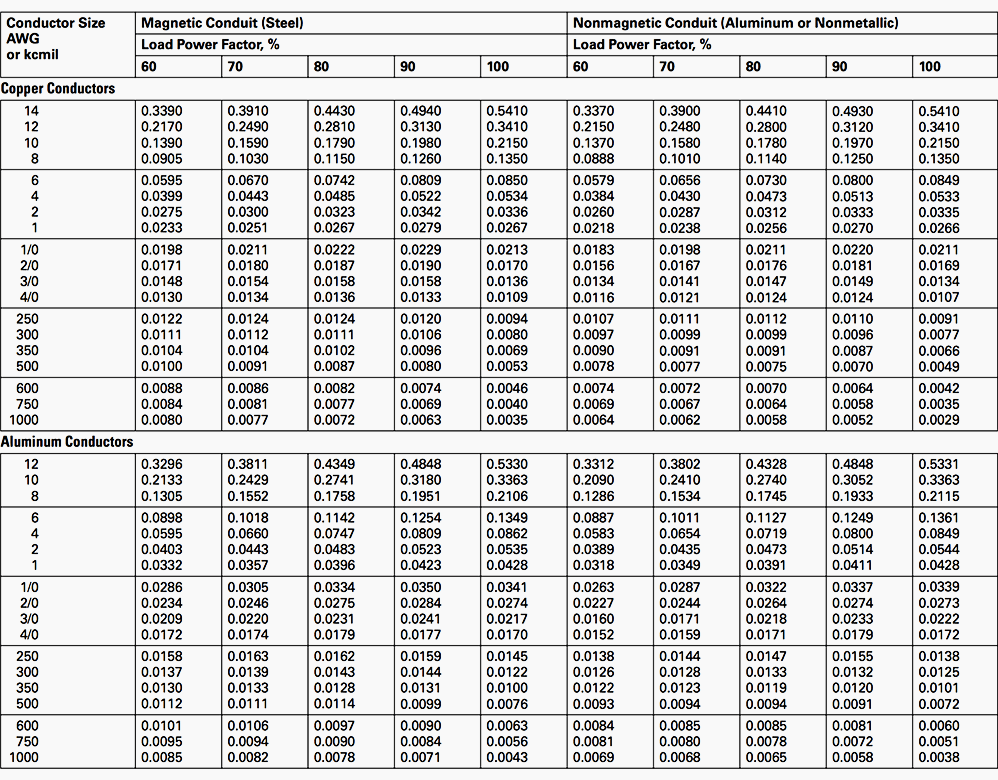
Tables for calculating voltage drop for copper and aluminum conductors, in either magnetic (steel) or nonmagnetic (aluminum or non-metallic) conduit, are shown below. These tables give voltage drop per ampere per 100 ft (30 m) of circuit length.
The circuit length is from the beginning point to the end point of the circuit regardless of the number of conductors.
Tables are based on the following conditions:
Condition #1
Three or four single conductors in a conduit, random lay. For three-conductor cable, actual voltage drop will be approximately the same for small conductor sizes and high power factors. Actual voltage drop will be from 10 to 15% lower for larger conductor sizes and lower power factors.
Condition #2
Voltage drops are phase-to-phase, for three-phase, three-wire or three-phase, four-wire 60 Hz circuits. For other circuits, multiply voltage drop given in the tables by the following correction factors:
Table 2 – Correction factors
| Three-phase, four-wire, phase-to-neutral | × 0.577 |
| Single-phase, two-wire | × 1.155 |
| Single-phase, three-wire, phase-to-phase | × 1.155 |
| Single-phase, three-wire, phase-to-neutral | × 0.577 |
Condition #3
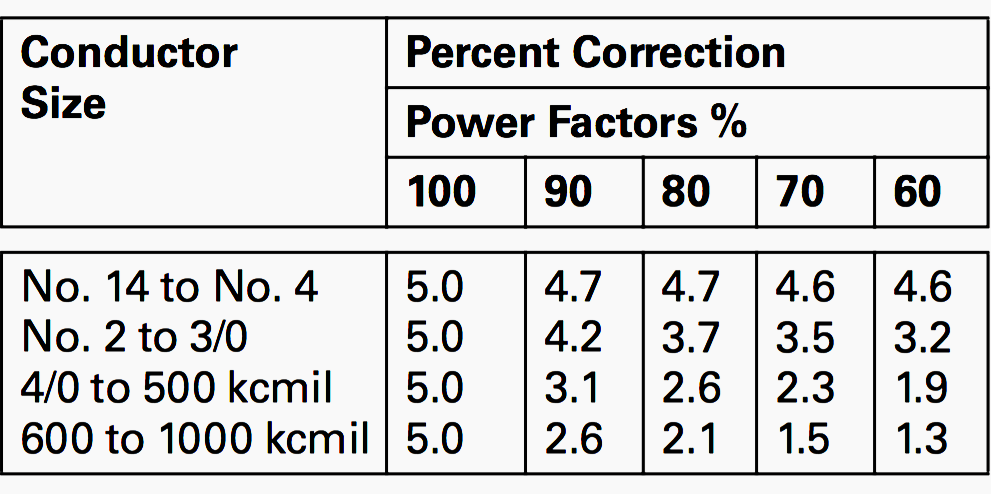
Voltage drops are for a conductor temperature of 75 °C. They may be used for conductor temperatures between 60 °C and 90 °C with reasonable accuracy (within ±5%). However, correction factors in Table 3 can be applied if desired. The values in the table are in percent of total voltage drop.
- For conductor temperature of 60 °C – SUBTRACT the percentage from Table 3.
- For conductor temperature of 90 °C – ADD the percentage from Table 3.
Table 3 – Correction factors for different conductor sizes
6. Voltage Drop Calculations
To calculate voltage drop:
- Multiply current in amperes by the length of the circuit in feet to get ampere-feet. Circuit length is the distance from the point of origin to the load end of the circuit.
- Divide by 100.
- Multiply by proper voltage drop value in tables. Result is voltage drop.
Example #1
A 460 V, 100 hp motor, running at 80% PF, draws 124 A full-load current. It is fed by three 2/0 copper conductors in steel conduit. The feeder length is 150 ft (46 m).
What is the voltage drop in the feeder? What is the percentage voltage drop?
- 124 A × 150ft (46m) = 18,600 A-ft
- Divided by 100 = 186
- Table: 2/0 copper, magnetic conduit,
80% PF = 0.0187
186 x 0.0187 = 3.48 V drop
3.48/460 x 100 = 0.76% drop
Conclusion: 0.76% voltage drop is very acceptable. (See NEC Article 215, which suggests that a voltage drop of 3% or less on a feeder is acceptable.)
To select minimum conductor size:
- Determine maximum desired i voltage drop, in volts.
- Divide voltage drop by ii (amperes x circuit feet).
- Multiply by 100.
- Find nearest lower voltage drop value in tables, in correct column for type of conductor, conduit and power factor. Read conductor size for that value.
- Where this results in an oversized cable, verify cable lug sizes for molded case circuit breakers and fusible 4 switches. Where lug size available is exceeded, go to next higher rating.
Example #2
A three-phase, four-wire lighting feeder on a 208 V circuit is 250 ft (76.2 m) long. The load is 175 A at 90% PF. It is desired to use aluminum 7 conductors in aluminum conduit.
- VD = 2/100 × 208 = 4.16 V
- 4.16 / (175 × 250) = 0.0000951
- 0.0000951 × 100= 0.00951
- In table, under aluminum conductors, nonmagnetic conduit, 90% PF, the nearest lower value is 0.0091. Conductor required is 12 500 kcmil.
(Size 4/0 THW would have adequate ampacity, but the voltage drop would be excessive.)
Table 2 – Voltage Drop—Volts per Ampere per 100 Feet (30 m); Three-Phase, Phase-to-Phase
7. Suggested Video Course
In this course, you will learn how to calculate voltage drop in single phase, balanced three-phase and unbalanced three-phase power systems. You will learn short circuit calculations with two different methods namely “Fault impedance method” and “Symmetrical Components method“.
You will also learn per unit system for short circuit current calculations.
Voltage Drop and Fault Current Analysis Course For Power Engineers
Reference: Power Distribution Systems by EATON
Related electrical guides & articles











Edvard Csanyi
Hi, I'm an electrical engineer, programmer and founder of EEP - Electrical Engineering Portal. I worked twelve years at Schneider Electric in the position of technical support for low- and medium-voltage projects and the design of busbar trunking systems.I'm highly specialized in the design of LV/MV switchgear and low-voltage, high-power busbar trunking (<6300A) in substations, commercial buildings and industry facilities. I'm also a professional in AutoCAD programming.
Profile: Edvard Csanyi
We are building a solar PV park 4.1 MW/120ams the distance to the substation is 20Km with 70mm2(2/0 awg) grid connection cable. Grid Voltage is 22KV We calculate voltage drop 5%. You believe this acceptable or We will have problems with the PV park operation?
Thank you!
I’m somewhat confused about the voltage drop tables, particularly the relationship between voltage drop and a load’s power factor. If I recall correctly, higher power factor loads should result in lower voltage drops, and vice versa. However, some tables seem to show the opposite: that higher power factor loads lead to higher voltage drops. Could you please explain this discrepancy for me?
hi ive been asked to calculate cable size for an ac rectified by ups pv cells array for my brothers home in France. The ups/controller might not exactly put out a sinewave. the outout might be 25 kW distance to house from array maximum might be 100metres in ground. can you describe the calculation and method to be used please i reckon on it being 100A and about 10.5VD. his cottage has very thick stone walls fitted with some insulation, what – god only knows, its a 17th century cottage in Brittany the onky reason he hasnt got PV on his cottage roof and must take it off the top of his green house is because it is thatched. the greenhouse is ineffective as hes used thick plexiglass for the wall in fills the roof is vinyl and felt. and he uses maybe 6 large panels and two controllers to each set of two lorry batteries. I would say 3 core, for the earth, 25 to 32mm swa xple lsf cable. What is your recommendation please.
regards Frank ex power station tech and MIET member.
What is the voltage drop on a 2000ft run of #2 use direct burial at 240vac 20 amp max load
DC Circuit. 12vdc
example: I’m installing a 1000w pure sine inverter in the back of the box of my truck. Length from truck battery to load connection of the inverter is approximately 15 feet.
When you increase the wire size for voltage drop for a load current of 12 amps, must you physically keep that same size of wire connected from source to the load connection of the inverter?( with no interruption of wire size) There is a relay just after the truck battery, then continues to the inverter. But it’s difficult to physically put a # 8 gauge copper wire on the 30 amp. rated relay. They don’t make a #8 gauge female stak-on crimp connector.
The question is: can I go down to a # 10 Gauge copper wire to make the connection to the relay, from # 8 gauge to # 10 gauge on both sides of the relay then back up to # 8 gauge travelling to the inverter without increasing the voltage drop?
Thank you
Reducing the cable size for a short distance will have minimal effect on voltage drop. It’s a function of cable impedance only. But, your numbers don’t make sense.
1000W/24Vdc = 42A. You stated it was a 12A load.
Please I need the analysis for voltage rise.
Im confused with correction factor table in condition #2. Should this item be “Three-phase, three wire, phase-to-phase x1.155” instead of “Single-phase, three wire, phase-to-phase x1.155”
IHAVE AN LANDSCAPING LED LIGHTS 30NOS CONNECTED IN SERIES FOR ADISTANCE OF 380METERS ZIGZAG LINE .
HOW IWILL GET THE CABLE SIZE AND HOW TO ELEIMENATE VOLTAGE DROP
PLEASE ANSWER ME AS SOON AS POSSIBLE.
BEST REGARDS
If found it stranges how dificult it seem to calculate pressure drop.
The resistance in conductors = Lengh x 0,0175/Divide by Cross sectional area.
The voltage drop 20 meter conduct , 10 Ampere ,1,5mm2, =4,7 Volt. That is for 2 wire cable
ٍER, Must be outside the radical
Hi,
How do you compute the voltage drop of a feeder installed in cable tray? Considering also the ambient temperature. I want to reduce cost by proper selection of cable size and number of set considering the voltage drop of main feeder cable.
i wont voltage drop 70sqmm 3 cor HV cable.( 600m lenght)..
voltage start from stepup transformer 11,000kv.
600m end is my other resort.
In a previous example:
124 x 154ft ÷ 100 = 186 x 0.0187 = 3.48drop
I need to clarify that in a 3-phase system you have to multiply it by 1.732
Vd = 1.732 x Amp x Length x R / 100f
Dear Edvard Csanyi;
Kindly advise me if the Demand factor should be used for the calculation of Voltage drop or not? Kindly submit the formula if the demand factor should be used.
Is there any change in voltage drop calculation if the cable is armoured and if so let us know the correction to be applied
pls send sample computation for volatage drop and short circuit using per unit method
I Want Voltage Drop Calculation For Single Phase System (Solar). Please share
Nice to know this. Bit can we get a link to download all these calculations for better understanding and to teach others.
Dear Edvard:
Please Show The Mathematical Derive Of The Equation Of Exact Method #1 (And How Sending End Voltage (Vs) Appears In Voltage Drop Formula .
Best Regards ,
Hi everybody,
In fact I have a confussion for which power factor I use in determining voltage drop of main cable (30m length) which supplies two motors (1st one 50HP , o.85 p.f, with 100m cable) and (2nd one 100HP , o.75 p.f,with 300m cable) .
Your answer is too much appreciated .
Thanks in advance
1- APPLY SUPERPOSITION THEOREM
2- APPLY PHASOR SUMMATION MOY ALGEBRAIC SUMMATION
3- THE MAIN SUPPLY WILL HAVE A DIFFERENT P.F. FROM BOTH
I saw the comments above and I guess what Gerald is referring to is the K factor method which is popularly followed by NEC. However, NEC also supports the IEEE 141-1993 formula. Refer to bottom of Table 9 Note 2 of NEC which clearly says: Multiplying current by effective impedance gives good approximation for line to neutral voltage drop. Thus, the approximate formula (Sqrt(3)*I*(Rcosphi+Xsinphi) can be followed. For all practical purposes, I have used this formula for last 25 years. The exact formula can also be used, and there is a vectorial method to get the solution.
Threre are 2 Standards IEEE 141 & 525 which defines the formulas. Answers of both are different and if i calculate by VL = VS – I (Rcosθ + Xsinθ) answer is different.
Which formula to be used; did not understand.
Dear Engineers,
GERALD NEWTON AND TOMMY RICE.
Please tell me your methods of voltage drop calculations I will be grateful for you to let me know the best way of calculation because I am new in this field.
best regards
Eng. Abdolgabar Ahmed
could you e-mail me and tell me how Washington state wants their calculations done. I use a different method for voltage drop calculations than edvard csanyi