


Estimated Study Time: 27 minutes
Practical Overview of Harmonic Studies
Modern power systems are undergoing fundamental transformation. The rapid growth of inverter-based resources—such as battery energy storage systems (BESS), solar PV plants, wind farms, HVDC links, electric vehicle chargers, and power-electronic-dominated industrial loads—has significantly altered the harmonic behavior of electricity networks.
 Why Compliance to Harmonic Studies Is Now Mandatory for Modern Power Systems
Unlike traditional synchronous generation, these technologies inject non-linear currents into the grid, increasing the risk of harmonic distortion, resonance, equipment overheating, protection mal-operation, and long-term asset degradation.
In response to these challenges, harmonic studies have evolved from a “best practice” engineering exercise into a mandatory regulatory requirement for new and modified grid connections.
In the UK, this obligation is governed by Engineering Recommendation G5/5, which sets out strict limits and assessment methodologies for harmonic emissions, voltage distortion, and network interaction effects. Compliance with G5/5 is now a fundamental prerequisite for connection approval from Distribution Network Operators (DNOs) and the Electricity System Operator (ESO).
In addition, the article explores how harmonic non-compliance can be mitigated, including the role of harmonic filters, OEM engagement, conditional DNO acceptance, and advanced measurement techniques such as Point-on-Wave (PoW) data and The Fast Fourier Transform (FFT)-based analysis in accordance with IEC power quality standards.
By bridging regulatory requirements with real-world engineering practice, this article aims to serve as a valuable reference for consultants, developers, EPC contractors, OEMs, and power system engineers working on modern grid-connected projects.
- Why Harmonic Studies Are Now Mandatory?
- Overview of Harmonic Study Requirements Under ER G5/5
- Key Calculations Required Under G5/5:
- Key Principles of G5/5 Harmonic Compliance:
- Essential Input Data Required for Harmonic Studies:
- What is Norton Equivalent Model:
- Harmonic Order Requirement:
- How Early Harmonic Risk Is Identified:
- How to deal the Harmonic Non-Compliance:
- Harmonic Measurement Techniques:
- Why PoW is important?
- Summary
- BONUS Attachment (PDF) 🔗 ‘Comprehensive Tutorial for Power System Harmonics and Passive Filter Design’
1. Why Harmonic Studies Are Now Mandatory
Under G5/5, harmonic assessment is a mandatory requirement for all generation and storage projects that could meaningfully affect harmonic levels particularly those involving power electronics.
A harmonic study is now a critical path activity in securing a UK DNO/TSO connection because:
- It directly affects the ability to issue a connection offer
- It determines whether mitigation (filters, reactors) is required
- It influences project cost, design, and timeline
- Non-compliance can lead to rejection or energization delays
The updated framework ensures that harmonic distortion remains within acceptable limits, protecting customer power quality and maintaining the stability of an increasingly inverter-dominated grid.
2. Overview of Harmonic Study Requirements Under ER G5/5
Engineering Recommendation G5/5 establishes a far more comprehensive and stringent methodology for assessing harmonic emissions on UK distribution and transmission networks. The standard requires every generator or storage plant to demonstrate that its connection will not adversely affect harmonic distortion levels at the Point of Common Coupling (PCC) or elsewhere in the wider network.
Under G5/5, compliance must be demonstrated for both incremental and total harmonic voltage distortion, ensuring that new connections do not compromise network power quality.
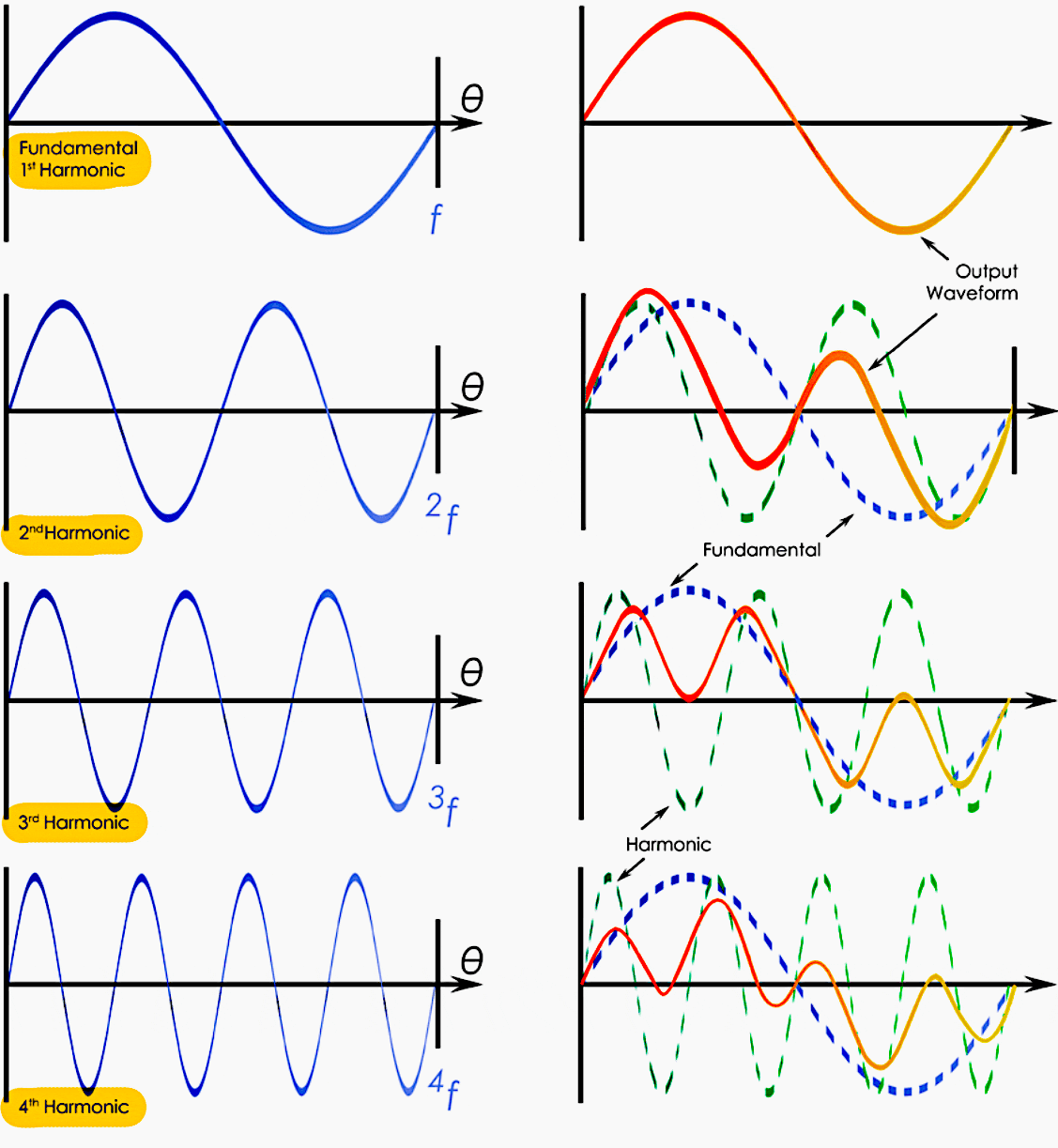
Figure 1 – Harmonics example
3. Key Calculations Required Under G5/5
3.1 Incremental Harmonic Voltage
This is the additional harmonic voltage distortion produced solely by the plant’s own harmonic current injection. It represents the plant’s individual contribution to the total distortion seen at the PCC.
This must be calculated for every harmonic order, typically from the 2nd up to the 100th harmonic.
3.2 Total Harmonic Voltage
This is the combined voltage distortion resulting from:
- The plant’s incremental harmonic emission, plus
- Pre-existing background harmonic voltages already present on the network.
G5/5 requires that both incremental and total distortion remain within prescribed limits for each harmonic order and for the overall THDv.
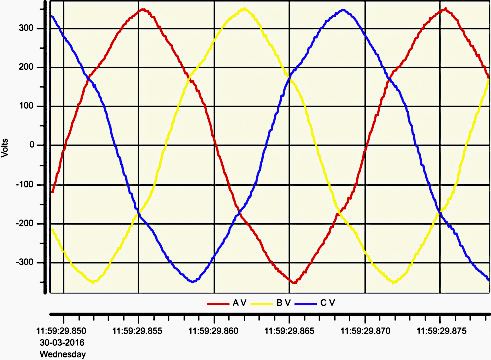
Figure 2 – Voltage Harmonics
3.3 Assessment Range
Harmonic orders up to the 100th must be evaluated because:
- Inverter-based technologies can produce high-frequency emissions
- Network resonance may amplify higher-order components
- Cable-heavy networks exhibit different behavior above the 50th harmonic
This ensures a complete and accurate understanding of plant–network interactions.
4. Key Principles of G5/5 Harmonic Compliance
4.1 Interaction with Other Connections
G5/5 recognizes that harmonic emissions from multiple generators and loads combine and interact.
Therefore, studies must:
- Consider other existing harmonic sources
- Account for concurrent projects in the pipeline
- Assess worst-case network scenarios
4.2 Investigation of Harmonic Resonance
A central requirement is assessing whether the proposed connection could:
- Excite network resonant frequencies
- Experience amplification at specific harmonic orders
- Produce instability or excessive harmonic currents
This is particularly important in networks with long cables, capacitor banks, reactors, or weak grid conditions.
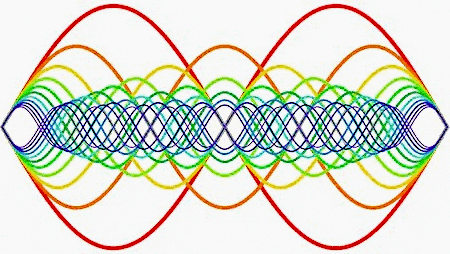
Figure 3 – Harmonics resonance
4.3 Assessment of Wider Network Impact
Compliance cannot be assessed solely at the PCC. The plant may affect:
- Upstream voltage levels
- Neighboring substations
- Sensitive locations such as hospitals, data centers, and industrial sites
G5/5 therefore mandates system-wide evaluation across multiple nodes.
5. Essential Input Data Required for Harmonic Studies
High-quality harmonic assessments depend heavily on the accuracy of input data provided by:
- DNO/TSO (UKPN, SSEN, ENWL, NGESO, etc.)
- OEMs (inverter, BESS, wind turbine, and equipment manufacturers)
The following core datasets are required for rigorous analysis:
5.1 Harmonic Voltage Limits and Background Levels
Incremental Limits: These planning limits define the maximum allowable harmonic voltage contribution from the proposed plant. They vary by:
- Voltage level
- Network strength (SCR, impedance)
- Location and topology
Total Limits: These ensure that the overall harmonic voltage distortion—background plus incremental—does not exceed safe levels defined by:
- ER G5/5
- IEC 61000-2-4 / 3-6
- Utility-specific limits
Background Harmonic Voltage Levels: These are typically based on:
- Two weeks of measured data
- Captured at or near the PCC
- Reflecting normal operating conditions
Accurate background data is essential because high pre-existing distortion reduces the headroom available to new connections.
EEP Recommends – ETAP Power System Design and Analysis Course: Learn To Resolve Power System Issues

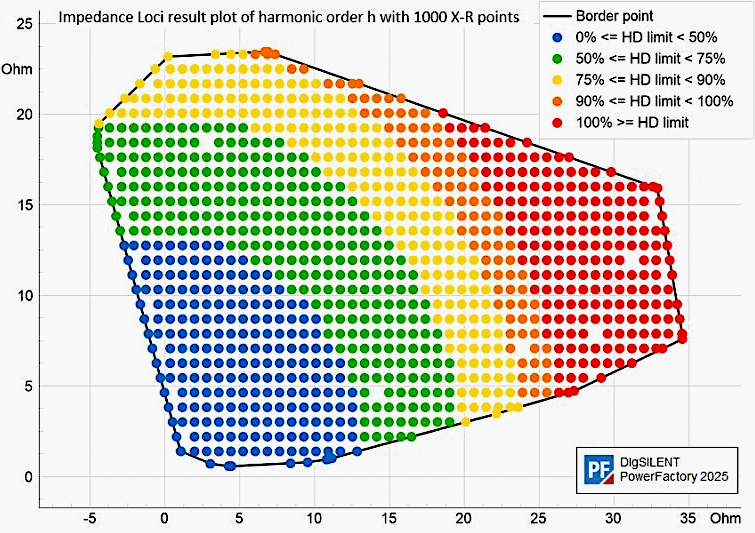
5.2 Harmonic Impedance Loci
The harmonic impedance loci describe how the network’s impedance varies at each harmonic order under:
- Different loading conditions
- Switching states
- Seasonal variations
- Contingencies (N-1 conditions)
There are two primary formats:
Grouped Envelopes: Several harmonic orders are grouped into a single impedance envelope. These are conservative but less accurate.
Ungrouped Envelopes: Each harmonic order has its own impedance envelope. This is the preferred approach for detailed and accurate harmonic analysis because it:
- Identifies resonance risks more reliably
- Produces realistic incremental voltage estimates
- Supports advanced modelling (Stage 3 studies)
The impedance loci are fundamental for understanding whether the plant will interact negatively with network resonances or amplify harmonic distortion.
Figure 4 – Harmonics Impedance Loci
What is Norton Equivalent Model
A critical component of harmonic assessment under ER G5/5 is an accurate representation of how the generating plant (BESS, solar PV inverter, wind turbine converter, or industrial drive) interacts with the network at harmonic frequencies.
This is achieved through the Norton Equivalent Model, which must be provided by the inverter or converter OEM.
The Norton model describes the plant’s behavior at each harmonic order in terms of:
6.1. Norton Current Source
This represents the harmonic current injected into the network by the device. For each harmonic order (2nd, 3rd, 5th, … up to the 100th), the manufacturer must provide:
- Magnitude of the harmonic current (as % of rated current or in amperes)
- Phase angle of each harmonic component
6.2 Norton Impedance
The Norton impedance reflects the frequency-dependent internal impedance of the inverter or converter at each harmonic order.
This is essential for:
- Understanding how the plant interacts with network resonances
- Predicting harmonic amplification or attenuation
- Performing accurate Stage 2 and Stage 3 harmonic studies
- Assessing potential harmonic instability issues in weak grids
The impedance typically varies substantially across harmonic frequencies, and a single “lumped value” is not sufficient for accurate modelling.
Learn more – The Rise of Harmonic Distortion in Modern Power Systems
7. Harmonic Order Requirement
For high-quality analysis, the Norton model must be provided at least up to the 100th harmonic order.
This is necessary because:
- Modern power electronics can generate high-order harmonics
- Cable-heavy networks often resonate in the higher-order frequency range
- G5/5 requires assessment up to the 100th harmonic for any plant with non-linear behavior
7.1 Identifying Harmonic Risk Early in the Project Lifecycle
A common challenge in UK grid connections is the timing of data delivery. In many projects, final harmonic data from the DNO/ESO (impedance loci, background levels, harmonic envelopes) arrives late in the program—sometimes only months before the energization date.
This creates uncertainty for developers, EPCs, and OEMs because:
- Mitigation equipment (filters/reactors) may be required
- Design changes may become costly
- Delays in approval can impact energization schedules
Despite this, substantial early insight can still be gained through preliminary analyses.
Suggested Guide – Filter networks for electrical engineering
8. How Early Harmonic Risk Is Identified
8.1 Frequency Sweep Analysis
We conduct frequency-domain simulations of the plant, sweeping through a broad frequency range to identify:
- Parallel resonance conditions
- Series resonance points
- Harmonic orders with high amplification potential
This is especially valuable for:
- Cable-rich BESS and solar sites
- Weak or rural grid areas
- Long underground connections
Even with limited data, resonance patterns can often be detected early.
8.2 Network Topology Review
Certain physical and electrical characteristics increase harmonic risk, such as:
- Long cable feeders
- High capacitance on collector systems
- Multiple inverters connected in parallel
- Sites located on electrically weak networks
- Networks with series compensation or capacitor banks
8.3 Sensitivity Studies and “What-If” Scenarios
We use indicative or assumed impedance and background data—based on similar networks, legacy models, or standard envelopes—to perform:
- Harmonic impedance sensitivity studies
- Worst-case scenario assessments
- Pre-emptive harmonic current simulations
This allows us to quantify the likelihood and severity of harmonic issues, enabling:
- Early mitigation planning
- Better equipment specification
- Reduced uncertainty for project financials and timelines
Even though the final study must be based on actual DNO/ESO data, early screening greatly reduces risk exposure and improves project readiness.
EEP Recommends – Practical Course to Power System Operation, Control, Stability, and Optimization
9. How to deal the Harmonic Non-Compliance
Discovering that a plant does not meet the harmonic limits defined under ER G5/5 does not automatically prevent the project from securing a connection agreement.
Harmonic non-compliance is relatively common in inverter-based generation and BESS projects, especially in cable-heavy, weak, or highly interconnected networks.
Below are the key mitigation strategies available.
9.1 Installation of Harmonic Filters
Harmonic filters are the most direct and widely used solution for addressing non-compliance.
Key Considerations:
- Highly effective in attenuating specific harmonic orders
- Available as passive filters, C-type filters, or active harmonic filters
- Must be integrated early into the design to avoid complex layout changes
- Late-stage filter additions may require re-routing of cables, switchgear resizing, or changes to substation footprint
- Long procurement and testing lead times (often 20–40 weeks) may affect energization deadlines
- Increased maintenance requirements and lifecycle costs
Filters provide a guaranteed solution but should ideally be considered before finalising substation layout and transformer specifications.
9.2 Contact the DNO/ESO for Conditional or Monitored Acceptance
Not all cases of non-compliance require physical mitigation. If the exceedance is:
- Minor,
- Occurs at only a few frequency points, or
- Appears under rare or extreme operating conditions,
the network operator may issue:
- Conditional acceptance, or
- Connection approval subject to post-energization monitoring
This may involve:
- Harmonic monitoring at the PCC for the first 12 months
- Operational restrictions under specific grid conditions
- Agreed operational envelopes to avoid resonance conditions
This pathway avoids additional equipment costs and may be acceptable for marginal cases.
More info – https://electrical-engineering-portal.com/problems-modern-distribution-systems-distributed-energy-resources-ders
The Problems of Modern Distribution Systems in the Age of Distributed Energy Resources (DERs)
9.3 Contact the Inverter or Converter OEM
Often, harmonic emissions can be significantly improved through adjustments at the inverter control level. OEM Support May Include:
- Controller retuning
- Adjusting switching patterns
- Changing modulation strategies
- Providing updated Norton models with improved harmonic performance
- Offering firmware revisions for reduced emission levels
9.4 Request Ungrouped Impedance Loci from the DNO/ESO
Impacted harmonic orders may appear non-compliant due to grouped impedance envelopes, which are conservative. By requesting ungrouped (order-by-order) loci, developers can:
- Identify precisely which harmonic orders are problematic
- Reduce false positives caused by conservative grouping
- Target only the affected orders for mitigation
- Avoid expensive filtering across the full spectrum
This often reveals that harmonic exceedances occur under very narrow scenarios rather than across the entire harmonic range.
Suggested Reading – Practical guidelines for protection system engineering
9.5 Request Frequency Sweep Data or Additional System Cases
Sometimes impedance loci are generated from multiple contingency scenarios. Non-compliance may only occur under:
- Rare switching conditions
- N–1 contingency scenario
- Abnormal system states
- Temporary transformer configurations
By obtaining detailed frequency sweep plots or insight into the contingency conditions, it may be possible to:
- Validate that exceedances are rare
- Agree a limited operational envelope
- Avoid unnecessary physical mitigation
- Use plant-level constraints instead of installing filters
This is especially beneficial in networks with multiple reactive devices or complex cable layouts.
10. Harmonic Measurement Techniques
Accurate harmonic measurement is essential for assessing power quality, validating compliance with ENA EREC G5/5, analyzing inverter behavior, and ensuring stable operation of distribution and transmission networks.
Harmonics are not static; they vary throughout the day based on load patterns, inverter activity, network switching, and background distortion.
Harmonic measurement is commonly performed using point-on-wave data, FFT-based analysis, and sliding-window measurement techniques, all governed by the international standards IEC 61000-4-7 and IEC 61000-4-30.
10.1 Point-on-Wave (PoW) Data
Point-on-wave data consists of high-resolution, time-domain recordings of voltage and current waveforms at the PCC or other monitoring locations.
This is the most detailed form of measurement and captures:
- Fundamental frequency waveform
- Harmonic components
- Inter harmonics
- Flicker-causing variations
- Transients (switching events, inrush, faults)
- Sub-cycle distortions
Suggested Guide (PDF) – A Guide to the Logic Behind the GIS Operation Interlocks
11. Why Point-on-Wave (PoW) is important?
Point-on-Wave (PoW) is important because:
- It provides raw unprocessed waveforms for replay and detailed analysis.
- It enables offline harmonic calculation at any desired resolution.
- It allows advanced diagnostic studies such as harmonic resonance detection, waveform reconstruction, and event correlation.
- It’s widely used in forensic analysis after faults, mis operations, or harmonic exceedance events.
11.1 Typical usage
Point-on-Wave (PoW) is commonly used for:
- Validation of harmonic data from OEMs (Norton models).
- Monitoring of BESS/PV sites during commissioning.
- Investigating resonance or oscillatory behavior.
- Analyzing power quality problems in industrial networks.
PoW is the most comprehensive but also the most data-intensive technique.
11.2 FFT-Based Harmonic Analysis
The Fast Fourier Transform (FFT) is the most widely used method for converting time-domain waveform data into frequency-domain harmonic content.
How FFT analysis works:
- Samples are taken over a fixed window (e.g., one cycle or 10 cycles).
- The waveform is decomposed into frequency components (50 Hz, 100 Hz, 150 Hz, etc.).
- Amplitude and phase of each harmonic order are calculated.
Strengths:
- Very fast processing
- High accuracy for steady-state harmonics
- Suitable for real-time monitoring systems
- Ideal for identifying discrete harmonic orders (5th, 7th, 11th, 13th, etc.)
Limitations:
- Accuracy decreases if waveform contains significant inter harmonics or rapidly changing conditions.
- Requires careful selection of time window length to avoid spectral leakage.
FFT is the backbone of most harmonic measurement instruments.
Suggested Guide – Testing and Commissioning Procedures for Substation Equipment
Testing and Commissioning Procedures for Substation Equipment
11.3 Sliding-Window Harmonic Measurement
Sliding-window measurement provides a continuous time history of harmonic magnitudes, rather than isolated snapshots.
How it works:
- The FFT is computed repeatedly using overlapping windows (e.g., every 200 ms using a 10-cycle window).
- Each new measurement window “slides” forward in time.
- This produces a smooth, time-resolved harmonic profile.
Benefits:
- Captures variability in harmonic levels across the day
- Detects short-duration harmonic spikes
- Identifies periodic behavior of inverters
- Reveals flicker-related harmonic variation
- Suitable for long-term harmonic monitoring (e.g., 2-week background data required under G5/5)
11.4 Requirements under IEC 61000-4-7 and IEC 61000-4-30
These two standards govern how harmonic measurements must be performed to ensure consistency, accuracy, and comparability across equipment and networks.
11.4.1 IEC 61000-4-7 – Harmonic and Inter harmonic Measurement Standard
This standard defines:
- Measurement bandwidths
- Frequency measurement accuracy
- Grouping and sub-grouping of harmonic orders
- Window lengths (10 or 12 cycles depending on system)
- How to treat inter harmonics between harmonic orders
- Recommended smoothing methods
Key requirements:
- Harmonics must be calculated using a 10/12-cycle window.
- Spectral components must be grouped to form “harmonic groups” and “sub-groups.”
- Instruments must support frequency-domain resolution suitable for harmonics up to the 50th or 100th order.
11.4.2 IEC 61000-4-30 – Power Quality Measurement Methods
IEC 61000-4-30 defines:
- Power quality reporting intervals (10-minute and 2-hour averages)
- Sliding-window application procedures
- Measurement classes (Class A, Class S)
- Requirements for voltage, frequency, flicker, and harmonic reporting
For harmonics, it defines:
- How often harmonics must be calculated (e.g., every 200 ms)
- How results must be aggregated (RMS, max, min, average)
- How to record voltage THD and individual harmonics
- Requirements for accuracy and error limits
IEC 61000-4-30 ensures that harmonic monitoring used by utilities, FFR providers, BESS operators, and regulators is accurate, fair, and auditable.
Recommended Study – Power protection study for a network with ten buses, five transformers, two generators and motors and six transmission lines
12. Summary
Together, these techniques provide a complete and reliable framework for measuring and analyzing harmonics distribution and transmission networks.
Table 1 – Summary of techniques for measuring and analyzing harmonics
| Technique | Purpose | Strength |
| Point-on-wave (PoW) | Raw waveform capture | Most detailed, good for diagnostics |
| FFT-based analysis | Frequency decomposition | Fast, accurate for steady-state harmonics |
| Sliding-window method | Time-resolved harmonic tracking | Best for long-term monitoring |
| IEC 61000-4-7 & -4-30 compliance | Standardized measurement | Ensures accuracy and comparability |
13. Attachment (PDF): Comprehensive Tutorial for Power System Harmonics and Passive Filter Design
Download: Comprehensive Tutorial for Power System Harmonics and Passive Filter Design (for premium members only):
Related electrical guides & articles









Muhammad Kashif
Muhammad Kashif Shamshad is an Electrical Engineer and has more than 17 years of experience in operation & maintenance, erection, testing project management, consultancy, supervision, and commissioning of Power Plant, GIS, and AIS high voltage substations ranging up to 500 kV HVAC & ±660kV HVDC more than ten years experience is with Siemens Saudi Arabia.Profile: Muhammad Kashif