
Comprehensive Masterclass: Learn Line Protection Panel Schematics (UK, US, EU, Middle East, and Asian Standards)

Deep-Dive Course Curriculum
Throughout this course, we will systematically break down and explore the fundamental building blocks of protection panel schematics. Our modules are designed to take you from a macro understanding of panel layouts down to the micro-level tracing of individual wire signals.
The course consists of 17 lessons with a total duration of 2 hours and 17 minutes.
There is a widely recognized hurdle in the power engineering industry: the steep learning curve between academic theory and field reality. Many capable engineers struggle immensely when they first encounter actual panel wiring schematics, complex terminal arrangements, and intricate protection logic drawings utilized in live, real-world projects.
Here’s what you will learn in this Masterclass:
1. Panel Architecture and Terminal Philosophy
We begin by exploring the foundational terminal philosophy used in modern P&C panels. You will learn how terminal blocks are arranged, numbered, and grouped logically to separate different voltage levels, AC currents, and DC control signals safely.
We also cover General Arrangement (GA) drawings, teaching you how to visualize the physical layout of the relays, switches, and meters on the panel layout and internal mounting plates before you ever look at a wiring diagram.
2. Wiring Paradigms: Internal vs. External
A common point of confusion for new engineers is distinguishing between what happens inside the panel and what connects outside the panel. We will teach you how to clearly identify internal panel wiring (connections between relays and local switches) versus external panel wiring (connections going out to the switchyard, circuit breakers, instrument transformers, and remote SCADA systems).
3. Mastering Global Schematic Standards
Engineering standards vary significantly across the world. You will learn to navigate the distinct differences in schematic practices between the UK/US/EU (often utilizing specific IEC or ANSI/IEEE symbols and layout structures) and the conventions commonly found in Asia and the Middle East.
This makes you a versatile engineer capable of working on international projects.
4. Critical Panel Hardware: Links, Fuses, and Test Blocks
Understanding schematics requires understanding the hardware they represent. We dedicate a section to the purpose, physical reality, and schematic representation of:
- Mini Links: Used for signal isolation and circuit configuration.
- Fuse Links (and MCBs): The critical protective devices for the DC and AC secondary circuits.
- Test Blocks (e.g., MMLG/MMLB): Absolutely essential for secondary injection testing. You will learn how to read their wiring to ensure safe isolation of trip circuits and CT/VT inputs during commissioning.
5. Signal Flow: Relay Inputs and Outputs
Modern numerical relays are highly programmable, but they still rely on hardwired physical inputs and outputs. You will learn to trace input signal wiring (such as breaker status, alarms, and block signals) and output signal wiring (such as trip commands, close commands, and SCADA alarms) directly to and from the relay terminals.
6. Control Logic and Switchgear Integration
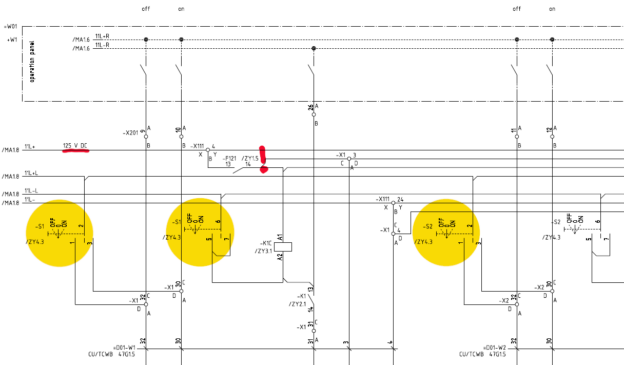
We will dissect the control logic embedded in the schematics, focusing on the critical Local/Remote selector switches. You will understand how control authority is passed between the physical panel, the substation HMI, and the remote dispatch center.
Furthermore, we explore Circuit Breaker (CB) auxiliary contacts (52a, 52b)—understanding their physical state and their vital role in protection schemes, discrepancy alarms, and interlocking.
7. Core Diagrams: From Single Lines to Tripping Circuits
In the final technical modules, we pull everything together. You will learn to read:
- Key Line Diagrams / P&C Diagrams: The overarching single-line representation of the protection scheme.
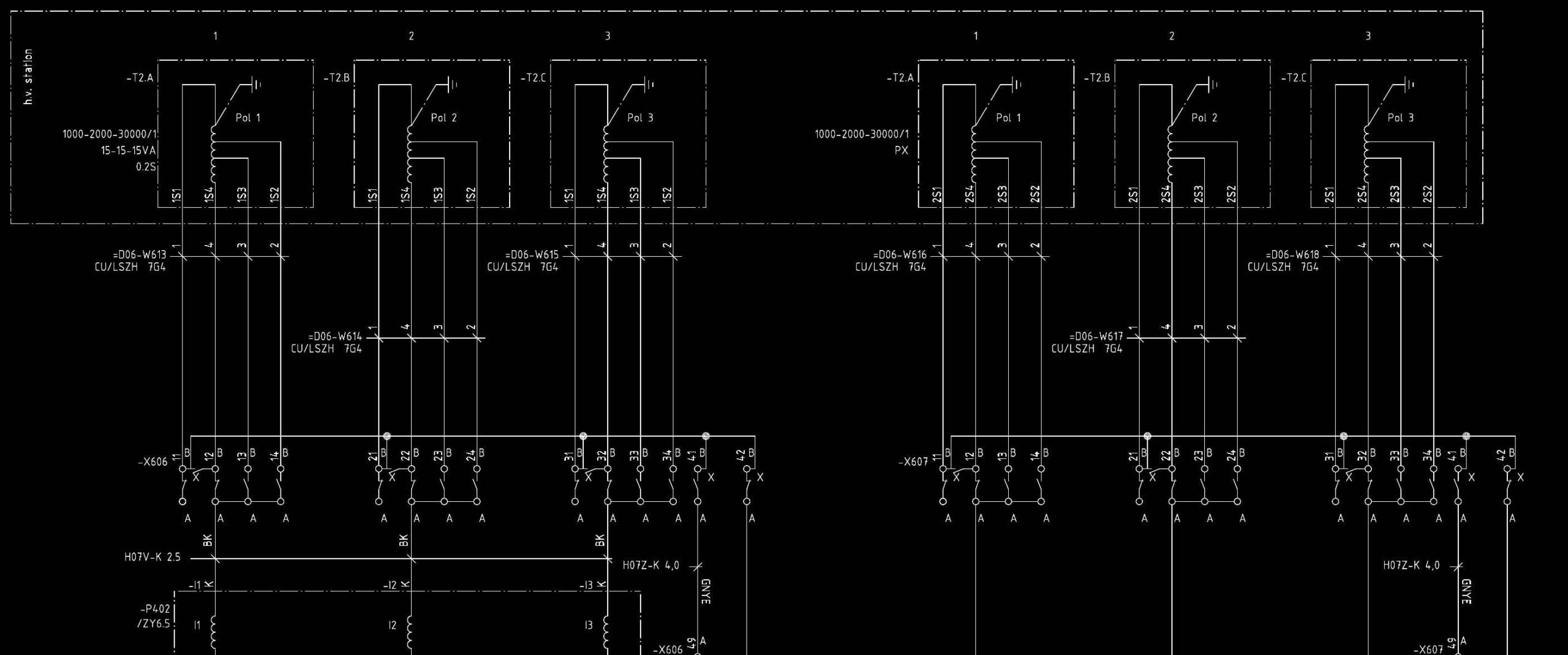
- AC Schematics: Tracing the Current Transformer (CT) and Voltage Transformer (VT) secondary circuits from the switchyard directly into the measurement inputs of the relays.
- DC Tripping Circuits: The most critical circuits in the substation. You will learn to trace the DC positive from the battery, through the protection relay trip contacts, test blocks, and master trip relays, all the way to the circuit breaker trip coil.
Who Will Benefit from This Course?
This program is specifically tailored for professionals who need to interact with electrical drawings in a tangible, high-stakes environment. It is particularly valuable for:
- Electrical Engineers in Substation Design: Enhance your ability to produce error-free, logical, and highly organized panel schematics that adhere to global standards.
- Protection and Control (P&C) Engineers: Move beyond relay setting files to understand the hardwired realities that execute your protection algorithms.
- Commissioning and Testing Engineers: Gain the critical skills needed to read drawings on the fly, safely isolate circuits via test blocks, and effectively troubleshoot miswirings during Site Acceptance Testing (SAT).
- Panel Manufacturing Engineers: Understand the why behind the wiring lists you assemble, bridging the gap between factory assembly and field operation.
- Graduate Engineers: Fast-track your career. Skip the years of trial-and-error by learning the industry secrets of reading complex drawings from day one of entering the power system sector.
Your Transformational Outcome
By the end of this course, the days of looking at a 200-page PDF schematic package with anxiety will be over. You will gain the rock-solid confidence required to open up real protection panel drawings, immediately understand the flow of signals, and accurately interpret the complex protection logic used in both transmission and distribution substations.
If you are ready to move from simply staring at complex, intimidating drawings to fundamentally understanding how protection panels function in the field, this course provides the exact practical skills required to succeed in modern substation projects.
Let’s get started and learn how protection panel schematics really work in the field.
Downloadable course materials
After purchasing the course, students can download the following files:
Course Materials (PDF)
- Basic setting of current differential line protection (PDF)
- Line protection calculations and setting guidelines for relays installed at 765kV, 400kV, 220kV transmission systems (PDF)
- Power protection study for a network with ten buses, five transformers, two generators and motors and six transmission lines (PDF)
- Applying directional overcurrent relays in ground fault protection of transmission lines (PDF)
- Protection of parallel (double) circuit transmission lines in modern power systems (PDF)
- Ground Fault Protection of Overhead Transmission Lines: Focus On Distance Relays (PDF)
Course Content
About Instructor

 +12
enrolled
+12
enrolled
Course Includes
- 17 Lessons
- Course Certificate
- Lifetime Access
