


Estimated Study Time: 12 minutes
Winding insulation resistance
If the motor is not put into operation immediately upon arrival, it is important to protect it against external factors like moisture, high temperature and impurities in order to avoid damage to the insulation. Before the motor is put into operation after a long period of storage, you have to measure the winding insulation resistance.
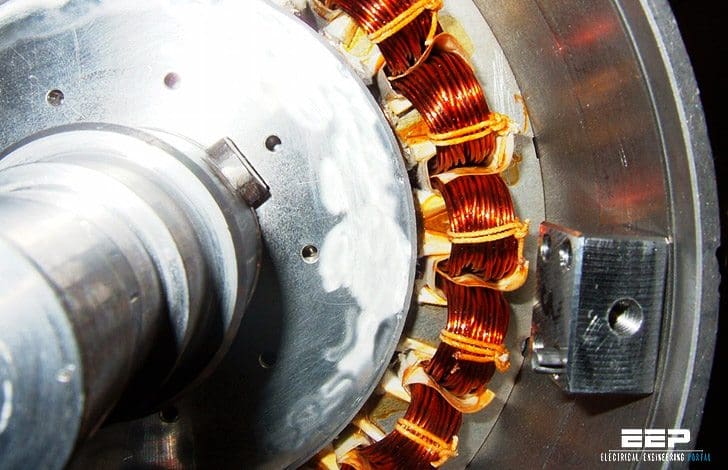
If the motor is kept in a place with high humidity, a periodical inspection is necessary.
It is practically impossible to determine rules for the actual minimum insulation resistance value of a motor because resistance varies according to method of construction, condition of insulation material used, rated voltage, size and type. In fact, it takes many years of experience to determine whether a motor is ready for operation or not.
A general rule-of-thumb is: Insulation resistance value = 10 Megohm or more.
| Insulation resistance value | Insulation level |
| 2 Megohm or less | Bad |
| 2-5 Megohm | Critical |
| 5-10 Megohm | Abnormal |
| 10-50 Megohm | Good |
| 50-100 Megohm | Very good |
| 100 Megohm or more | Excellent |
The measurement of insulation resistance is carried out by means of a megohmmeter – high resistance range ohmmeter. This is how the test works: DC voltage of 500 or 1000 V is applied between the windings and the ground of the motor.
Figure 1 – Ground insulation test of a motor
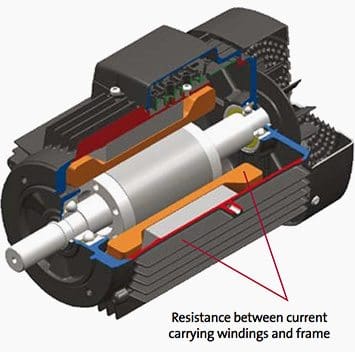
During the measurement and immediately afterwards, some of the terminals carry dangerous voltages and MUST NOT BE TOUCHED.
A drop in insulating resistance often occurs gradually, providing ample warning when assessed regularly. Such inspections enable scheduled maintenance prior to operational failure. In the absence of inspections, an electrically insulated equipment may provide a risk of electric shock upon voltage application and may also suffer total destruction.
A quick decline in insulating resistance is extremely uncommon, such as when a device gets waterlogged. This is the rationale for conducting an insulation-testing program. A routine schedule of insulation resistance testing is highly advised to avoid electrical shocks, ensure staff safety, and minimize downtime. It aids in identifying insulation degradation to facilitate the scheduling of maintenance tasks, including vacuum cleaning, steam cleaning, drying, and rewinding.
It is also beneficial for assessing the quality of repairs prior to the device being energized.
Additionally, the strong early polarization absorption current is a contributing factor in the low initial insulation resistance being observed. Additionally, this current declines with time, but it does so in a more slow manner. It takes anywhere from ten minutes to several hours for it to decay to a value that is negligible.
On the other hand, for the purposes of testing, the change in dielectric absorption current can be ignored after ten minutes have passed.
Additionally, the leakage current remains unchanged over the course of time, and this current is the major aspect that may be used to evaluate the quality of the insulation. Insulation resistance varies in a manner that is directly proportional to the thickness of the insulation being tested and in a manner that is inversely proportional to the area of the insulation being evaluated.
Now, three points are worth mentioning in this connection: Insulation resistance, Measurement and Checking.
1. Insulation resistance
The minimum insulation resistance of new, cleaned or repaired windings with respect to ground is 10 Megohm or more. The minimum insulation resistance, R, is calculated by multiplying the rated voltage Un, with the constant factor 0.5 Megohm/kV.
For example: If the rated voltage is 690 V = 0.69 kV, the minimum insulation resistance is: 0.69 kV × 0.5 Megohm/kV = 0.35 Megohm
How to check Insulation resistance check?
Insulation resistance should be used as a trend indicator to determine changes in the insulation system. In new machines the IR is usually thousands of Mohms and thus following the change of IR is important so as to know the condition of the insulation system. Typically, the IR should not be below 10 MΩ and in no case below 1 MΩ (measured with 500 or 1000 VDC and corrected to 25 °C).
The insulation resistance value is halved for each 20 °C increase in temperature.
Figure 2 can be used for the insulation correction to the desired temperature.
Figure 2 – Diagram illustrating the insulation resistance dependence from the temperature and how to correct the measured insulation resistance to the temperature of 40 °C.

WARNING! – To avoid risk of electrical shock, the motor frame must be grounded and the windings should be discharged against the frame immediately after each measurement. If the reference resistance value is not attained, the winding is too damp and must be oven dried.
The oven temperature should be 90 °C for 12-16 hours followed by 105 °C for 6-8 hours. If fitted drain hole plugs must be removed and closing valves must be opened during heating. After heating, make sure the plugs are refitted. Even if the drain plugs are fitted, it is recommended to disassemble the end shields and terminal box covers for the drying process.
Windings drenched in seawater normally need to be rewound.
2. Measurement
The minimum insulation resistance of the winding to ground is measured with 500 V DC. The winding temperature should be 25°C ± 15°C. The maximum insulation resistance should be measured with 500 V DC with the windings at a operating temperature of 80 – 120°C depending on the motor type and efficiency. Analyze the test graph data to assess the state of the insulation. Refer to Figure 3 below.
Point A denotes the condition of the motor insulation at the time the motor was commissioned. Point B illustrates the impact of aging, pollution, and other factors on motor insulation. Point C denotes a failure in motor insulation. Point D indicates the condition of the motor insulation post-rewinding.
The minimum reading is utilized since a motor’s efficacy is determined by its weakest component.
Insulation resistance (IR) should be measured prior to commissioning, after extended storage or stoppage, or if winding moisture may be anticipated. Insulation resistance (IR) must be measured directly at the motor terminals with the supply cables disconnected to prevent interference with the results.
Figure 3 – Insulation spot test measurement data is recorded on a test graph over time

3. Checking
If the insulation resistance of a new, cleaned or repaired motor that has been stored for some time is less then 10 Mohm, the reason might be that the windings are humid and need to be dried, If the motor has been operating for a long period of time, the minimum insulation resistance may drop to a critical level. As long as the measured value does not fall below the calculated value of minimum insulation resistance, the motor can continue to run.
However, if it drops below this limit, the motor has to be stopped immediately, in order to avoid that people get hurt due to the high leakage voltage.
The insulation resistance (IR) should generally not fall below 10 MΩ and, under no circumstances, below 1 MΩ, as tested with 500 or 1000 VDC and adjusted to 25 °C. The insulating resistance value is reduced by half for every 20 °C rise in temperature.
Caution!
A megohmmeter employs very high voltages for insulation resistance testing, reaching up to 5000 V. Consistently adhere to established protocols and safety regulations. Upon conducting insulation resistance testing with a megohmmeter, connect the tested device to ground via a 5 kW, 5 W resistor if the megohmmeter lacks a discharge capability.
Watch the Video – How to check your Electrical motor winding – Continuity & Insulation resistance test
Reference: Grudfos – Motor Book
Related electrical guides & articles








Edvard Csanyi
Hi, I'm an electrical engineer, programmer and founder of EEP - Electrical Engineering Portal. I worked twelve years at Schneider Electric in the position of technical support for low- and medium-voltage projects and the design of busbar trunking systems.I'm highly specialized in the design of LV/MV switchgear and low-voltage, high-power busbar trunking (<6300A) in substations, commercial buildings and industry facilities. I'm also a professional in AutoCAD programming.
Profile: Edvard Csanyi
single phase motor 0.37kw, 240Volt, 2.7amps, power factor 0.87, Rpm 1400, what is the winding resistance value in ohm? I got value from multimeter ohm 23.8. Is it correct?
The two bullets under the section Insulation Resistance seem to be in conflict. I believe the first bullet should not include the word “minimum”.
I want to learn more about LOGO SOFT work and actually programing logic control. I will be very happy is examples and exercises are sent to my email. Thanks so much.
can this insulation test be applied to 3 phase heater and servo motors?
What about MV Motor insulation. We can not never run any MV motor with 10 Mohm IR value. My opinion is that it will be much more correct if voltage level of motor is mentioned in above article.
Thanks for your sharings.
Ksa….. What is the different between the caculated value…. And the measured value? And How they are interconnected with different IR values?
I want learn more about electricity and motors control.so this blog very helpful forme
I want learn more about electricity and motors control.
I would like to learning 3phase 5hp motor wiring . which is operating by PLC controller
normally when it is constructed the insulation is subject to certaines electrical tests and if i remember well the test are hight tension test, short circuit test, blocked rotor test.
thank you
What is your recommendation if the motor has low or bad insulation?
If the motor has a bas insulation, there is 3 cases:
1. The winding enclose humidity (it’s may be stored in a humid place, or the heating resistance is not running,..etc): This is the most common case, in this case the motor must be dismantled and heated to absorbe all the moisture)
2. The insulation of the motor is too weak (the motor exeed its life, or running in bad conditions of température or charge): in this case, i think we have to rewind the engine.
3.Court circuit or flash, here, when we dismantel the motor we can see the damage inside (rotor or stator) : in this case, automaticaly, the only solution is rewinding
How bad is the insulation? can we talk about figures in Mega Ohms for example and the system voltage? Is anyone familiar with this 1 kV = 1Mega Ohms + 1? do you believe this formulae?
The motor should dismantle and the stator must be washed by a water gun by a recomended cleaning method. the stator then must keep out for well drying. this can be done by an oven. All the water particles and moisture must be gone. then apply motor shellack to the stator and armature.Then re check the insulation. If its still bad the motor must be replaced.
Washing with distilled water is possible but very dangerous if we use ordinary water which has minerals that can add more harm on the core, core will become corroded. I myself use a motor winding cleaner chemical it removes oils and dirt, it is a non conductive chemical, i use it with a spray gun with less than 20psi pressure.
Replace the motor, and disassemble the motor clean the winding and let it dry using heaters and monitor the insulation continue drying and heating until a good insulation can be obtain. and re apply varnish let it dry again, let it cool and re assemble again, once completely reassembled, check the insulation again.
hello we have a motor that pumps Acetone to cylinder which is highly flammable and we dont know the pump/motor is fire rated/proofed how we know or check if it is fire rated?
Hello,
To know if your motor/pump is rated, you should verify the nameplate. First, the it must be Atex (the symbol is EX inside a triangle or hexagone) group IIA
Contact the manufacturer of the motor.
This article is really helpful to me and solved half of my worries concerning resistance insulation. But there is something that is not clear to me or maybe I don’t understand it. Well, its base on resistance in ohms. please, tell me the general rules guiding winding resistance in ohms.
I will be very glad if you can solve this worries of mine.
Thanks.
My candit option is the article have been so explicit, however, you have said the IR, varies, depend on the type of material used, the size… Is it in kW? Pl use another example, because, .35mohms/kV, is not clear to me. I want to know how to calculate the minimum IR, of an electric motor.
Is it common to test the resistance between the windings as wells as the one between winding and ground?
Nice ,articles provides good practical knowledge
75HP (55KW) motor has 0.1M ohms L1 – L2 – L3 conductors and 0.0M ohm conductors to GND after three idle years. It was cleaned, dried by 1000W lamp heat and re-vanished to get 2.2G ohms conductors to GND. Thereafter, motor draws currents 22A on NO-Load and 149A when coupled to 75HP Fire water pump which caused over heat to 250Kw and 350Kw power generator. What is the fault of the above procedure and possible solution?
The problem is on your driven pump, (at no load the motor draws 22A and when it’s coupled with pump load current becomes 149?) What is the Full Load current of your motor? and what is the overload relay setting?
Tank u for de help pls we need more information about magger
Very useful artciles are take place here. As an unexperienced engineer those articles are very educating and informative.
How about the ratio one min per 15s and 10mins per 1 min?
Thanks
Am a bit confused on the illustrations on insulation resistance test. If 2 megaohm is considered bad base on the thumb rule and you calculated the minimum insulation resistance in the example to be 0.35megaohm is this not below the 2megaohms considered bad? Pls clarify
Michael okikiri
In general, it is considered as 2 M ohms. But for critical operation this can be lowered to 0.35 M Ohms as stated. Once the emergency situation is out, the cause of low insulation should be attended.
I want to learn more about electrical engineerinf department
how could i download the pdf of this article?please help me…
how could i download the pdf of this article?please help me…
As a lecturer in electrical department I find this page very useful.
I think we can use EASA or IEEE std. 43, table 3
Nice presentation!
What may be the cause when you meggar between L1 and L3 and get results of less than 0,5 Megohm? and when you meggar between other phases you get more than 0,5 Megohm even between phases and earth is 0,5 Megohm.
L1 & L3 always should show zero resistance with megger. So, also between L1 & L2, L2 & L3. But, with respect to Earth the value should be higher the resistance higher the benefits. The symptoms that you wrote clearly shows that the windings are pretty bad. Requires overhauling.
Vijay
Thanks
very useful ………
I agree with John that there is an contradiction about the minimum insulation resistance.
The example above is saying that 0,35Mohm is the minimum IR for a 690V motor. I don´t agree.
There is another point that I don´t know if I didn´t understand or if there is an error:
2 Measurement
Minimum insulation resistance of the winding to ground is measured with 500 V DC. The winding temperature should be 25°C ± 15°C.
Maximum insulation resistance should be measured with 500 V DC with the windings at a operating temperature of 80 – 120°C depending on the motor type and efficiency.
In my opinion there is no reason to measure de IR in 2 different temperatures. Also, when we increase the temperature the IR tend to reduce not increase because isolating material have a behavior different from conductive materials.
Muy buena nota! !!
It is good article sir,
Thank u
Very very useful for me
Hi John !
Good Morning.
It is because of An Electrical Equipment for that matter should run at High Value of IR.based on Operating Voltage and current as well.
i.e We can Charge an apparatus but we cannot take risk of continued charging an apparatus with minimal Safe Value of IR which may vary depends on Site Conditions.
for further details refer the standard Books on Electricity Utility.
Hi
I need some info about electromotor rtd’s. such as:wiring;how to work & position in electromors
Thanks
Hadi
The above article reads partially as follows:
“2 Megohm or less Bad”
” The minimum insulation resistance of new, cleaned or repaired windings with respect to ground is 10 Megohm or more.
The minimum insulation resistance, R, is calculated by multiplying the rated voltage Un, with the constant factor 0.5 Megohm/kV.
For example: If the rated voltage is 690 V = 0.69 kV, the minimum insulation resistance is: 0.69 kV x 0.5 Megohm/kV = 0.35 Megohm”
There appears to be a contradiction here unless I am missing something. How can .35mOhm be ok if anything under 2 is Bad and the recommended is 10?
Hi eng john , i think this calculated values it true when the applyed voltage 1000 V, otherwise your point is 5stars
ya its fine
Very useful article sir. Thanks….
hi sanjana how do u do nice I also appreciate